
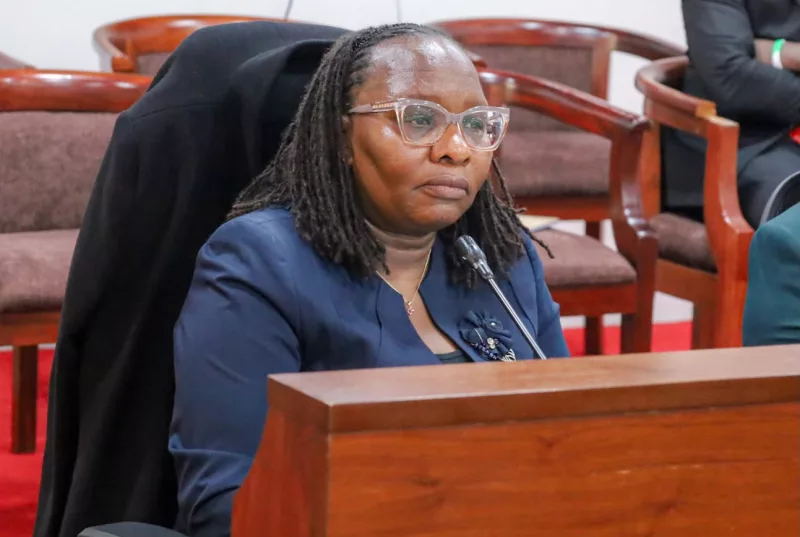
 Bishop Gatimu Ngandu Girls High School chief principal Jane Njuguna during a meeting with MPs at Parliament Buildings on September 15, 2026.
A House team has put Bishop Gatimu Ngandu Girls High School on the spot over more than a Sh1 million investment in the stock market that generates only Sh5,381 in annual dividends.
The National Assembly Public Investments Committee on Governance and Education raised concerns during a meeting with the school leadership on Tuesday.
MPs at the committee said that the funds could have been better utilised to address the school's pressing financial needs.
The lawmakers made the observations as the committee examined Auditor General reports covering the financial years 2020-21 to 2024-25.
Auditor General Nancy Gathungu had queried the short-term investments amounting to Sh1,583,111 as of June 30, 2021.
Gathungu said the school had failed to provide supporting documents such as investment certificates.
Auditors told the committee that they initially could not verify the investment due to missing documentation.
"In our paragraph, we had indicated that they didn't have a certificate of investment to show where they had invested the amount," the auditors said.
It emerged that subsequent checks established that the money had been invested at the Nairobi Securities Exchange before it was later moved back to the school's operational account during the review.
Chief Principal Jane Njuguna told MPs the Sh1.583 million short-term investment comprised several accounts, including Sh1 million in stock exchange shares.
She listed the investments as KCB account balances of Sh53,383.70 and Sh102,726.70, an NDCU Net investment of Sh406,714, a Barclays Bank Optimum account of Sh20,287, and stock exchange shares of Sh1 million.
"The investment amount in the balance is Sh1 million in the NSE, which generates finance income to the school," Njuguna said.
MPs demanded answers, saying the explanation was not satisfactory.
Kiminini MP Maurice Bissau questioned how the school had accumulated the money and why it had abandoned income-generating activities like coffee farming.
"This was from the savings that the school was making. What savings did you make during those years?" Bissau asked.
The headteacher said the school had previously operated income-generating projects, including coffee farming.
She added that the school no longer had enough land due to the expansion of buildings and other agricultural projects.
Kilome MP Thaddeus Nzambia struck the chord by asking how much income the school was receiving from the Sh1 million investment.
Njuguna said the school had received only Sh5,381 in dividends during the year, drawing strong criticism from committee members.
"How can you invest Sh1 million and just get a return of Sh5,000? I think this is a serious joke," Nzambia said.
Luanda MP Dick Maungu, who chairs the committee, questioned whether the investment offered value for money.
"Let's look at the value for money. Sh5,000 [for an investment of]Sh1 million? How much percentage is that in terms of return? We may need to really dig deep into that," Maungu said.
Embakasi MP Mark Mwenje said that public schools should concentrate on educating learners rather than making investments that produce negligible returns.
"Schools are there to educate children. They are not investment centres. We have ICDC [Industrial and Commercial Investment Corporation] and all these other institutions for the government to do that," Mwenje said.
He described the investment as a misuse of funds if the school was receiving only Sh5,000 annually from Sh1 million.
Sotik MP Francis Sigei sought to establish whether parents had been involved in the decision to invest the money.
Lungalunga MP Chiforomondo Munga supported calls for further examination, asking whether the investment had been included in the school's approved budget.
For auditors, investments by public institutions require approval from the National Treasury through the relevant parent ministry.
MPs asked the school principal whether the investment had received such approval.
The principal requested more time to obtain the relevant information, but the chairman rejected the request.
"We have no benefit of time. That's why you are here. So you need to give us the feedback," he said.
The chairman directed that the matter be deferred until the school supplied the committee with the necessary documentation.
"This is a suspect issue. I don't think the board has such powers unless we get approval from the ministry," Maungu said.
The committee also raised questions over the identity of the companies in which the Sh1 million had been invested.






