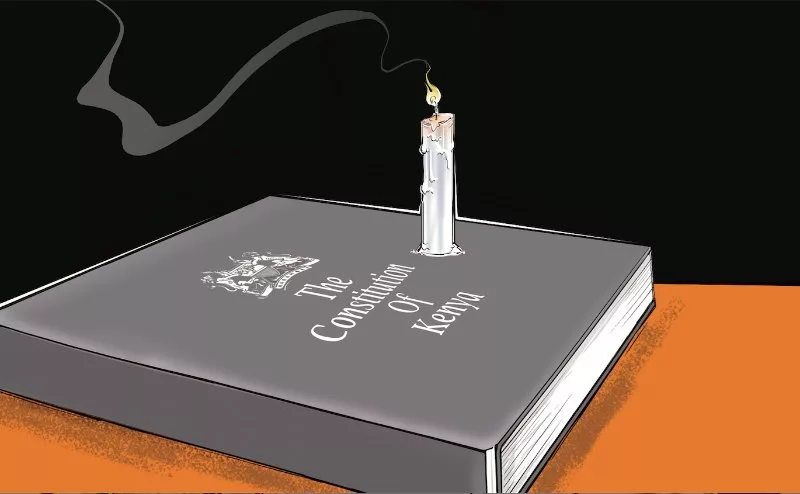
Sixteen years after Kenyans promulgated the Constitution of Kenya, 2010, one glaring omission stands out. The national government has never produced a comprehensive, multi-thematic audit of its implementation comparable to the Katiba Institute’s Ten Years On: Assessing the Achievements of the Constitution of Kenya 2010. This absence is a failure of constitutional responsibility.
State officers, from the President and cabinet secretaries to members of Parliament, judges and independent office holders, swear oaths to respect, uphold and defend the constitution. Article 3 places this duty on every person, and Articles 73 and 74 demand that leadership be exercised in a manner consistent with the national values in Article 10.
Yet the very institutions charged with giving life to the constitution have not systematically measured how far the country has travelled, what has been achieved, and what remains unfinished.
The contrast is stark. In 2022, the Katiba Institute published a detailed expert assessment covering parliament, elections, the executive, the judiciary, independent commissions, devolution, policing, and rights realisation. It painted a picture of incomplete transition, including real gains in devolution and judicial independence alongside persistent shortfalls in accountability, gender representation, electoral integrity and the realisation of socioeconomic rights.
Earlier, the Commission for the Implementation of the Constitution monitored progress until 2015, and a National Assembly-commissioned socioeconomic audit in 2015–2016 examined fiscal and institutional impacts. Parliament’s Constitutional Implementation Oversight Committee continues to issue useful but narrow status reports on individual bodies such as the Auditor-General, Controller of Budget, Commission on Revenue Allocation and selected Chapter 15 commissions.
These efforts matter. They are not enough. Fragmented, institution-specific reviews cannot replace a holistic stock-taking of the constitution as a whole. Without a regular, government-supported multi-thematic audit, Kenyans are left with anniversary speeches, selective claims of success and civil society reports that officials can too easily sideline. The oath to uphold the constitution demands more than rhetoric. It requires evidence, transparency and a willingness to confront uncomfortable truths.
This gap has practical consequences. Devolution has brought services closer to citizens, yet financing disputes, accountability weaknesses and uneven performance persist. The Bill of Rights is progressive on paper, but enforcement remains inconsistent.
Independent institutions often operate under funding constraints and limited enforcement powers. Electoral and integrity reforms continue to face credibility tests. Without systematic measurement, these problems are debated in the abstract rather than tracked with data and clear benchmarks drawn from the constitution itself.
The solution is straightforward and overdue. Multi-thematic audits of constitutional implementation should be conducted every year, with reports publicly released on or around August 27, the anniversary of the promulgation. Katiba Day should become more than a ceremonial occasion. It should be the moment when the nation receives an honest, evidence-based assessment of progress against the constitution’s promises.
Annual audits would serve several purposes. They would create a consistent public record, allowing citizens, Parliament and the executive to see trends rather than isolated snapshots. They would strengthen accountability by forcing institutions to respond to findings rather than ignore them. They would inform budgeting, law reform, and policy with data instead of political convenience. And they would reinforce the culture of constitutionalism that the 2010 document sought to embed; one in which power is exercised under continuous public scrutiny.
Practical design is possible. A core set of indicators covering the main pillars of the constitution could be updated annually, supplemented by deeper examination of rotating priority themes. The process should be independent enough to command credibility, drawing on the Auditor General, relevant commissions, parliamentary oversight, independent experts and meaningful public participation while remaining anchored in state responsibility.
Reports must be debated in Parliament, answered by the executive and followed by tracked recommendations. Cost and capacity constraints are real, but they are not insurmountable; lighter annual scorecards combined with fuller reviews every few years could serve as a transitional model.
Those who are unwilling to expend effort may argue that existing oversight mechanisms are sufficient or that annual exercises would be repetitive and expensive. The record suggests otherwise.
Sixteen years on, Kenyans still lack a regular, authoritative government account of whether the constitution is delivering on its core promises of accountable government, equitable resource sharing, protected rights, and responsive institutions.
Relying solely on civil society or occasional parliamentary reports leaves the primary duty-bearers, namely, the state and its officers, insufficiently tested against the document they swore to defend.
The Constitution of Kenya, 2010 was hard-won. It remains one of the most progressive in Africa and the world. Its value, however, lies not in the text alone but in its faithful implementation. State officers who take the oath accept a continuing obligation to measure, report and improve.
Instituting annual multi-thematic audits, published on the anniversary of promulgation, would turn that obligation into practice. It would honour the people who adopted the constitution and the generations who still await its full promise. The time for such a commitment is long overdue.
Social impact adviser, social consciousness theorist, trainer and speaker, agronomist consultant for golf courses and sportsfields and author of 'The Gigantomachy of Samaismela' and 'The Trouble with Kenya: McKenzian Blueprint'