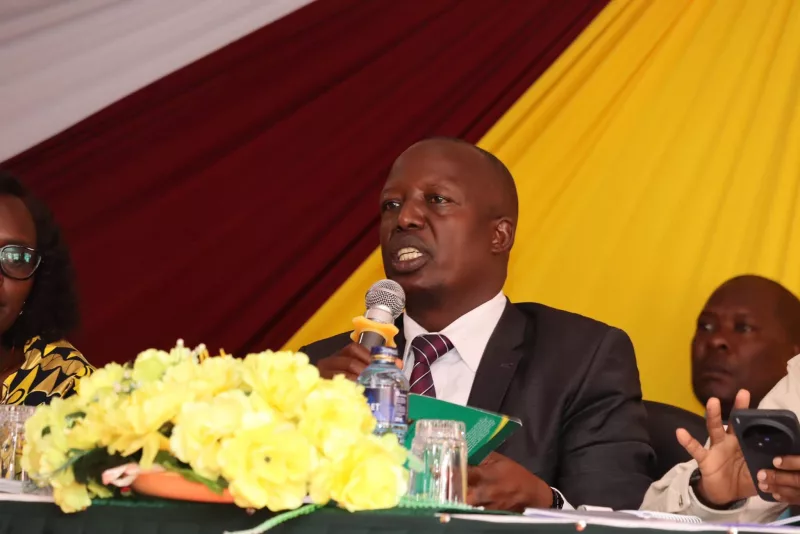
 National Assembly Education Committee chairperson Julius Melly during public hearing sittings in Uasin Gishu on September 14, 2026. /PARLIAMENT
Parliament has begun collecting public views on the Basic Education Bill 2026 and five other proposed education reform laws that seek to reshape Kenya’s education sector.
The National Assembly Education Committee, chaired by Tinderet MP Julius Melly, began the public hearings on Monday with sittings in Uasin Gishu and Elgeyo-Marakwet counties, allowing members of the public and education stakeholders to make submissions on the proposed legislation.
The committee is scheduled to hold engagements in Trans Nzoia, Kakamega, Kilifi and Tana River counties on Tuesday.
Deputy committee chair Ombane Gisairo said the Basic Education Bill 2026 was the most extensive of the six proposals as it seeks to overhaul the Basic Education Act, 2013.
"We are here to hear the opinions of all the stakeholders in the education sector on the six bills that are currently in front of the House, mainly being the Basic Education Bill 2026, which is quite extensive because it completely overhauls the 2013 Basic Education Act," Gisairo said.
Among key proposals of the Bill is a Sh20 million fine, imprisonment for up to three years, or both, for anyone found operating an unregistered school.
During Monday’s hearings, stakeholders raised concerns over access to education, student placement, teacher management, curriculum development, assessment, school discipline and funding.
On discipline, participants called for a clear definition of corporal punishment and clarity on how school rules would be enforced.
Some parents supported its reintroduction, while others advocated for mental empowerment of learners and a change in how discipline is addressed in schools.
A KNUT representative in Uasin Gishu said teachers could find themselves facing harsh penalties in situations where there's a thin line between punishing a learner and enforcing school rules.
"I find it hard when a teacher is trying to separate two learners who are fighting and one of them is very aggressive; he ends up giving a hot slap. That one, you'll be forced to six months' imprisonment," the representative said.
Stakeholders also called for clearer management arrangements for junior schools, with participants divided over whether they should remain under the comprehensive school framework or operate separately from primary schools.
"All those classrooms belong to the primary; they were donated by primary, and we cannot have two centres of power in the same station," a KNUT representative said.
Participants further called for stronger support for learners with special and multiple needs, clearer mandates among institutions responsible for curriculum development, assessment and teacher management, and greater transparency in the management of teachers and Boards of Management.
They proposed that parents’ representatives remain on Boards of Management while calling for continuous teacher promotion, timely resolution of teachers’ welfare issues, adequate staffing and timely remuneration.
Other proposals included institutionalising the Centre for Mathematics, Science and Technology Education in Africa (CEMASTEA), strengthening related teacher-training programmes and guidance and counselling in schools.
Student placement into universities and TVET institutions also featured prominently, with stakeholders calling for a more transparent system that takes into account learners’ interests, abilities and individual circumstances.
In Elgeyo Marakwet, participants separately called for zero-interest student loans under the proposed Tertiary Education, Placement and Funding model and flexible repayment terms, including a reasonable grace period before beneficiaries begin repayment.
As currently drafted, the Tertiary Education, Placement and Funding Bill requires beneficiaries to begin repaying their loans one year after securing employment.
The other bills before the public are the Pre-Service Education and In-Service Training Bill, 2026; Kenya Institute of Curriculum Development (Amendment) Bill, 2026; Kenya National Educational Assessments Council Bill, 2026; and Kenya National Qualifications Framework (Amendment) Bill, 2026.
Public hearings across 31 selected counties will take place from September 14 to September 25, 2026.
Stakeholders and citizens unable to attend in-person hearings must submit their written views to the National Assembly by September 24, 2026.