
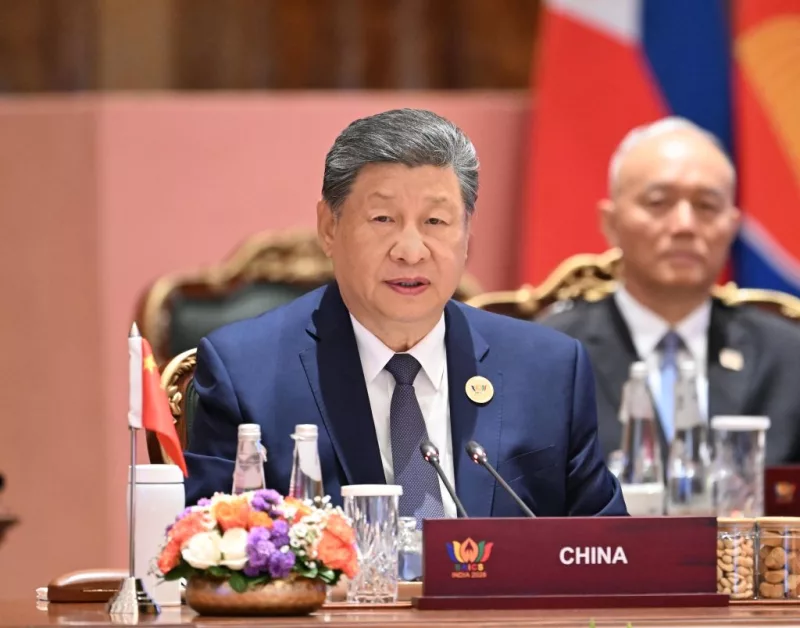
China has once again placed Africa at the centre of its push for stronger Global South cooperation.
President Xi Jinping used the 18th BRICS Summit to outline commitments to deepen trade, investment, technology and skills partnerships.
Xi said at the BRICS meeting in New Delhi, India, that the forum had become a major cooperation platform for emerging markets and developing countries.
The Chinese leader pitched it as a pioneer in shaping a more just and equitable international order.
For Africa, one of the clearest commitments was Beijing’s decision to extend zero-tariff treatment to all 53 African countries that have diplomatic relations with China.
Xi said China would continue to broaden its independent and unilateral opening up and share the opportunities created by its development with other countries.
Xi also linked China’s BRICS engagement to the Global Development Initiative which was launched five years ago to promote people-centred development.
Since its launch, more than 2,000 projects have been implemented in partnership with other countries.
Latest Chinese data shows that more than 200,000 professionals have received training, benefiting people in more than 120 countries.
China says it’ll continue implementing the initiative alongside high-quality Belt and Road cooperation, offering opportunities for developing countries to participate in China’s economic growth.
BRICS, in Xi’s vision, is a key engine for translating that cooperation into practical programmes.
At the summit’s first session, he called on BRICS countries to become pioneers in innovation-driven development, particularly through cooperation in artificial intelligence.
China has proposed the BRICS initiative of AI-empowered new industrialization.
Its prime focus would be on research, application, industrial cooperation and stable supply chains.
The proposal has particular relevance for African countries seeking to expand digital economies and use technology to accelerate industrialisation.
Xi said China had already initiated the World AI Cooperation Organization and established international AI application cooperation centres with BRICS members and other countries, providing platforms for closer cooperation, particularly for the Global South.
At the second session, Xi announced five initiatives designed to cement the foundation of BRICS cooperation.
The first is an open-source and inclusive AI initiative under which China will help establish a BRICS AI open-source community.
It will also support cooperation in developing and applying large language models, and organise specialised seminars and training.
The second is a trade and investment facilitation initiative.
China proposed a BRICS special economic zone partnership, allowing countries to coordinate policies and establish intelligent portals to promote open development.
Beijing will also host a BRICS Forum on Trade in Services next year.
The third initiative targets digital industry cooperation.
China will push for a BRICS digital ecosystem cloud platform, alongside digital skills training, technological exchanges and industrial alignment.
The fourth focuses on intelligent manufacturing, with China offering to assist fellow BRICS countries in building smart factories, developing standards and upgrading manufacturing.
The fifth is aimed at science and technology talent.
China proposed a BRICS engineer cultivation alliance, including joint development of engineers and mutual recognition of competency standards, as well as a youth exchange programme for scientific and technological innovation.
African nations could tap into the initiatives as they offer potential entry points beyond traditional commodity trade, particularly in digital services, manufacturing, skills development and technology.
Xi also positioned BRICS as a political platform for giving developing countries a stronger voice in global governance.
He called for greater representation of the Global South in international institutions, reform of the international financial architecture and stronger support for the multilateral trading system.
China said BRICS should oppose protectionism, including the abuse of tariffs, while supporting reform of the World Trade Organization and the development of the New Development Bank to facilitate Global South cooperation.
The Chinese leader further called for cooperation on climate change, security governance and global AI rules, arguing that emerging technologies should be developed for positive purposes and used to promote shared prosperity.
China will take over the BRICS chairship next year and host the 19th BRICS Summit.
Xi said Beijing would use the opportunity to build consensus, plan for the future and usher in what he described as the third golden decade of BRICS cooperation.
For Africa, the message is that China sees BRICS not only as a political grouping, but as a practical platform for expanding development partnerships, opening markets, sharing technology and building capacity across the Global South.
With Africa enjoying prominent place in the BRICS framework, Xi’s commitments mean the continent continues to get access to Chinese markets, investment, digital expertise and skills.






