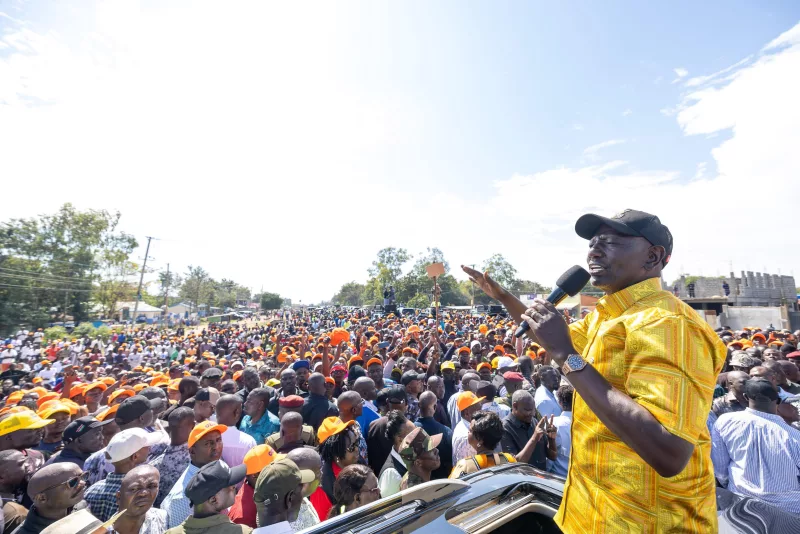
 President William Ruto speaks after launching the construction of the 12km Rabuor-Chiga road in Nyando Constituency, Kisumu County, September 14, 2026. /PCS
President William Ruto has hit back at Linda Mwananchi leader Edwin Sifuna over claims that Kenya's slums are primarily an income problem rather than a shortage of housing.
Ruto dismissed the argument, saying Sifuna was getting his economics wrong and should not purport to lecture him on the relationship between housing, employment and income.
Speaking in Kisumu on Monday during the second day of his four-day tour of Nyanza, the president said the construction of affordable houses was itself an avenue for creating jobs and putting money in the pockets of young people.
"Let me enlighten you: yes, Kenya's problem is income, but housing is what gives us employment. When these youths work in those houses they get money; that is what we call income," he said.
Ruto was responding to remarks Sifuna made on Sunday during Linda Mwananchi's inaugural rally at Jacaranda grounds in Nairobi, where the Nairobi senator challenged the President's approach to tackling the country's slum problem.
Sifuna argued that many Kenyans live in informal settlements because they lack sufficient income to afford better housing.
"Mr William Ruto, the slums in Nairobi are not a housing problem; they are an income problem. If you give these people money in their pockets, they will look for decent houses to live in," Sifuna said.
He questioned the President's assertion that affordable housing construction would help eradicate slums, arguing that existing informal settlements had remained in place four years after the programme was launched.
"When you were elected, the Mathare slum was there, Mukuru kwa Njenga was there and Kibera was there. Since you have built these houses, tell us which slum in Nairobi you have closed?" he asked.
Ruto said Sifuna's argument overlooked the employment opportunities created through the construction of affordable homes.
He said the income generated by young people working on housing projects would subsequently enable them to buy food, create other opportunities and afford decent housing.
"When they have income, they can buy food, they can create opportunities for themselves and they can live in decent housing. So, our affordable housing programme solves three problems – housing, income and employment," Ruto said.
The President's response places employment creation at the centre of his administration's justification for the Affordable Housing Programme, which has been presented not only as a response to the housing deficit but also as an economic stimulus.
Sifuna, however, has questioned whether the programme is addressing the housing needs of people currently living in Nairobi's informal settlements.
During Sunday's rally, he said that if the opposition forms the next government after the 2027 General Election, the Linda Mwananchi administration would convert affordable housing units into residential quarters for police officers.
The competing positions come as the Kenya Kwanza administration seeks to defend its record on affordable housing, four years after taking office.
In its latest self-assessment released following the 15th National Development Implementation Committee meeting, the government said it had completed about 10,000 affordable housing units across the country, with approximately 8,000 already occupied.
The government said a significantly larger number of units were under construction or at various stages of implementation.
In June 2026, the President said the government was building 300,000 housing units and 180,000 student hostels, putting completed affordable housing units at 11,000.