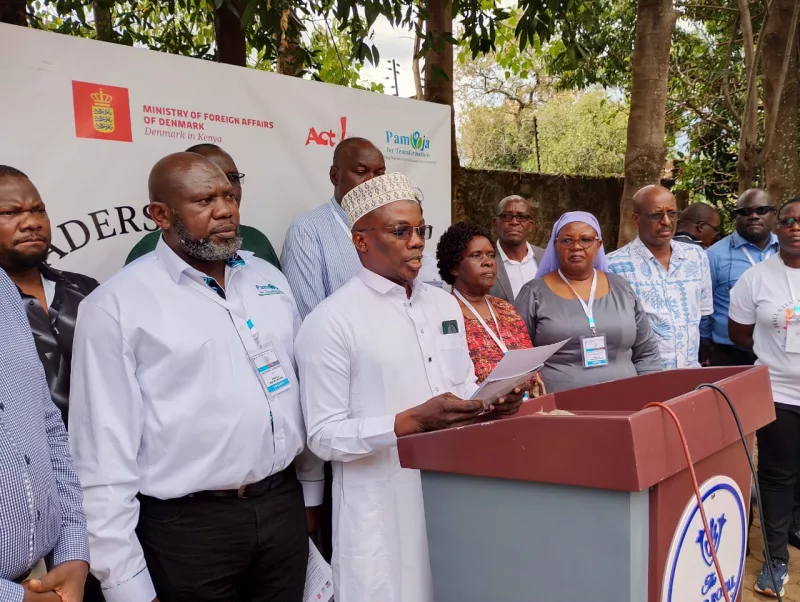
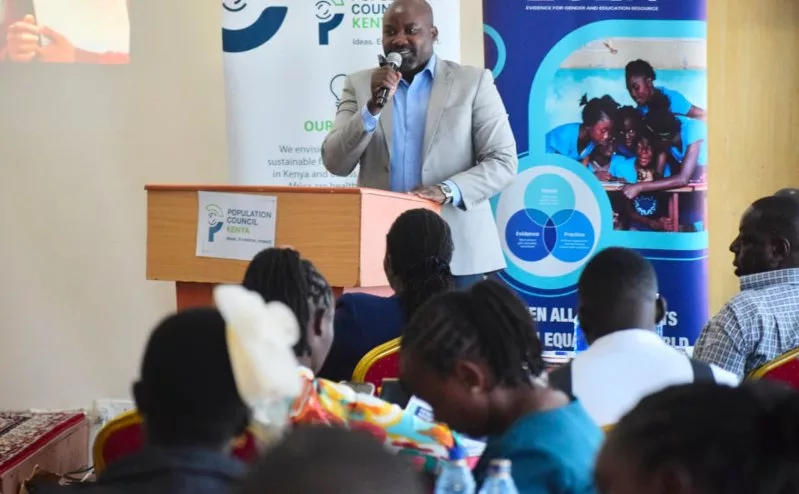
 Homa Bay executive for Gender Elijah Munga speaks during the launch of an action plan in Homa Bay town/Robert Omollo
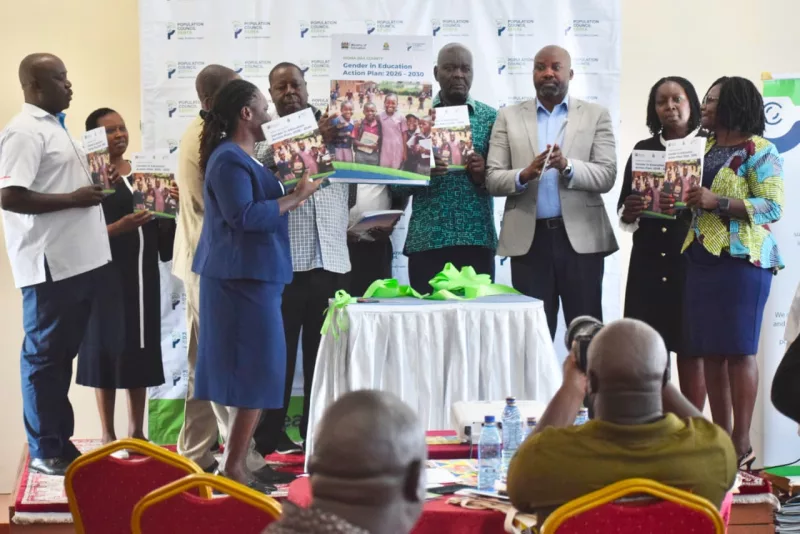 Gender and Education stakeholders in Homa Bay during the launch of the action plan in Homa Bay town/Robert Omollo
Population Council-Kenya, in partnership with the Homa Bay County Government and education stakeholders, has launched an action plan to address school dropout among girls.
The Gender in Education Action Plan 2026-2030 is intended to address challenges that create disparities in school completion between boys and girls in Homa Bay County.
Some of the issues include teenage pregnancies, HIV infections, child labour, poverty and sexual and gender-based violence (SGBV), among others.
Statistics indicate that primary school completion rates favour girls, with 85.5 per cent of girls aged 15-19 completing primary school, compared to 70.3 per cent of boys.
However, as students transition to secondary school, a slight gender gap emerges in favour of boys. Secondary school completion rates stand at 56.7 per cent for boys and 52.9 per cent for girls among those aged 20-24.
This is according to findings by Population Council-Kenya.
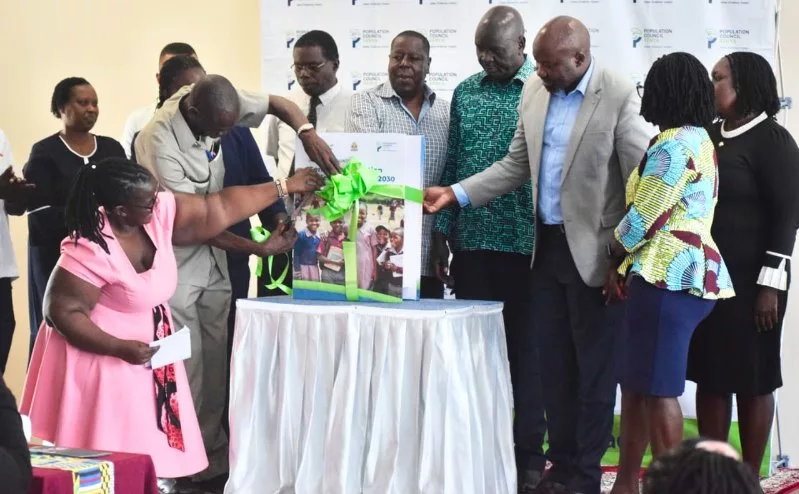 Homa Bay Director of Education Eunice Khaemba, executive member for Education Martin Opere and Gender executive Elijah Munga display documents at launch of the action plan in Homa Bay town/Robert Omollo
The findings were presented to Homa Bay gender and education officials and stakeholders, who were asked to come up with measures to address barriers to education.
Researcher for the Evidence for Gender in Education Resources (IGA) project at Population Council-Kenya, Lilian Agesa, said many girls drop out of school due to social vices at the community level.
"Homa Bay has one of the counties with high dropout prevalence for girls at primary level. More than 30 per cent of girls do not complete secondary school despite transitioning from primary school," Agesa said.
Speaking to journalists on the sidelines of the meeting in Homa Bay town, Agesa said boys are also affected.
“We also lose boys because the rate of their attendance in primary and secondary varies in Homa Bay. Boys have challenges like poverty and child labour that affect them,” the researcher said.
Homa Bay County Education Director Eunice Khaemba said the county has many challenges that girls face. She cited the triple threat of teenage pregnancy, new HIV infections and gender-based violence.
Education officials noted that girls in the region also suffer from early marriages.
She explained that over-age enrolment, poverty and being orphans cause many girls to start school late.
“Some of the children head their families. They take over parental responsibility as these make them go back to school when they are older as compared to other children,” Khaemba said.
She said older girls in school are more likely to become pregnant than those who are younger.
During the launch of the Gender in Education Action Plan 2026-2030, which is meant to mitigate the challenges that adolescents face, different stakeholders committed to supporting initiatives meant to retain girls in school.
Homa Bay Gender Executive Elijah Munga and his Education colleague Martin Opere said the county has been conducting mentorship programmes but lacks data to back the action.
Munga said the plan will help the county government allocate resources where there is need.
"We will focus our resources and time in the sub-counties that are highly hit. We've had a number of mentorship programmes, community engagement, especially in the Suba region, because the numbers show where we have rampant cases," Munga said.
Opere said the plan has given the county government justification to spend on secondary and vocational education.
"Statistics show that we do well at access, retention, and completion at primary level, but not at senior school. We plan to support students at school by issuing bursaries to senior school students and even scholarships at vocational training centres,” Opere said.
Homa Bay Deputy County Commissioner Philip Kipsang said there must be an education system where both boys and girls have equal access to education.
"There is a need for full implementation of the action plan. It has measurable results and action at all levels," he said.