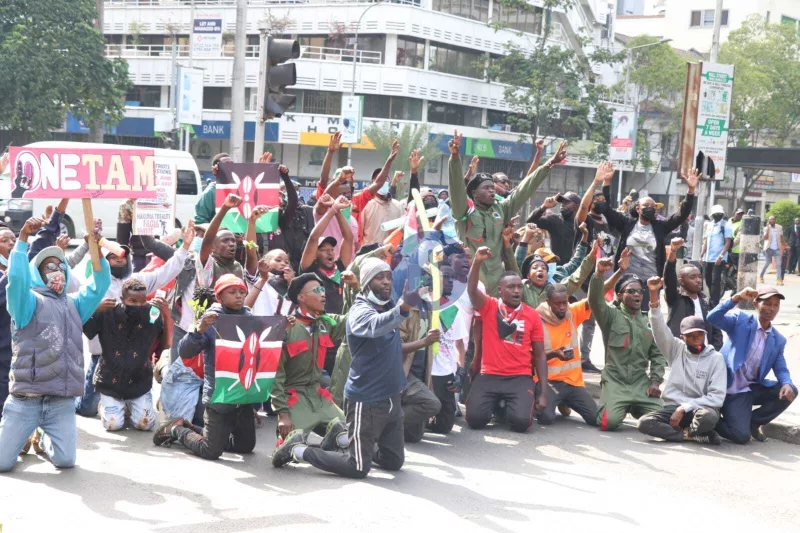
An overwhelming majority of Kenyans support the right of citizens to organise and participate in lawful and peaceful demonstrations, even as the government and police are largely blamed when violence occurs during protests, a new poll by TIFA shows.
The survey found that 82 per cent of Kenyans support peaceful and lawful demonstrations, affirming protests as a legitimate form of public expression. 16 per cent oppose peaceful demonstrations, while two per cent said they did not know or gave no response.
The poll found that 79 per cent of supporters of the broad-based government (BBG) support peaceful demonstrations, compared with 86 per cent of those who oppose the BBG.
Among those opposed to demonstrations, however, there is a wider difference, with 21 per cent of BBG supporters rejecting peaceful protests compared with 12 per cent of BBG opponents.
Despite the strong support for peaceful protests, the survey found that Kenyans largely place responsibility for violence that occurs during demonstrations on State actors. 42 per cent of respondents identified the national government as most responsible for violence during demonstrations.
The police followed at 24 per cent, while 12 per cent blamed local politicians. Nine per cent identified protesters and demonstrators as most responsible, while six per cent blamed jobless youth and Gen-Z. Four per cent were not sure.
Taken together, the National Government and the police account for 66 per cent of responses, indicating that more than half of respondents identified State actors as primarily responsible for violence during demonstrations.
The findings also show significant differences in perceptions of government responsibility depending on respondents' political affiliation.
Among BBG supporters, 29 per cent blamed the National Government and President for violence during demonstrations, compared with 52 per cent among those who oppose the BBG.
The perception of police responsibility, however, remained unchanged across the two groups, with 24 per cent of both BBG supporters and BBG opponents identifying the police as most responsible.
Local politicians were identified by 17 per cent of BBG supporters and nine per cent of BBG opponents, while 13 per cent of BBG supporters blamed protesters and demonstrators compared with six per cent of BBG opponents.
Similarly, nine per cent of BBG supporters attributed responsibility to jobless youth and Gen-Z, compared with three per cent of those who oppose the BBG.
Ordinary criminals were identified by three per cent of BBG supporters and two per cent of BBG opponents.
The study fieldwork was carried out between June 13 and June 22, 2026. It drew on a nationally representative sample of 2,048 respondents across nine regions: Central Rift, Coast, Lower Eastern, Mt Kenya, Nairobi, Northern, Nyanza, South Rift and Western.
Data were collected through face-to-face household interviews, conducted primarily in Swahili, with English also used where preferred by respondents.
The survey has an overall margin of error of plus or minus 2.18 percentage points, although the margin is higher for smaller sub-samples.