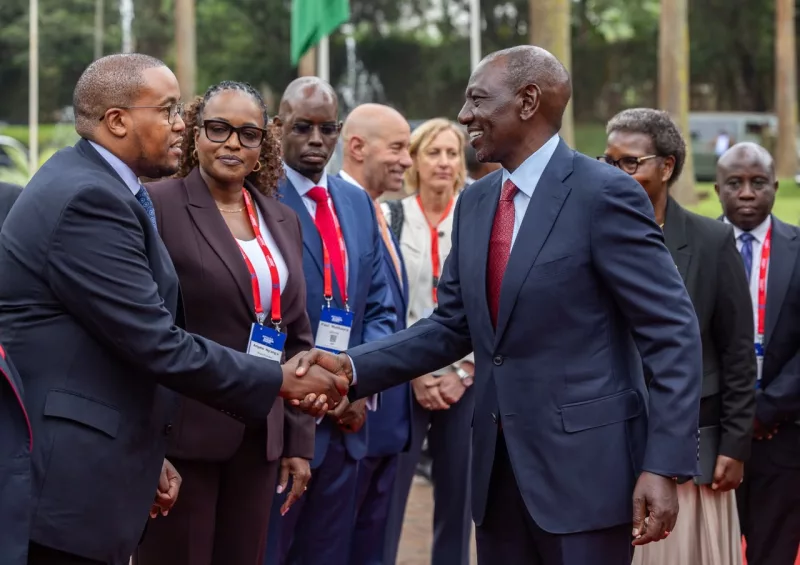
 President William Ruto, when he arrived for the AmCham business summit at Windsor Golf Hotel and Country Club on September 9, 2026/PCS
President William Ruto has challenged county governments to harmonise licensing procedures and eliminate duplicate and opaque charges, warning that cumbersome regulations could make Kenya unattractive to investors.
Ruto said his administration was working to reduce the cost and complexity of doing business at the county level through the County Licensing (Uniform Procedures) Act, 2024.
Speaking on Wednesday, September 9, at the American Chamber of Commerce Business Summit in Nairobi, Ruto urged the Council of Governors and county governments to move faster in implementing the law, including by digitising applications and standardising licensing procedures across the country.
The summit was held under the theme “Advancing Mutual Prosperity Through Trade and Investment”.
“An investor should not encounter a different country every time a truck crosses a county boundary,” Ruto said.
Ruto said reducing regulatory barriers was critical to attracting investment and creating jobs, particularly as Kenya seeks to position itself as a regional economic hub.
He said the government had undertaken additional reforms to improve Kenya’s investment environment, including reducing local ownership requirements for pension scheme administrators.
The government has also equalised the corporate income tax rate for foreign companies with permanent establishments and domestic companies at 30 per cent.
Ruto said his administration had introduced incentives targeting special economic zones, pharmaceutical manufacturing, public-private partnerships, electric mobility and agricultural value addition.
He added that advance pricing agreements would help reduce disputes involving transfer pricing and provide greater certainty to investors.
The President said Kenya’s investment proposition extended beyond its domestic market, pointing to the country’s access to regional and continental markets through various trade blocs.
“Kenya offers investors more than a national market,” Ruto said.
He said through the East African Community, Kenya was connected to a market of more than 300 million people, while the Common Market for Eastern and Southern Africa provides access to about 700 million people.
Through the African Continental Free Trade Area, he said, investors operating in Kenya could tap into a continental market of about 1.4 billion people.
Ruto said the latest AmCham summit marked another step in strengthening Kenya-US economic ties, with trade, investment and job creation forming key measures of the relationship.
“This year’s theme captures the next phase of the Kenya–United States relationship, measured by the volume of our trade, the scale of our investment and the jobs we create,” he said.
The summit is the fifth edition of the American Chamber of Commerce’s flagship business forum since 2018.
Previous editions have brought together more than 5,000 delegates from over 30 countries and generated commitments across several priority sectors.
Ruto said the government would continue working with the private sector to remove barriers to investment and strengthen Kenya’s competitiveness.
He said closer cooperation between national and county governments would be essential in ensuring businesses face predictable rules and costs regardless of where they operate in the country.