
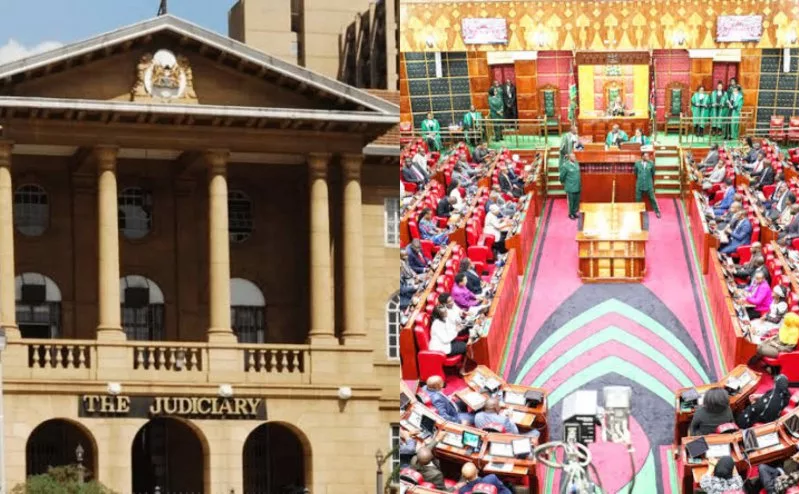
 A photo collage of the Judiciary and National Assembly./FILE
Public confidence in Kenya’s key governance institutions has fallen below 40 per cent, with Judiciary, IEBC, police and Parliament all recording low trust ratings in the latest Tifa National Survey.
The Judiciary recorded the highest level of trust at 36 per cent, followed by the Independent Electoral and Boundaries Commission (IEBC) at 30 per cent, the National Police Service at 29 per cent and Parliament at 27 per cent.
The survey was conducted between June 13 and June 22, 2026, using a nationally representative sample of 2,048 respondents drawn from nine zones: Central Rift, Coast, Lower Eastern, Mt Kenya, Nairobi, Northern, Nyanza, South Rift and Western.
Data was collected through face-to-face household interviews, conducted mainly in Swahili, with English also used. The survey had a margin of error of plus or minus 2.18 percentage points, although the margin was higher for smaller sub-samples.
The findings point to a significant gap between Kenyans and institutions responsible for administering justice, overseeing elections, maintaining security and making laws.
The low rating of the IEBC comes as attention turns to the next election cycle, raising questions about public confidence in the body responsible for managing the country’s polls.
The survey found a clear political divide in perceptions of the commission. Among supporters of the Broad-Based Government (BBG), 42 per cent said they trusted the IEBC. The figure fell to 24 per cent among BBG opponents, while 47 per cent of opponents said they had no trust in the commission.
The National Police Service also recorded a low trust rating of 29 per cent. The findings come amid public concerns over the conduct of law enforcement officers during demonstrations and routine operations.
The Judiciary, despite recording the highest trust rating among the four institutions, also failed to command the confidence of a majority of respondents, with only 36 per cent expressing trust in it.
The survey further examined perceptions of government compliance with court orders. Among opponents of the Broad-Based Government, 39 per cent said they believed the government did not respect court orders at all.
Parliament recorded the lowest trust rating at 27 per cent, putting it at the bottom of the four institutions assessed in the survey.
The findings highlight a widening gap between citizens and some of the country’s most important public institutions.
The low levels of trust could pose a challenge to institutions whose effectiveness depends partly on public confidence, particularly the electoral commission and security agencies.
The survey findings also highlight concerns over the relationship between the Executive and the Judiciary, with perceptions about compliance with court orders emerging as another area of concern.
The results present a difficult picture for institutions seeking to rebuild public confidence.
The findings suggest that restoring trust will require stronger accountability, transparent leadership and greater public confidence in how state institutions carry out their mandates.






