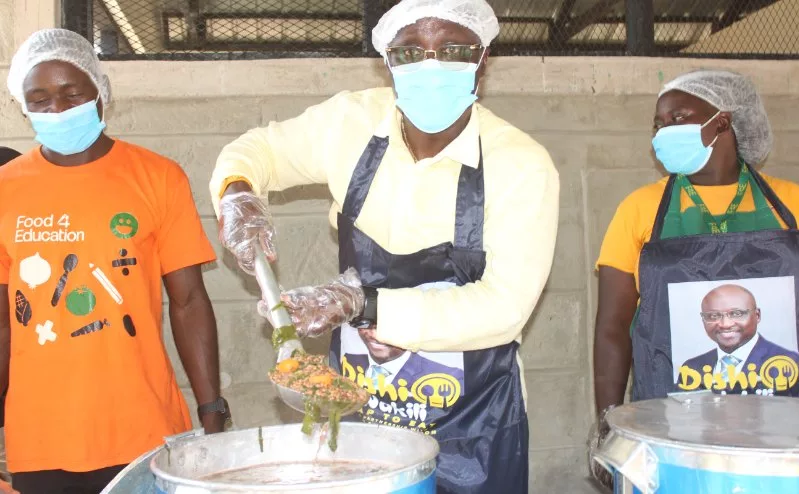
 Gatanga MP Edward Muriu sampling food served to learners at Ngaatho primary school in Ithanga on June 19, 2026/ ALICE WAITHERA
Parents with children in public day
secondary schools in Gatanga constituency
will from January pay Sh883 per term after the National Government
Constituencies Development Fund moved to subsidise fees for all learners.
MP Edward Muriu said the arrangement was reached after consultations with secondary school principals, officials from the Teachers Service Commission and Ministry of Education, with the fund taking up the larger share of the cost to ensure no learner misses classes because of fees.
“We sat with all secondary school principals and directors of education from TSC and the ministry, we agreed that all secondary school learners in public day schools will pay Sh883 per term, an equivalent of Sh10 per day from next January. All the rest will be catered for by the NG-CDF,” Muriu said.
The legislatorsaid the constituency will spend about Sh7,000 annually on every learner, easing the burden on families that have in some schools been paying between Sh12,000 and Sh18,000 per year.
The initiative will also standardise fees across all public secondary schools in the constituency to ensure parents are not overburdened with extra fees.
Muriu said the programme will guarantee uninterrupted learning, adding that the constituency plans to clear all the money payable by the NG-CDF before the end of March each year to avoid delays that could disrupt school operations.
“From next year, parents will pay Sh883 for each of the three terms. School fees is no longer a burden in Gatanga.
It is affordable. By March 30, we will have cleared what the NG-CDF will be paying for the learners,” he said.
The MP said the constituency currently issues bursaries to about 12,000 secondary school learners and around 1,000 students in tertiary institutions as part of its efforts to improve access to education.
At the same time, the constituency has been implementing a school feeding programme targeting more than 25,000 primary school pupils, with the initiative already running in 52 of the constituency’s 87 public primary schools.
Under the Dishi Ya Wakili Tap to Eat programme, parents contribute Sh20 daily through a paybill system, while learners use wristbands linked to their accounts to access meals prepared in modern central kitchens before being distributed to schools.
Studies in Kenya have consistently shown that hunger is a major barrier to learning, with children from food-insecure households more likely to miss school, struggle to concentrate and perform poorly in examinations.
The Ministry of Education and development partners have in recent years expanded school feeding programmes, especially in arid and vulnerable regions, after evidence linked regular meals to improved attendance, retention and academic outcomes.
“We have teachers and we have done a lot to improve the infrastructure but we’ve been having a gap in the availability of food for many pupils,” Muriu said.
The MP said his push for a feeding programme began after attempts to have the national government support meals in primary schools did not succeed.
He later partnered with Food 4 Education, a local organisation that provides meals to school-going children.
The organisation established 22 modern central kitchens in the constituency, creating jobs for cooks and 52 riders who distribute meals to schools.
Muriu argued that younger learners require more nutritional support to enhance their growth and learning, emphasising the role played by school feeding programmes improving concentration in class and reducing absenteeism.
“In Gatanga, education is not a punishment. It’s fun. Learners eat good meals to support their growth, including rice with beans, rice with lentils and vegetables, and potatoes, and later, we will consider including meat,” he said.
The MP expressed confidence that all the 87 public primary schools in the constituency will be covered by the programme by the end of his term, marking a major step towards ensuring every child learns in a conducive environment free from the burden of hunger and unaffordable school fees.