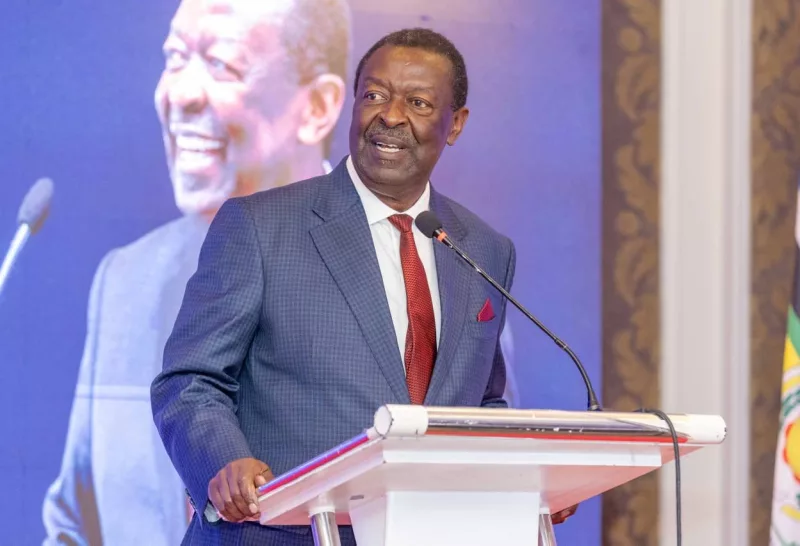
Prime Cabinet Secretary Musalia Mudavadi has proposed a five-point framework for strengthening the protection of critical infrastructure and public spaces against terrorism and other security threats.
Mudavadi said countries must move beyond responding to attacks and develop stronger systems for anticipating threats, preparing for possible incidents, mitigating risks, responding effectively and recovering from crises.
Speaking at the Fifth Nairobi Caucus on Protecting Critical Infrastructure Systems and Public Spaces, Mudavadi said enhanced anticipation of terrorist threats should be at the centre of national and regional security planning.
He proposed that countries strengthen their national and regional capacity to identify emerging terrorist risks targeting essential infrastructure and public spaces.
“First, we must enhance national and regional anticipation capacities to identify terrorist risks to essential systems,” Mudavadi said.
He said governments should also institutionalise national and regional readiness by jointly developing the capabilities required to protect critical infrastructure and public spaces.
According to Mudavadi, cooperation between countries would strengthen preparedness and ensure that security agencies have the necessary capabilities to respond to threats that transcend national borders.
His third proposal was for countries to adopt proactive mitigation measures aimed at hardening critical infrastructure and public spaces against potential attacks.
“Thirdly, we must adopt mitigation measures that proactively harden critical infrastructure systems and public spaces,” he said.
Mudavadi further called for countries to jointly develop and continuously refine their response capabilities to ensure that security policies can be translated into effective action when threats occur.
He said the fourth priority should therefore be strengthening joint response mechanisms and ensuring that institutions are adequately prepared to deal with attacks and other emergencies.
His fifth proposal focused on recovery, with Mudavadi calling for comprehensive frameworks that would enable countries to quickly restore stability following a crisis.
“Finally, we must establish comprehensive recovery and adaptation frameworks that facilitate a swift transition from crisis management to the restoration of national and regional stability and the institutionalisation of long-term resilience,” he said.
Mudavadi urged participants at the two-day meeting to consider the five propositions during their deliberations and incorporate them into the outcome document.
The Prime Cabinet Secretary said Africa faces an increasingly serious terrorism threat, citing findings from the Global Terrorism Index 2026 which indicate that six of the 10 countries most affected by terrorism are in sub-Saharan Africa.
He added that four of the five countries accounting for nearly 70 per cent of global terrorism deaths are also located on the continent.
Mudavadi said the situation underscores the need for African countries to strengthen cooperation in protecting infrastructure that supports national economies and regional integration.
He also pointed to the ongoing crisis in the Middle East as a reminder of the vulnerability of critical global infrastructure, particularly maritime assets and strategic shipping routes.
He said blockades and disruptions along key maritime chokepoints, including the Strait of Hormuz and Bab el-Mandeb, had heightened concerns over maritime security and the potential impact of attacks on global trade.