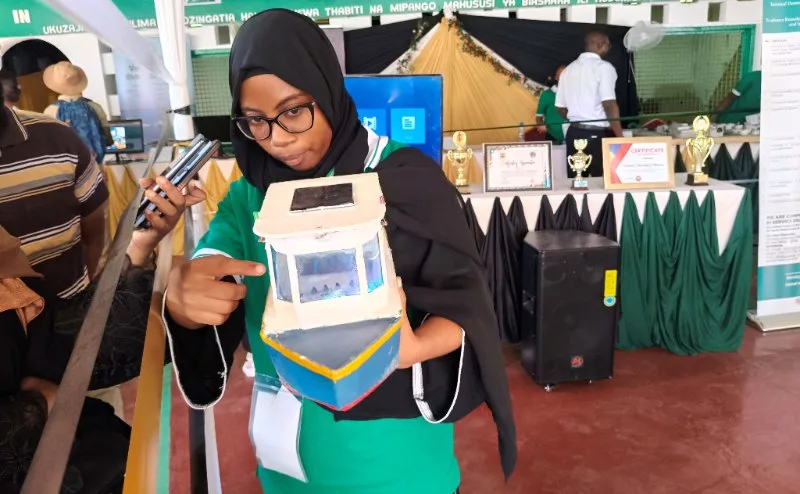
 TUM student Said Omar showcases her solar powered boat innovation at the Mombasa ASK Show in Mkomani, Nyali on Friday / BRIAN OTIENO
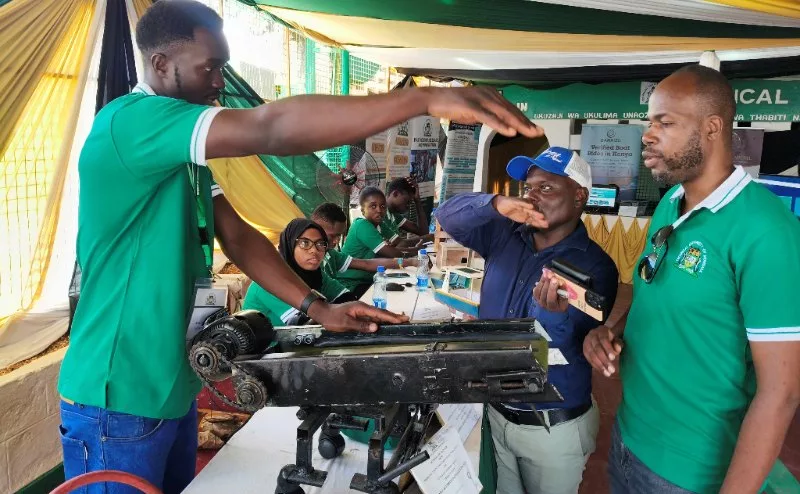 TUM’s Edwin Omondi [L] and Jacob Elkana [C] at the TUM stand at the Mombasa ASK Show in Mkomani, Nyali, on Friday / BRIAN OTIENO
Agriculture should be made fun and easier so as to attract Gen Z, who simply think agriculture is meant for the old people in the villages and not for the young people in towns.
Technical University of Mombasa vice chancellor Prof. Leila Abubakar Friday said this can only be done if there are innovations that make work easier in the farms.
Speaking at the TUM stand at the Mombasa International ASK Show in Mkomani, Nyali, Abubakar said they teach their students to be job creators and not job seekers.
“Through innovations, we need to change the perception that agriculture is for the old people in the villages and not for young people in towns,” Abubakar said.
She said more and more, students are coming up with smart technologies that, if commercialised, make agriculture more interesting.
Edwin Omondi, a final-year Bachelor of Mechanical Engineering student at TUM, has come up with a portable conveyor machine that can be used to load and offload goods at the farm.
The machine, which is connected, through sensors, to a computer that does the computing, saves time and is accurate, making work faster and easier to monitor.
The sensor and the counter-sensor count the number of goods that pass through the conveyor.
“My main aim was to reduce the number of loaders, save costs to the farmer and help the farmer better monitor his products from the farm,” Omondi told the Star.
He said the machine also drastically reduces the risk of injury to the few loaders who will be working at the farm.
“With this, we also reduce the risk of goods being stolen,” Omondi said.
Abubakar said the conveyor belt technology means the farmer can remotely monitor operations at the farm.
That technology helps the farmer know exactly how much was used as inputs during planting and as outputs during harvesting.
“This makes work easier for the farmer who does not need to physically count the bags of fertilisers or seeds used or the bags of whatever harvest was made. The computer does that for them,” she said.
The technology also means there will be less need for loaders at the farm, thus saving costs for the farmer in the long run.
The conveyor technology is portable and can be used anywhere.
The TUM VC also highlighted the technology used to extract beauty products from seaweeds.
This way, value addition to harvests from the blue economy can be harnessed to get the maximum value from sea products.
Seaweeds, for instance, are rich in vitamin E and collagens that can be used in making other products.
“As has been demonstrated by the students, we can use technology to come up with products like shampoos and anti-ageing agents from seaweeds so that we get maximum value from seaweeds, unlike in the past when we used to sell the raw seaweeds and people took advantage of us,” Abubakar said.
This, if done commercially, can be used to reduce importation of such products, helping reserve Kenya’s foreign exchange.
“We sometimes import canned fish, yet we have the same fish that is canned here at the Coast going bad because of oversupply and lack of storage space. It is unacceptable,” she said.
She said Kenyan fisherfolk must be able to do value addition to their harvests.
The TUM VC said students have also been able to use pineapple peels to make vinegar.
“There is no need to throw away the pineapple peels after eating the pineapple because we can use technology now to make vinegar out of them.
“The peels have more value than the fruit itself. This helps reduce the use of chemical preservatives that sometimes bring issues like cancer to our health,” she said.
Jacob Elkana, who is eying the Nyali MP seat, said such innovations should be encouraged and supported.
Elkana said young people in Mombasa are very innovative but lack capital and support to develop their innovations commercially.
“We need to be able to support our own to become inventors of things and not just users of innovations by others. We have serious young people with brains that, if we tap into them, can make Mombasa an innovation hub in the world,” Elkana said.
INSTANT ANALYSIS:
Young people are not attracted to agriculture because they perceive farming as hard, low-paying physical labor with uncertain financial returns. Society often views farming as a low-status job for unskilled or older people rather than a modern business. School programs in agriculture are also often too theoretical and do not teach practical, modern business skills.