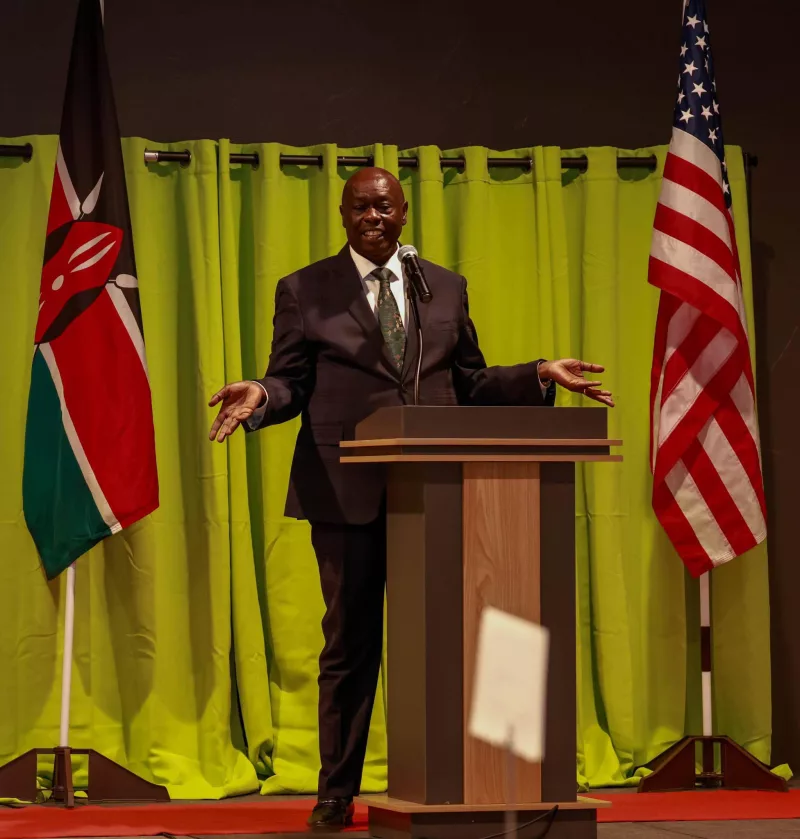
SRC chairperson Sammy Chepkwony during the briefing on the upcoming productivity conference, May 26, 2026.
President William Ruto’s pledge to tame the ballooning public wage bill faces a test, with the Salaries and Remuneration Commission revealing the scale of the crisis.
SRC’s Fourth Quarter Wage Bill Bulletin for April-June 2026 shows that the public workforce grew by 4.6 per cent in 2025, from 1.023 million workers in 2024 to 1.07 million.
The commission estimates that the wage bill will rise to Sh1.29 trillion in the 2025-26 financial year, up from Sh1.25 trillion in 2024-25.
It is expected to rise by another Sh40 billion in the current financial year.
Overall, the public service wage bill has jumped from Sh988 billion in 2020-21 to Sh1.247 trillion in 2024-25.
The increase comes despite repeated government commitments to bring the wage bill under control by 2028 and free more resources for development.
SRC attributes the rise to increased recruitment in key sectors, particularly teaching, health and security, as well as periodic salary adjustments.
“This growth is largely driven by expansion in teaching, health, and security employment, as well as periodic cost-of-living salary adjustments,” the commission said.
The Teachers Service Commission (TSC) remains the country’s biggest public-sector employer.
Its workforce jumped from 410,700 employees in 2024 to 436,300 in 2025, representing a 6.2 per cent increase.
Ministries and other extra-budgetary institutions followed with 243,500 workers.
In the counties, SRC says county governments spent Sh171.36 billion on personnel emoluments during the first nine months of 2025-26, up from Sh154.94 billion during a similar period the previous year.
That represents an 11 per cent increase.
The county governments employed 239,000 people.
“In FY 2025-26, an analysis of the county government expenditure on the wage bill, as a share of ordinary revenue, shows that on average, the county wage-bill-to-revenue ratios remained above the PFM Act, 2012, threshold of 35 per cent,” the report states.
During the first nine months of FY 2025-26, only five counties recorded wage-bill-to-revenue ratios below the PFM Act threshold of 35 per cent.
They are Tana River (27 per cent), Kwale (30 per cent), Nakuru (30 per cent), Uasin Gishu (31 per cent) and Kirinyaga (32 per cent).
In contrast, Taita Taveta (63 per cent), Homa Bay (63 per cent) and Machakos (58 per cent) recorded the highest ratios.
Overall, the public service workforce crossed the one-million mark in 2024, underscoring the scale of the payroll challenge confronting the government.
But the problem is not simply the number of employees.
SRC says remuneration levels are equally responsible for the growing wage bill, meaning that even a freeze on recruitment would not necessarily stop payroll costs from rising.
“Although staff numbers influence the wage bill, the level of remuneration (the quantum per employee) is an equally significant determinant,” the commission said.
However, the commission revealed that the wage bill as a proportion of ordinary revenue has declined from 54.77 per cent in 2020-21 to 41.82 per cent in 2024-25.
SRC projects the ratio will fall further to 40.68 per cent in 2025-26.
The improvement has been attributed to fiscal consolidation and increased revenue collection.
At the national government level, personnel expenditure remains below the 35 per cent threshold.
PE as a proportion of total revenue, however, edged up from 27.6 per cent to 28.1 per cent during the first nine months of the two financial years.
SRC has sought to shift the debate from simply cutting jobs to improving productivity and controlling the cost of employment.
In June, the commission convened the first National Productivity and Performance Conference, which adopted seven resolutions targeting productivity, service delivery, revenue mobilisation and accountability.
It also advised 42 institutions on collective bargaining negotiations.
INSTANT ANALYSIS
The SRC data exposes a widening contradiction in government’s wage-bill policy. While the wage bill has risen to a projected Sh1.287 trillion, public-sector employment continues expanding, particularly in teaching, health and security. Counties remain the biggest concern, with personnel costs exceeding the 35 per cent threshold.