
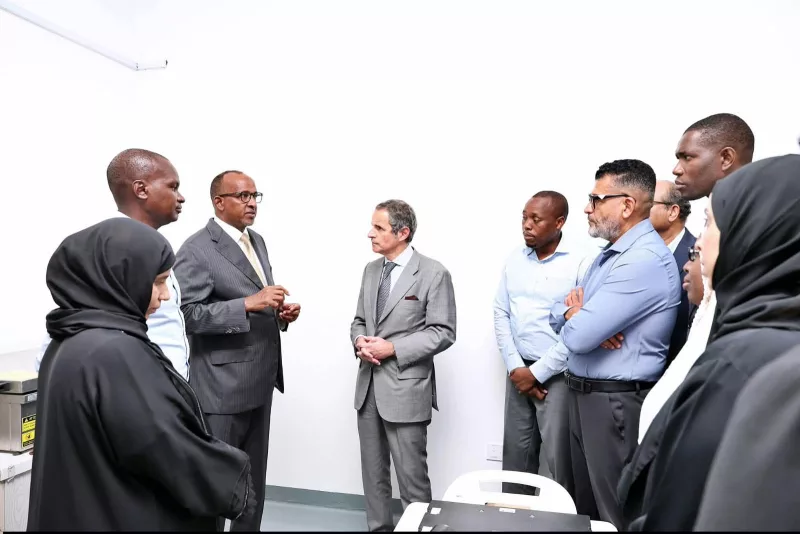
Kenya is seeking a fresh IAEA review and expanded technical support as it moves to turn its long-running nuclear power ambition into a construction-ready programme by 2034.
Kenya wants the International Atomic Energy Agency to conduct a Phase II Integrated Nuclear Infrastructure Review (INIR) mission in the last quarter of 2026, while helping address a shortage of nuclear engineers and scientists needed to advance the programme.
Nairobi seeks to use the 70th IAEA General Conference set for September 14-18 in Vienna to seek advisory services, skills development and technical assistance to advance its nuclear power programme.
Kenya will also seek support for a nuclear research reactor targeted for completion by 2030.
A high-powered 30-member delegation is expect to travel to Austria, and will be composed of a Cabinet minister, MPs drawn from relevant parliamentary committees as well as technocrats in the sectors.
According to a brief on the conference seen by the Star, Nairobi is seeking a broader push to move Kenya’s nuclear ambitions from institutional preparation towards implementation.
Nairobi is also seeking to strengthen the institutional, regulatory and technical foundations for its first nuclear power plant, which it aims to commission by 2034.
The proposed INIR mission is also an important milestone because the IAEA's Milestones Approach provides a framework for countries developing their first nuclear power programme.
Kenya already underwent an initial INIR mission in 2015 and a follow-up in 2021. The latter found significant progress in areas including nuclear policy, legislation, regulatory institutions and coordination among the agencies involved in the programme.
A further IAEA mission in 2025 focused on the institutional arrangements for the first nuclear plant and helped pave the way for the designation of KenGen as the owner-operator.
The May 2025 owner-operator mission provided advice on the roles, responsibilities and organisational requirements of the prospective operator, contributing to Kenya's decision to designate KenGen to run the country's first nuclear power plant.
The development marks an important shift in Kenya's nuclear programme from building institutions towards preparing for an actual power project.
A Sh500 billion nuclear plant has been proposed in Siaya.
Kenya says it now needs assistance in long-term energy analysis, implementation of the nuclear programme, human-resource development and advisory services as it prepares for the nuclear plant and a separate research reactor targeted for 2030.
The shortage of specialised personnel is emerging as one of the programme's key challenges.
The brief says Kenya is seeking capacity building to address shortages of nuclear engineers and scientists, with the IAEA having already supported the development of national expertise over the past decade.
Between 2016-26, 263 Kenyan nationals benefited from medium- and long-term technical competency development programmes, while 139 participated in fellowships and 61 in scientific visits.
Kenya and the IAEA also signed an MoU in May 2026, which provides a framework for cooperation in energy planning, modelling and monitoring, nuclear infrastructure development, and specialised training.
The agreement specifically includes capacity building around small modular reactor technologies.
IAEA Director General Rafael Mariano Grossi has also stressed the importance of Kenya selecting technology and contractors, which are fit for purpose and capable of meeting the country's long-term energy requirements.
He has also invited Energy and Petroleum CS Opiyo Wandayi to the International Ministerial Conference on Nuclear Power on October 27-29, 2026 in Incheon, South Korea.
The conference will provide a forum for ministers, policymakers, senior officials and experts to engage in high-level dialogue on the role of nuclear energy.
The agency has reaffirmed its willingness to provide professional advice as Kenya makes those decisions.
Kenya has spent more than a decade developing the institutional architecture required for nuclear energy. The Nuclear Power and Energy Agency was established in 2019 as the implementing organisation, the Kenya Nuclear Regulatory Authority was established the same year as the regulator, while KenGen was designated owner-operator in 2025.
The country is also pursuing a Nuclear Research Reactor by 2030, with the IAEA expected to provide advisory and capacity-building support. Kenya underwent an IAEA research-reactor infrastructure mission in 2023, which found significant progress in developing the national infrastructure for the project.
Under the agency's Rays of Hope initiative, Kenya has received two linear accelerators for cancer treatment centres in Nakuru and Mombasa. The equipment was delivered in 2024 and commissioned in May 2026.
Kenya is now seeking five additional LINAC machines and recognition as an IAEA regional centre for cancer diagnosis and treatment training.
Kenya is also seeking support to establish its first food irradiator to address post-harvest losses and food security challenges, while seeking to become a pilot country under the IAEA-FAO Atoms4Food initiative.