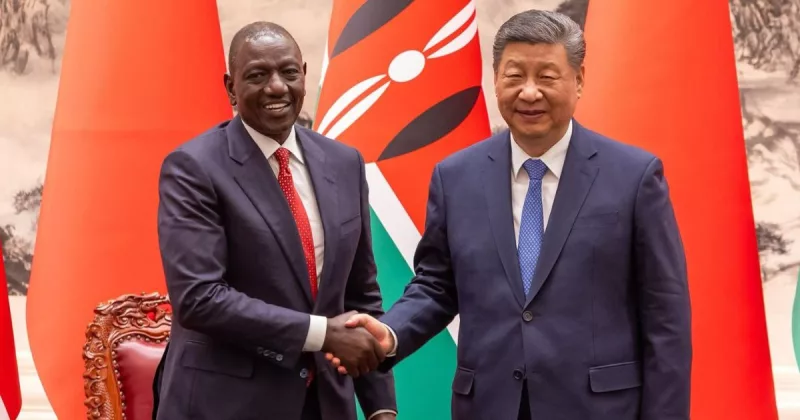
 President William Ruto shakes hands with his Chinese counterpart Xi Jinping during a past meeting in Beijing/FILE
China says its Global Governance Initiative (GGI) has won significant international support in the year since its launch, as Beijing pushes for what it calls a more representative and equitable global order.
In a brief obtained by the Star, China says the initiative has evolved from a diplomatic proposal into what it describes as a “growing framework for international cooperation”.
Chinese President Xi Jinping unveiled the GGI on September 1, 2025, during the 80th anniversary of the United Nations.
The initiative calls for countries to work together to reform global governance and strengthen multilateral cooperation.
According to China, nearly 160 countries and international organisations have supported or responded positively to the GGI, while more than 60 countries have joined the Group of Friends of Global Governance.
The group has established platforms in New York, Geneva and Vienna, which China says serve as a voice for developing countries in global affairs.
The GGI is built around five principles: sovereign equality, international rule of law, multilateralism, a people-centred approach and taking real action.
China argues that the principles respond to growing calls, particularly from the Global South, for international institutions to become more representative.
Chinese Foreign Minister Wang Yi said in May that countries were increasingly calling for fairness, justice, solidarity and cooperation amid what he described as “profound changes and turbulence in the international system”.
He made the remarks at a meeting of the Group of Friends of Global Governance at the United Nations headquarters in New York, attended by foreign ministers and representatives from more than 60 countries.
“The current international situation is marked by intertwined changes and turbulence,” Wang said.
For China, the GGI offers a framework for countries to respond collectively to these challenges.
A major focus of the initiative is the reform of the United Nations and international institutions that shape the global political and economic order.
China has proposed nine areas for reform, including strengthening the UN, enhancing the authority and capacity of the Security Council and adapting peacekeeping operations.
Other areas include promoting development, reforming international human rights governance and overhauling the global economic and financial system.
The proposals also cover artificial intelligence, cyberspace and outer space governance, as well as greater exchanges between civilisations.
China says the reforms should give developing countries a stronger voice, particularly at the UN Security Council, the International Monetary Fund and the World Bank.
On Africa, Beijing has specifically called for the continent's representation on the Security Council to be addressed as a matter of priority.
China has also linked the GGI to emerging technological challenges, particularly artificial intelligence.
Its position is that the international community needs common rules for AI governance, with the UN playing a central role and greater attention paid to preventing the digital divide from widening.
The proposal is also closely tied to China's other multilateral initiatives, including the Belt and Road Initiative (BRI) and the Shanghai Cooperation Organisation (SCO).
China says the BRI, which now involves more than 150 countries and over 30 international organisations, has produced what it describes as success stories. Kenya’s Standard Gauge Railway was built under the BRI.
The SCO, meanwhile, is cited by Beijing as an example of a multilateral framework based on sovereign equality and consensus, with members required to make decisions collectively.
The Group of Friends of Global Governance has similarly been presented as a platform that complements rather than replaces the UN system.
Its members have endorsed five areas of consensus: democratising international relations, upholding the UN Charter, maintaining the UN's central role, narrowing the North-South divide and addressing pressing global challenges.
China has also sought to demonstrate that the GGI is not limited to diplomatic declarations.
Beijing says the International Organization for Mediation has begun operations and resolved its first international maritime dispute.
New institutions focused on data and artificial intelligence have also been established.
The country has further pledged new climate commitments and is preparing to host the Xiong'an Global Governance Forum this autumn.
The forum is expected to bring together representatives from different sectors to discuss ways of reforming international governance and strengthening multilateral cooperation.
China says the developments of the past year demonstrate that countries share an interest in a system based on consultation, joint contribution and shared benefits.
The initiative also reflects Beijing's long-standing argument that global institutions must adapt to changes in the distribution of economic and political power.
Central to the GGI is China's insistence that sovereignty among states should be respected and that international affairs should not be dominated by unilateral decisions or bloc politics.
Beijing says such an approach could work better for developing countries seeking greater participation in decisions affecting the global economy, security, climate and emerging technologies.
Wang said China would continue to uphold the UN-centred international system and support multilateral and regional cooperation mechanisms.
The GGI's first anniversary comes as China seeks to turn its call for global governance reform into a broader international agenda.
Africa and other developing regions are expected to remain central to the debate over who gets a greater voice in shaping the rules of the international system.