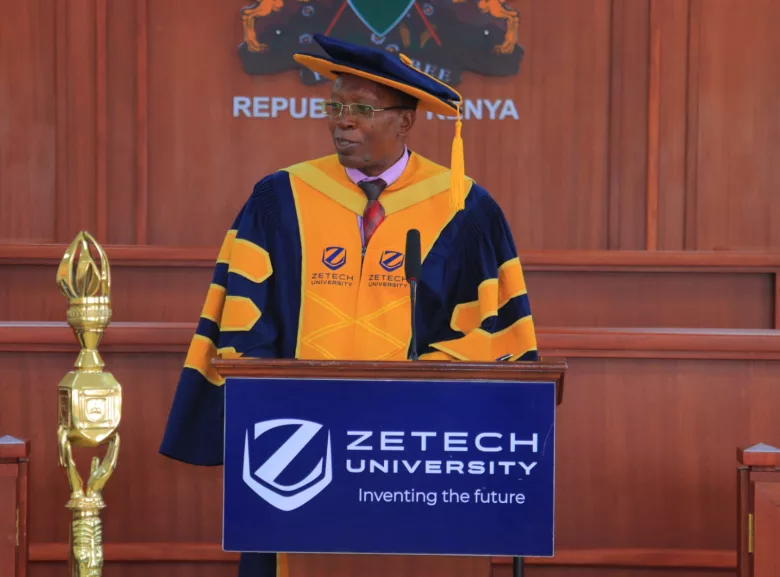
 Zetech University Vice Chancellor Prof Njenga Munene /HANDOUT
AS global crises continue to evolve, training more international relations and diplomacy professionals is necessary because world faces complex, cross-border challenges that require skilled negotiation and cooperation.
Scholars observe that issues like climate change, pandemics, and cyber threats cross national borders and require countries to work together, therefore requiring countries to have more experts.
According to Prof Njenga Munene, the Zetech University Vice Chancellor, global business and supply chains require professionals trained in international relations and diplomacy to manage international trade agreements and economic stability.
“These experts play a pivotal role in bridging gaps between societies and political systems. It is high time institutions of higher learning enhance training of more professionals,” Prof Munene said.
The don who spoke at the university’s Thika Road campus in Ruiru, Kiambu County averred that the world is changing rapidly and the practice of international relations must evolve with it.
He noted that today, diplomacy is shaped not only by political and economic interests, but also by technology, data, climate change, security, trade, and the changing architecture of global governance.
“As an institution, we believe there is a need to develop a new generation of professionals and scholars who can critically understand these shifts, generate data-based evidence, and contribute meaningfully to policy and international affairs,” the VC said.
He revealed that the university has expanded its postgraduate offering with the introduction of the Master of Arts in International Relations & Diplomacy and the Doctor of Philosophy in International Relations & Diplomacy, strengthening its commitment to developing professionals, researchers and thought leaders equipped to understand and shape an increasingly complex global environment.
The programmes come at a time when the practice of international relations is undergoing significant transformation.
Traditional diplomacy which centered largely on state-to-state relations is increasingly intersecting with technology, international trade, climate change, global health, cybersecurity, artificial intelligence, digital governance, economic diplomacy and emerging forms of geopolitical competition.
For Kenya and the wider East African region, these developments have particular significance.
Kenya's Foreign Policy 2024 explicitly identified emerging areas beyond the traditional scope of diplomacy, including digital and technology, climate, health and global governance reform, while also responding to new threats to peace and security, changing geopolitical dynamics and new opportunities in trade, investment and technology.
“The introduction of the Master’s and PhD programmes in International Relations and Diplomacy is therefore a deliberate investment in knowledge, leadership and Africa's capacity to participate more effectively in shaping the global agenda,” he noted.
The scholar maintained that the introduction of the programmes aligns with national priorities (Vision 2030), regional prorities (The East Africa Community (EAC) Vision 2050), continental focus (Africa Union (AU) Agenda 2063), and global priorities (United Nations (UN) Pact for the Future).
“This approach reflects the reality that technology is no longer simply a tool used by diplomats. It is increasingly becoming a subject of diplomacy. Artificial intelligence, cybersecurity, data governance, digital sovereignty, misinformation and emerging technologies are creating new questions around international cooperation, regulation, security and power,” Prof Munene said.
United Nations Educational, Scientific and Cultural Organisation’s (UNESCO) 2025 Tech Diplomacy Forum, for example, brought together technology, policy and diplomatic stakeholders around issues including digital sovereignty, AI ethics, cybersecurity and the digital divide.