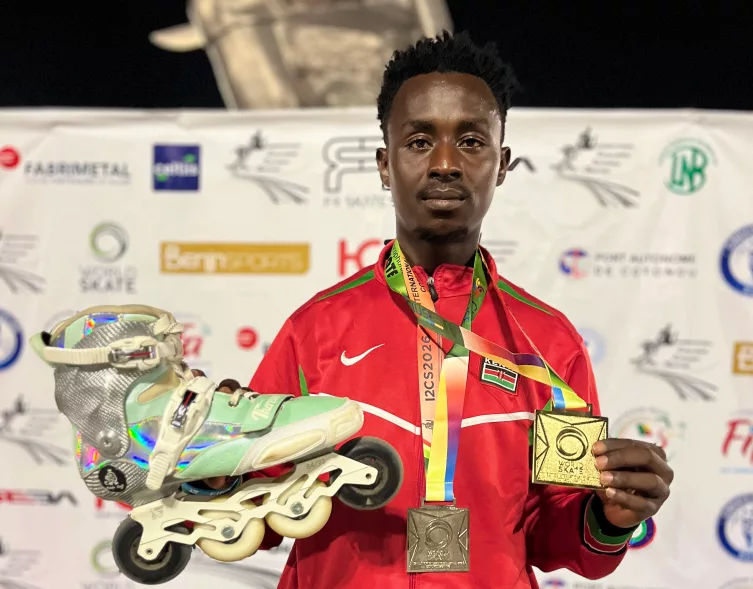
 Skater Kevin Kiarie Ruhiu. /X
Freestyle slalom skater Kevin Kiarie has questioned his inclusion on the proposed 2026 national heroes list, citing lack of State support for international competitions.
Kiarie, a multiple African champion who has represented Kenya at international skating events, said he had never received support from the Ministry of Sports for any of his international competitions despite repeatedly carrying the Kenyan flag abroad.
He said the recognition sits uneasily with his experience of seeking support in vain.
“I have seen that I am among the proposed national heroes of 2026. While I appreciate the honour, I would like to ask why I have been proposed whilst I have never been supported by the Ministry of Sports to any of my international competitions upto now?” Kiarie said.
“As a matter of fact, I have also not received any of my reimbursement funds and no action has been taken.”
Kiarie’s inclusion on the list comes against the backdrop of a career in which he has won medals for Kenya at continental and international events, while publicly highlighting the financial strain in the absence of State support.
His name appears on page 72 of the proposed National Heroes Council list, where he is recognised for his achievements in freestyle slalom skating.
The council describes him as a multiple African champion who has represented Kenya in international competitions, earning continental recognition after winning gold at the 2026 African Skating Championship in Cairo and silver at the Challenge Skating Championships in Benin.
“Kevin is being recognised for his exceptional achievements in sports, specifically freestyle slalom skating,” the description states.
"His determination, resilience, and commitment to excellence have inspired many young Kenyans to pursue their talents despite limited resources and opportunities,” it adds.
The recognition is particularly significant because Kiarie’s achievements have come in a sport that receives considerably less public attention and funding than Kenya’s traditional sporting disciplines like football.
Among his notable international appearances was the International Skating Challenge in Cotonou, Benin, where he competed for Kenya.
His career has also included African championship success, establishing him as one of the country’s leading freestyle slalom skaters.
In mid-July, Kiarie was hosted and recognised by Foreign Affairs Principal Secretary Korir Sing’Oei for his achievements and for raising Kenya’s profile internationally.
The recognition by the Foreign Affairs Ministry provided another public acknowledgement of the contribution he has made to Kenya’s sporting reputation beyond the country’s better-known athletics and team sports.
But his latest remarks have brought the issue of State support for lesser-known sporting disciplines back into focus.
Kiarie has previously spoken about the challenges athletes face when they have to raise money themselves to participate in international competitions, including difficulties in recovering expenses incurred while representing the country.
Hours after questioning his proposed national hero recognition, Kiarie turned his attention to the upcoming international assignment, updating Kenyans on the milestone reached in crowdsourcing to fund the trip.
“Finally we have reached our target. Sh340,000 contributions. Thank you Kenyans. It's indeed humbling. I appreciate for all forms of support chanelled and showed towards this journey, God bless you all. Now my only focus is the World Skate Games. I'll keep you posted,” he said on X.
The Sh340,000 was raised through contributions from Kenyans as Kiarie prepares for the World Skate Games in Paraguay.
The event is scheduled to take place from October 2 to October 18, 2026, giving Kiarie another opportunity to compete on the global stage and represent Kenya.
His fundraising appeal, coming on the same day he questioned his proposed national honour, underscores the contradiction at the centre of his complaint: an athlete considered worthy of national recognition is still relying on public contributions to finance his participation in a major international competition.
The proposed national heroes list is part of the process through which Kenya identifies individuals whose achievements and service warrant national recognition.
National heroes are officially honoured every year on October 20 during Mashujaa Day, the public holiday designated to celebrate Kenyans who have made outstanding contributions to the country.
For Kiarie, however, the proposed honour appears to have raised a broader question about how Kenya supports athletes before they become worthy of celebration.
His complaint is not directed at the recognition itself, rather, he is questioning why an athlete whose international achievements are being cited as grounds for national recognition has had to contend with a lack of government support.
The issue also highlights the often less visible costs of competing internationally in emerging sports.
Athletes who lack sponsorship or State support are forced to meet travel, accommodation, competition and other expenses from their pockets, creating a financial burden that can determine whether they are able to participate at all.
With the Sh340,000 fundraising target reached, the multiple African champion can turn his attention to competition as the questions over lack of support remain.