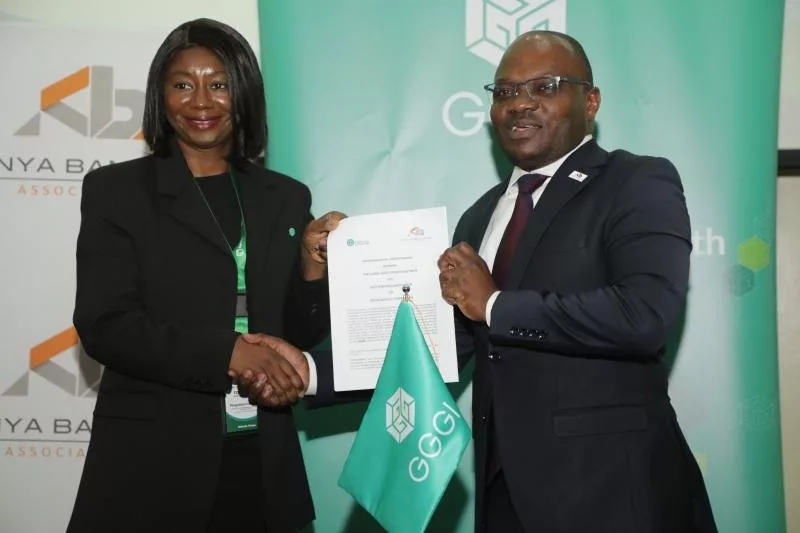
 Nagnouma
Kone, Manager, Africa Strategy and Partnerships, and Head of Kenya Office, Global
Green Growth Institute (GGGI), and Raimond Molenje, Chief Executive Officer,
Kenya Bankers Association, during the signing ceremony./HANDOUT.
Nagnouma
Kone, Manager, Africa Strategy and Partnerships, and Head of Kenya Office, Global
Green Growth Institute (GGGI), and Raimond Molenje, Chief Executive Officer,
Kenya Bankers Association, during the signing ceremony./HANDOUT. Kenya is seeking to bring banks, businesses and other private investors into biodiversity conservation as the country steps up efforts to close a financing gap threatening the implementation of its national biodiversity targets.
According to the Global Green Growth Institute (GGGI), greater private sector involvement is needed to complement public and donor funding and accelerate the implementation of Kenya’s National Biodiversity Strategy and Action Plan (NBSAP).
The call comes as GGGI begins implementing the Systemic Learning and Mainstreaming of Biodiversity Targets for Innovative Transformation and Behavioural Change (SYMBIOTIC) project in Kenya.
Nagnouma Kone, GGGI Manager for Africa Strategy and Partnerships and Head of the Kenya Office, said the initiative will help identify financing gaps and develop ways of mobilising resources from both the government and private sector.
“Symbiotic helps with really accelerating the implementation of the National Biodiversity Action Plan,” Kone said.
She said the project would also help identify areas where additional investment is required and bring other partners on board to address the gaps.
The five-year project, running from February 2026 to January 2031, is funded by the German Federal Ministry for the Environment, Climate Action, Nature Conservation and Nuclear Safety through the International Climate Initiative. It is being implemented in Kenya, Ethiopia, Madagascar, Indonesia and Kyrgyzstan, with GGGI responsible for implementation in Kenya and Ethiopia.
Kone pointed out that in Kenya, GGGI will focus on integrating biodiversity into national and sectoral planning, strengthening biodiversity financing through fiscal instruments and natural capital accounting, and working with businesses and financial institutions to promote biodiversity-positive investments.
Lavenda Ondere, Project Manager, SYMBIOTIC Kenya and Ethiopia, said the organisation will first assess existing policies, legislation, subsidies and incentives to determine whether they are creating an environment that encourages investment in biodiversity.
“We want to mainstream investment into biodiversity sectors. Private sector actors are increasingly important as governments and development partners face competing financing demands,” Ondere said.
The project will also hold dialogue sessions with businesses and other stakeholders to improve understanding of the NBSAP and identify opportunities for companies to participate in its implementation.
GGGI is considering partnerships with financial and private sector bodies, including the Kenya Bankers Association and the Nairobi Securities Exchange, to explore investment opportunities and understand the challenges businesses face in adopting biodiversity-friendly practices.
The World Bank estimates that 44 per cent of Kenya’s GDP comes from sectors that are highly or very highly dependent on ecosystem services, underlining the economic importance of protecting nature.
GGGI said innovative financing instruments, including green and sustainability-linked bonds, carbon finance and debt-for-nature swaps, could help mobilise additional resources.
Ondere said the initiative would ultimately develop a roadmap showing how, where and when different financing instruments can be used to support biodiversity conservation and restoration.
“The project will therefore seek to move biodiversity conservation from being viewed mainly as an environmental issue to one that is incorporated into economic planning, public finance and private investment,” she said.