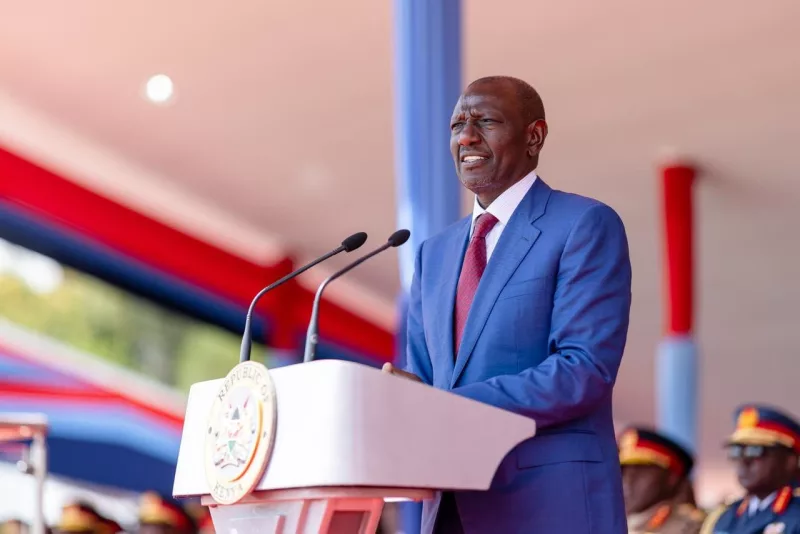
 President William Ruto /PCS
When President William Ruto took office in September 2022, eCitizen was already in operation, having been introduced years earlier as a platform for accessing government services online.
What changed under his administration was the scale and speed of the digitisation drive.
The Kenya Kwanza government made eCitizen a central part of its plan to move government services from physical offices to a single digital platform, with the stated objectives of reducing bureaucracy, improving access, increasing transparency and sealing revenue leakages.
The difference is most visible in the number of services available.
In 2022, the government reported about 350 government services on eCitizen. By 2024, that number had risen to 20,855, while Ruto said in November that the platform hosted 22,515 services and had more than 13 million users.
But the expansion of eCitizen has happened alongside a broader growth in Kenya's digital infrastructure.
The 2023 Economic Survey reported that ICT sector output rose by 9.9 per cent to Sh608 billion in 2022. Available bandwidth capacity also grew by 9.9 per cent to 12 million Mbps, while mobile money remained an important part of the country's digital economy.
The 2024 Economic Survey showed total wireless internet subscriptions had risen to 51.3 million by 2023, from 48 million in 2022, while fixed internet subscriptions increased to 1.03 million.
From hundreds of services to thousands
The administration moved quickly. In January 2023, Ruto said his government would digitise 5,000 government services by June. By March, he announced that 2,800 had already been digitised.
“Today, I'm happy to announce that 2,800 government services have been digitized,” Ruto said on March 3, 2023.
The President said Kenyans should be able to obtain and pay for services without physically travelling to government offices.
“Kenyans should be able to access documents and services using technology. We must use technology to close the loss of government revenue,” he said.
By May 24, Ruto announced that 5,000 services had been digitised, saying the move would cut transaction costs and reduce opportunities for corruption.
“The aim is to significantly cut down transaction costs and minimise opportunities for corruption by eliminating unnecessary bureaucracy, and also increase transparency in government,” he said.
The government also made eCitizen the main payment channel for state services, with Treasury introducing the universal government paybill number 222222.
Revenue rises as access expands
The digitisation drive quickly became a revenue-collection strategy as much as a service-delivery programme.
On October 5, 2023, Immigration and Citizen Services Principal Secretary Julius Bitok said more than 10,000 services were available on eCitizen and revenue collected through the platform had risen from Sh1.397 billion in June to Sh4.169 billion in September.
By December 20, eCitizen collected Sh903.6 million in a single day, according to Bitok, as the number of services on the platform passed 14,000.
The revenue gains accelerated in 2024. In February, then ICT Cabinet Secretary Eliud Owalo said daily collections through eCitizen had reached Sh1 billion, up from Sh60 million.
“Since the government decided to digitise all its services and place payments on the eCitizen platform, our daily collection has risen to Sh1 billion from Sh60 million,” Owalo said.
He said automation had eliminated middlemen, brought services closer to the public and reduced the cost of doing business.
By November 2024, Ruto was presenting eCitizen as one of the administration's major digital achievements.
“E-citizen currently hosts 22,515 services of a thriving community of 13 million users,” he said on November 28 at the Kenyatta International Convention Centre.
He also linked the platform directly to his administration's transparency agenda, saying: “When I campaigned, I made a fundamental statement, I said in my administration there would be no money to steal and part of that journey is through digitisation.”
Building the digital highway
The expansion of eCitizen has been accompanied by investment in connectivity.
In September 2024, the national fibre network had grown from 8,900km in 2022 to 18,767km. The government had also established 1,490 public Wi-Fi hotspots and 274 digital hubs. Digital literacy registrations rose from 73,948 in 2022 to 516,505 in 2024.
Ruto has repeatedly presented connectivity as necessary for digital government.
Speaking at the Connected Africa Summit on April 22, 2024, he said: “As a country we made a very conscious decision that technology is going to inform the way we transform our country.”
He said the government was 80 per cent through its plan to put all government services on a digital platform.
The government has therefore been pursuing two sides of the same strategy: putting services online while expanding the infrastructure needed to access them.
Access beyond smartphones
But digitisation also created a new question: what happens to Kenyans who cannot easily access digital services?
In June 2023, Ruto launched Gava Express to provide physical access points for people who do not own smartphones.
“Unlike Huduma Centers that are primarily based in county headquarters, Gava Express will provide services at the grassroots,” he said.
The initiative was intended to extend government services through private-sector outlets, including M-Pesa shops, banks and other businesses.
The move acknowledged a central weakness of digital government: putting a service online does not automatically make it accessible to every citizen.
The user experience test
The administration's claims of convenience have also faced resistance.
In February 2024, Ruto defended the push to move payments, including school fees, onto eCitizen despite a court challenge.
“The cash payments system is slippery and often an avenue for corruption. Technology will help us eliminate this,” he said.
But the High Court temporarily suspended the school-fees directive after a challenge over its legality, consultation and the Sh50 convenience fee.
The controversy illustrated the tension between the government's desire to centralise digital payments and citizens' concerns over mandatory use, additional charges and access.
Technical reliability has presented another challenge.
On March 5, 2026, the Directorate of eCitizen Services said the platform had been fully restored after a disruption that affected thousands of users trying to access payments, passport applications and other services.
“All services are now operational and accessible as normal,” the Directorate said.
Three weeks later, motorists reported that driving licence renewals were stuck because the system was failing to trigger M-Pesa payment prompts. One motorist told The Star: “I have been trying to renew my permit for two days now. Sad that the government is not giving any way forward, yet thousands of people are stuck.”
On August 31, 2026, another disruption affecting eCitizen-linked eTIMS services left some taxpayers unable to download electronic tax invoices and complete business transactions.
By 2025, eCitizen had become a much bigger revenue channel.
The Draft 2026 Budget Policy Statement showed monthly collections had risen from Sh1.45 billion in 2022 to Sh8.2 billion in 2025 — more than five times the 2022 level.
In September 2025, eCitizen Director General Isaac Ochieng said daily collections had reached between Sh700 million and Sh1 billion and that the platform had collected more than Sh550 billion over three years.
“What we want on eCitizen is for Kenyans to obtain services at their convenience, something that never used to happen before,” Ochieng said.
But the strongest test of the transformation came from the Auditor General.
In March 2026, Auditor General Nancy Gathungu reported that 28,373 services had been onboarded onto eCitizen by June 30, 2025. Only 5,731, or 20 per cent, were active, leaving 22,642 unused.
“Review of data revealed that a total of 28,373 services had been onboarded onto the eCitizen platform. However, only 5,731 services (20 per cent) were active,” the audit found.
The government had also spent Sh946 million on onboarding services whose value for money auditors could not confirm.
The audit raised questions about governance, revenue reconciliation, payment systems and the absence of documented standard operating procedures.
There are also unresolved questions around ownership and governance. In March 2025, Bitok told MPs that the government wholly owned eCitizen and had documentation to prove it, while explaining that ICT Authority and Treasury were involved in operating the platform and managing revenue collection.
In May 2026, Treasury began the process of anchoring eCitizen in law, saying the platform had been operating largely through executive orders and administrative directives and proposing regulations covering payment, revenue settlement and accountability.