 El nino rains.
Schools will not be converted to emergency disaster relief shelters for families displaced by the expected El Nino, the government has announced.
Instead, county commissioners have been ordered to identify chiefs' camps, churches and mosques that can house the displaced.
The disaster readiness plans got a major impetus on Thursday after weather forecasts determined they were 100 per cent certain of a once in a lifetime deluge due in October and will likely only die down in February.
Col (Rtd) David Samoei, Director General of the National Disaster Operations Centre (NDOC), said they are mapping centres to host people from October to February.
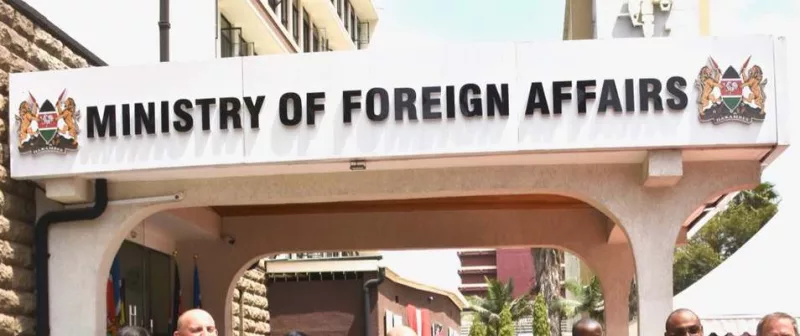
“Going by what we have been told by Kenya Met, it looks to me from a disaster point of view that the rains will be like 1997 El Nino. It was not something very easy and we have to be careful as a country,” he told a forum dubbed Mazingira talk at the Ministry of Environment.
In 1997, an estimated 100,000km of both rural and urban roads were destroyed leading to a general transport paralysis in most parts of Kenya, a report by UNEP said.
More than 300,000 families were displaced by floods which also swept away schools, health facilities, bridges and large sections of roads.
The NDOC projects the rains might bring huge farming benefits, but possible destruction of homes and infrastructure and loss of lives.
“We have been talking to county commissioners, asking them to identify IDP (internally displaced persons) areas. And we have discouraged use of primary schools and secondary schools as IDP camps. Reason being that they interfere with the exams which are coming up in October, and November. And also, if schools are used as IDP camps, they destroy the infrastructure,” he said.
He said they project the displacements will begin in November, when the rains will be heaviest, and December.
“We have also endeavoured to find out which counties are going to be affected most because not all counties will be affected the same way. Not all counties will be affected at the same time,” he said.
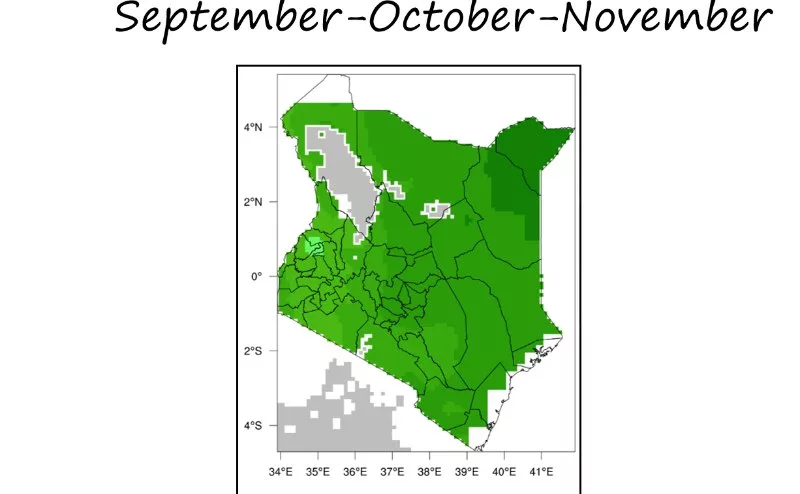
The Kenya Meteorological Service Authority classified 18 high-risk counties as most vulnerable to severe impacts during the El Niño-driven short rains.
Samoei said once the rescue centres are identified, food and other supplies such as medicine will be sent there. He said fuel should also be stocked in these areas.
“So that is why we have been talking to Kenya Coast Guard to position boats in these areas. We are strategising the country and making sure that we have boats in Garissa, in the area of Baringo, in the [other] lakes regions, so that we can assist people in cases we need to take Kenyans across water bodies,” he said.
“We are also expecting a lot of accidents, including boat accidents. So we have trained about 30 divers, at least three for each county where we expect a problem.”
Interruption of road transport is expected especially in Wajir, Mandera, Turkana and Marsabit in which event helicopters will be deployed to evacuate and deliver food and medicine.
“We are also looking at the issue of disease outbreaks. We have people from Ministry of Health who are also looking at these diseases and trying to figure out how to help Kenyans during that time,” he said.
Dr Festus Ng’eno, PS for Environment and Climate Change announced the response plan is being coordinated by Deputy President Kithure Kindiki.
“And the National Disaster Operations Centre, which is hosted in the Ministry of the Interior, [Interior PS Omollo] Raymond has been on this. Waziri Kipchumba Murkomen has been coordinating this at the ministerial level. And on the operational level, that is where we sit, Kenya Met are the ones that provide information,” Ng'eno said.
On Thursday, the World Meteorological Organisation (WMO) confirmed that El Niño is firmly established and is expected to become a “very strong” event in the coming months, with its effects likely to continue into 2027.
WMO forecasts put the chance of El Niño continuing through February 2027 at almost 100 per cent.
WMO Secretary-General Celeste Saulo warned that the weather event could have a major economic impact.
She said countries must prepare early because of the strength of the forecast.
“This exceptional El Niño demands exceptional preparation and response. Never before in the 50-year history of the World Meteorological Organization have we launched such a major mobilisation with National Meteorological and Hydrological Services who are on the frontline of delivering the forecasts and services to save lives and livelihoods,” she said.
But WMO cautioned that a strong El Niño does not mean the same weather everywhere. Its effects depend on location, season and other climate systems.
The phenomenon usually brings heavy rains into Kenya while it causes drought in most countries.
A positive Indian Ocean Dipole (IOD) is also expected to develop, which could influence the amount of rain received in Kenya.
A positive IOD refers to the warming of Indian Ocean waters near East Africa, which causes heavy rains in the region.
Saulo said governments and other sectors must act before the worst effects are felt.
“WMO is committed to working closely with partners across the United Nations and humanitarian system to provide the climate intelligence and insights needed to support disaster management and climate-sensitive sectors like agriculture, health, energy and water resources,” she said. “We have no time to lose.”
Unicef said more than 162 million children - over two-thirds of all children in Eastern and Southern Africa - live in areas exposed to the effects of the strengthening 2026/27 El Niño.
“Across the region, children are facing food and water insecurity, overstretched health services and disrupted learning,” Unicef regional director for Eastern and Southern Africa Etleva Kadilli said.
The agency has identified Kenya alongside Djibouti, Eritrea, Ethiopia, Madagascar, Malawi, Mozambique, Somalia, South Sudan, Sudan, Uganda, Zambia and Zimbabwe as countries facing overlapping risks.
El Niño develops in the Pacific Ocean when changes in wind patterns allow warm water to move eastwards, releasing heat into the atmosphere. The resulting disruption to global weather patterns can leave some regions unusually dry while bringing heavy rainfall and flooding to others.
UN Secretary-General António Guterres said the phenomenon was being “supersized”, warning that the planet was entering uncharted territory.
The agency is seeking $173 million (about Sh22 billion) in the 2026 humanitarian needs to provide anticipatory and life-saving assistance across 13 priority countries, Kenya included.
It estimates that every $1 invested in disaster risk reduction can save up to $15 in recovery costs.
In Nairobi, Governor Sakaja Johnson has established a multi-agency team with five sub-committees covering infrastructure and drainage, emergency response and evacuation, shelter and relief, security and traffic, and communication.
The county has identified 227 flood hotspots across its 17 sub-counties.
A Sh2.4 billion flood-mitigation programme has been rolled out, with Sh2 billion allocated to drainage and flood-mitigation works targeting 19 flood-prone roads.
The identified risks include blocked and undersized drainage channels, silted waterways, waste obstructing rivers, vulnerable roads and transport links, and areas where emergency access could be compromised during heavy rains.
The county says it is mobilising personnel, equipment and resources to clear drains, remove silt and waste and strengthen emergency response.
The emergency response and evacuation team will oversee rescue operations, while the shelter and relief team will prepare shelters and coordinate food, water, medical assistance and other support.
The security and traffic team will focus on maintaining security, traffic management and emergency access, while the communication team will issue early warnings and public alerts.
For residents, the preparations underline a simple message: extreme weather should not be treated as a surprise.