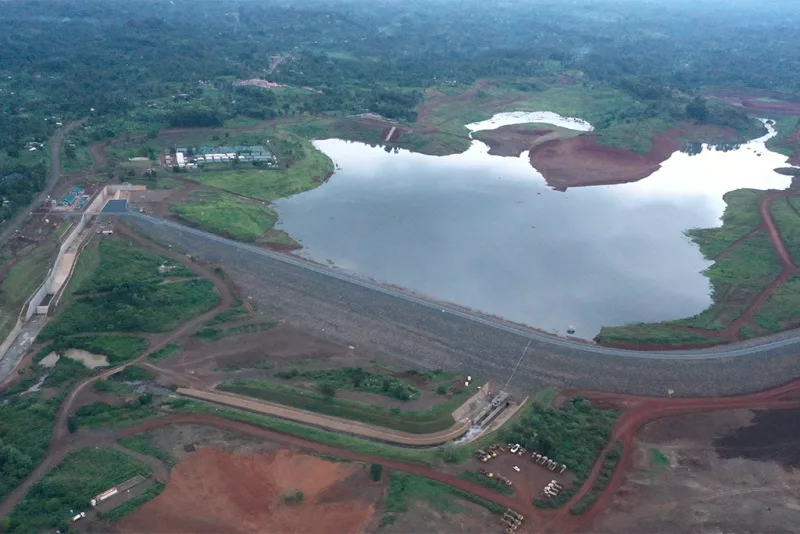
 Thiba Dam in Kirinyaga county /FILE
When President William Ruto took office four years ago, he made one promise central to his food security agenda: Kenya would stop depending almost entirely on the rains and unlock its vast agricultural potential through water storage and irrigation.
Since then, the government has invested billions of shillings in dams, irrigation schemes, water pans and canals, opening up new farmland and expanding production in areas where farmers previously relied on increasingly unpredictable rainfall.
The gains are visible in established schemes as well as in new projects spread across the country.
Official government data shows that irrigation has expanded through the rehabilitation of existing schemes, new community projects, large-scale irrigation developments and the construction of water-storage infrastructure.
The latest figures indicate that the country had put an additional 80,340 acres under irrigation by December 2024, lifting the total irrigated area from about 664,000 acres in 2022 to 744,340 acres.
The expansion is significant because Ruto came to office promising to move agriculture away from its heavy dependence on rainfall and make water availability the foundation of food security.
At the launch of his administration's water and irrigation agenda in 2023, Ruto declared: “Irrigation is the most transformational intervention we can undertake in agriculture.”
Water Cabinet Secretary Eric Mugaa echoed the sentiment.
“Rain-fed agriculture has become unreliable due to climate change, and one way to address these shortcomings is by investing in rainwater harvesting, a reliable and sustainable water supply,” he said during a past event.
But the bigger question four years into his presidency is not simply how many acres have been announced for irrigation.
It is how many of those acres have received reliable water and are actually producing crops.
That distinction is becoming increasingly important as the government rolls out an ambitious plan to increase the area under irrigation to 1,289,142 acres by 2027-28.
The National Irrigation Authority (NIA) says its expanded irrigation programme has already put 228,731 acres under irrigation across 44 counties.
Of this, 147,131 acres are through smallholder and community irrigation projects, while 80,600 acres have come from rehabilitation and expansion of gazetted schemes.
There are also 88 ongoing projects expected to add another 67,225 acres once completed.
The numbers, however, need to be read carefully.
The 228,731-acre figure is cumulative under a programme that began in 2011, meaning it cannot be presented as acreage created solely since Ruto took office.
A more direct measure of the administration's first years comes from government progress reports.
The Environment, Water and Natural Resources sector reported that between the 2021-22 and 2023-24 financial years, an additional 91,499 acres were developed for irrigation targeting rice, maize and horticulture.
The same report says the expansion of Mwea Irrigation Scheme to 30,600 acres, together with Thiba Dam, contributed to increased rice production and enabled more consistent double cropping.
The government has therefore moved beyond simply talking about irrigation towards expanding schemes that already have farmers, canals and markets.
Mwea provides one of the clearest examples
The completion of Thiba Dam increased the irrigated area within the scheme from 25,000 acres to about 30,600 acres, while the government is targeting expansion to 35,000 acres in a season.
The National Irrigation Authority says the project could support double cropping, translating to as much as 70,000 irrigated acres in a year.
It also projects rice production to rise from about 114,000 tonnes to 200,000 tonnes annually, while the value of production could increase from Sh10 billion to Sh18 billion.
This is perhaps the strongest argument for measuring irrigation not only by acreage but by productivity.
Government data shows rice production increased to 303,724 tonnes in 2025 from 192,299 tonnes in 2022.
Public irrigation scheme acreage increased from 48,324 acres to 71,624 acres over the same period.
That suggests the expansion of irrigation has been accompanied by increased production, particularly in rice-growing areas.
Mwea has also demonstrated the economic impact of reliable water.
Mwea Irrigation Scheme Chairman Peter Chege said the project is critical to food security at both local and national levels.
“Kenya is currently facing a rice deficit of about 700,000 metric tonnes, forcing the government to rely on imports to meet demand. This expansion will help reduce that gap,” Chege said.
NIA says the value of rice produced at the scheme has risen from Sh10 billion to Sh14 billion annually following the completion of Thiba Dam, with an additional 28,000 jobs created.
The longer-term target is even more ambitious, with the scheme expected to reach 35,000 acres in a season and support double cropping.
Elsewhere, the expansion has been less dramatic but spread across more regions.
During the 2024-25 financial year, the State Department for Irrigation reported an additional 3,150 acres through expansion of existing schemes, 2,000 acres in Bura, 450 acres in Tana, 200 acres in Bunyala and 500 acres in Ahero.
Another 11,050 acres were reported under large-scale irrigation projects, including 2,200 acres in Lower Kuja, 3,000 acres in Lower Nzoia, 5,000 acres in Galana and 850 acres in Turkana.
The Farmer-Led Irrigation Development initiative added another 100 acres.
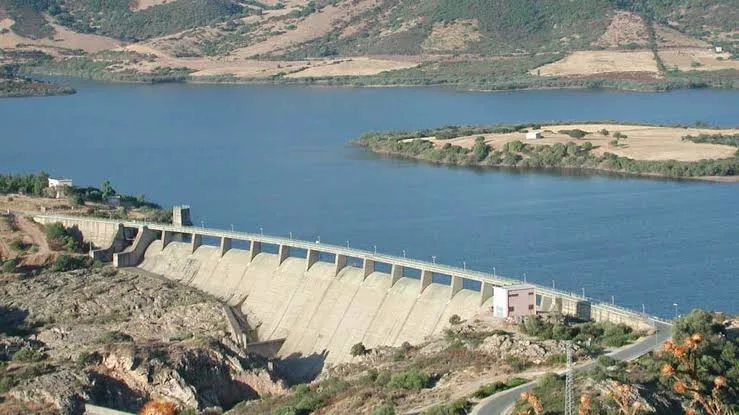 Thwake dam built across the Athi River, just downstream of the Thwake and Athi rivers confluence in Makueni county /COURTESY
That brings the reported additions from these interventions to more than 14,000 acres in the 2024/25 financial year alone, although not all government programmes use identical reporting periods or definitions of “developed” and “under irrigation”.
The administration has also attempted to bring irrigation to areas historically considered unsuitable for large-scale crop production.
In November 2025, Ruto announced plans to use 50 mega dams to support irrigation of 1.5 million acres in northern and coastal Kenya.
The President said 1.5 million of the government's planned 2.5 million additional irrigated acres would come from northern and coastal regions.
“In our plan for placing 2.5 million acres of land under irrigation, 1.5 million of those will be from Northern Kenya and the Coast regions,” he said.
The High Grand Falls Dam is at the centre of that strategy.
Ruto said the proposed dam on the Tana River could irrigate between 300,000 and 400,000 acres, potentially transforming parts of the eastern and northern regions into major food-producing areas.
“It is time to expand from that 15 per cent of Kenya that has rainfall to the rest of the 85 per cent that has no rainfall by storing water for irrigation,” he said.
The statement captures the administration's central philosophy: Kenya does not necessarily lack agricultural land; rather, much of the country lacks dependable water.
Yet this is also where the scorecard becomes more complicated.
Several of the biggest projects expected to unlock hundreds of thousands of acres are still incomplete.
Galana-Kulalu
Ruto has made Galana-Kulalu a key part of his plan to expand irrigation and boost the country’s food production, reviving a project that had stalled for years.
When he took over in 2022, Ruto ordered the project revived, directing that the already developed 10,000 acres be put into production while plans were prepared for much larger expansion.
NIA says the long-term plan includes construction of the Galana Dam to support irrigation of up to 300,000 acres.
During an inspection of the project in May 2025, Ruto declared that the era of promises was over.
“For a long time, there has been a lot of talk about this project. It has been enough talk; now the work begins,” Ruto said.
He said the government wanted Galana-Kulalu to produce food, create jobs and generate products for export.
“We want to use this project to grow food, create jobs as well as ensure we have products for export,” he said.
The government has since adopted a private-sector model, with Selu Limited allocated 20,000 acres, Nyumbani Foundation 50,000 acres and UAE-based Al Dahra 180,000 acres under the wider 250,000-acre expansion plan.
Thwake Multipurpose Dam in Kitui and Makueni is a major example
The dam has a storage capacity of 688 million cubic metres and is ultimately expected to support irrigation of about 100,000 acres.
But the project has suffered prolonged delays.
In March 2026, an Auditor General's report raised concerns over stalled works, cost escalations and financial losses, while noting that the project had reached 94.2 per cent completion by the end of 2024.
By September 2026, construction had resumed after nearly two years without significant activity, following the securing of Sh10.6 billion from the African Development Bank.
The government now expects the critical works to be completed within eight months, with filling of the dam targeted for January 2027.
The delay matters because the irrigation component cannot deliver its full benefits until the broader water-storage infrastructure is operational.
The same problem applies to Mwache Dam on the Coast.
When Ruto launched the project in 2023, he said it would provide water to irrigate at least 7,000 acres and generate Sh1.3 billion worth of food annually.
“If we produce more food, it means more earnings for our farmers and more jobs for our youth,” he said.
But the irrigation component is itself still being developed.
In 2026, the government was undertaking a feasibility study for a 2,000-hectare, roughly 4,942-acre, irrigation scheme around the Mwache Dam area.
This shows the gap between a dam's headline irrigation potential and the acreage that is actually equipped, watered and cultivated by farmers.
The government has simultaneously expanded smaller water infrastructure.
During the 2025-26 financial year, the National Water Harvesting and Storage Authority said it completed 76 water projects comprising weirs, small earth dams, boreholes and related water-supply systems.
The projects harvested and stored about 1.196 million cubic metres of water, benefiting more than 115,000 people and supporting irrigation on more than 12,000 acres.
The authority also reported rehabilitation of small dams, water pans, boreholes and weirs that restored about 300 million litres of storage capacity.
These smaller interventions may ultimately prove as important as mega-dams because they can put farmers into production without waiting for decade-long infrastructure projects.
The government is now working under the National Irrigation Sector Investment Plan, which seeks to increase irrigated land from 664,000 acres in 2021/22 to 1,289,142 acres by 2027/28.
It also targets a huge increase in water available for irrigation, from 55.4 million cubic metres to 2,379.2 million cubic metres over the same period.
But financing remains a major obstacle.
In 2025, the Ministry of Water warned Parliament that budget reductions could delay major irrigation projects.
Bura faced a potential Sh250 million cut that could affect its planned 18,500-acre expansion, while Mwea faced a Sh200 million reduction that could put an additional 5,000 acres at risk.
The National Expanded Irrigation Programme also suffered an Sh850 million reduction.
This exposes the central challenge facing Ruto's irrigation agenda.
The government has demonstrated that targeted investment can transform farmland, Mwea and the expansion of rice production are evidence.
It has also expanded irrigation infrastructure across communities and established a pipeline of dams and schemes that could unlock vast new agricultural areas.
But many of the biggest promises remain in the future tense.
Ruto's original ambition was to build 100 large dams and 1,000 smaller dams and increase irrigated land dramatically.
Later, the administration shifted towards a target of 2.5 million additional irrigated acres, including 1.5 million acres in northern and coastal Kenya.
“With dams, we can transform our arid and semi-arid areas into hubs of agricultural production, even in the absence of rainfall,” Ruto said in his 2025 State of the Nation Address.