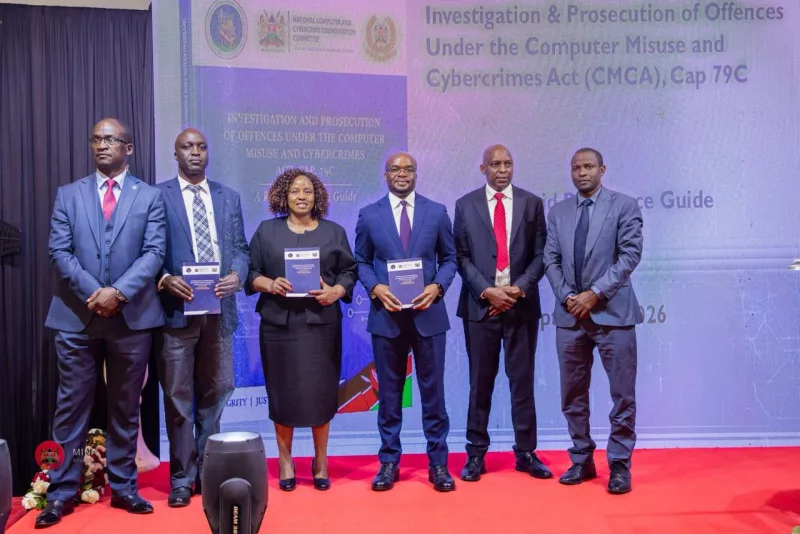
 Internal Security Principal Secretary Raymond Omollo (4th from left) and other officials during the unveiling of the guide to standardise cybercrime investigation and prosecution/HANDOUT
The document, which contains a comprehensive list of 76 cyber offences as well as sample cases, is intended to standardise and streamline the handling of cybercrime cases – from investigation to prosecution.
According to Internal Security Principal Secretary Raymond Omollo, the guide was developed to provide investigators and prosecutors with practical tools to support the entire process, including standard approaches to investigating offences, preparing charges, identifying the evidence required and undertaking key investigative procedures.
Speaking during the launch of the guide, the PS said it would serve as a common operational framework for investigating and prosecuting offences under Kenya’s Computer Misuse and Cybercrimes Act (CMCA).
“This changing threat landscape demands that our officers are equipped not only to understand the law, but also to follow digital evidence, preserve it properly, and build cases that can withstand the scrutiny of our courts,” Omollo said.
 Internal Security Principal Secretary Raymond Omollo giving a certificate during the unveiling of a guide to standardise cybercrime investigation and prosecution/HANDOUT
In Kenya, cybercrime and related digital security threats are estimated to cost the country about Sh29 billion each year, underscoring the need to strengthen investigative and prosecutorial capacity.
“The scale and sophistication of cybercrime in our country are increasing,” he said. “We must have investigators and prosecutors who understand the law, know the procedures for securing and preserving digital evidence, and can translate intelligence and evidence obtained across borders into cases that meet the requirements of our courts.”
The guide also strengthens Kenya’s capacity to respond to cybercrime across borders by providing a common framework for prosecutors and law enforcement agencies to work with foreign counterparts, exchange information, and obtain and preserve electronic evidence through available international cooperation mechanisms.
PS Omollo, who also chairs the National Computer and Cybercrimes Coordination Committee (NC4), said the guide would promote greater consistency and effectiveness in the investigation and prosecution of cybercrime, including through collaboration with international partners.
 Internal Security Principal Secretary Raymond Omollo/MINA
PS Omollo said Kenya had also committed to sharing cybercrime information with 76 countries, strengthening its ability to exchange intelligence and support investigations involving multiple jurisdictions.
“This means that our investigators and prosecutors will increasingly be called upon to work across borders, exchange information with foreign counterparts, obtain electronic evidence from other jurisdictions, and build cases that may span several countries,” he said.
The PS further emphasised the importance of taking the public along in the fight against cybercrime, noting that “wananchi have a right to know what the Government is doing to protect them, the progress being made, the threats they face and the steps they can take to protect themselves.”
 Internal Security Principal Secretary Raymond Omollo giving a certificate during the unveiling of a guide to standardise cybercrime investigation and prosecution/HANDOUT
Beyond strengthening legal and regulatory frameworks, Kenya is also pursuing institutional reforms to enhance national cyber resilience. These efforts include reforms led by the National Computer and Cybercrimes Coordination Committee (NC4).
In June this year, the National Assembly approved the establishment of the National Cybersecurity Agency (NCSA), an autonomous body expected to coordinate national cybersecurity initiatives and strengthen the protection of critical information infrastructure underpinning government services, economic activity and national security.
 Internal Security Principal Secretary Raymond Omollo/MINA