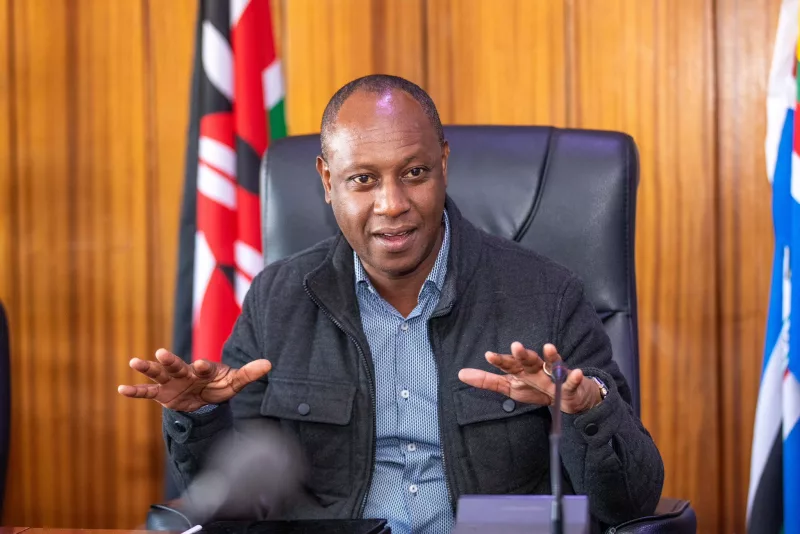
 Livestock Development Principal Secretary Jonathan Mueke/HANDOUT
The government has announced a raft of measures to address milk supply constraints in the country.
Livestock Development Principal Secretary Jonathan Mueke attributed the current shortage largely to inadequate fodder caused by lack of rainfall.
Mueke said the government was working with stakeholders across the dairy value chain to support farmers and restore milk production, warning that the challenges facing producers were already affecting the supply of milk and dairy products to processors and consumers.
Speaking during a press conference, the PS said the government had agreed to take immediate measures to ensure farmers had access to animal feed and received fair prices for their milk.
“We have agreed that all across the value chain, we are going to do whatever it takes to support our farmers,” Mueke said.
He said farmers remained the foundation of the dairy industry, noting that milk processors and consumers could not be guaranteed adequate supplies without protecting producers.
“The farmer is the producer of milk, and without them we may not be able to enjoy milk and the dairy products,” he said.
Mueke identified fodder shortage as the main challenge currently affecting milk production, attributing the problem to inadequate rainfall in several parts of the country.
“The real issue is fodder shortage due to lack of rain,” he said.
To address the immediate feed shortage, the government plans to engage animal feed manufacturers and map areas with adequate stocks that can be made available to farmers facing shortages.
“We have agreed that we are going to speak to animal feed manufacturers, map out areas in the country where we have excess storage of animal feed, then avail them to farmers through cooperatives,” Mueke said.
The government is also preparing to allow the duty-free importation of yellow maize for use in animal feeds as part of efforts to increase the availability of feed and support livestock farmers.
Mueke said the process was already underway and that the necessary gazettement was expected next week.
“We are also going to allow duty-free import of yellow maize for animal feed. That is in the process. That should be gazetted sometime next week,” he said.
The government is also turning its attention to milk pricing, with concerns that poor prices offered to farmers could encourage them to sell their milk to brokers instead of delivering it to processors.
Mueke said authorities would work to ensure farmers received fair prices for their produce, arguing that better returns would encourage them to continue supplying the formal dairy sector.
“We have agreed that we will ensure farmers get the right pricing for their milk so that farmers don’t resort to giving it to brokers and thereby deny processors milk for packing. Then we end up not having them on the shelves,” he said.
The Kenya Dairy Board (KDB) will take the lead in addressing the pricing concerns and examining the practices of cooperatives and other players in the dairy value chain.
Mueke said the government had discovered that some cooperatives were purchasing milk from farmers at relatively good prices but were passing on only a small portion of the earnings to producers.
The government is also considering a longer-term intervention to cushion the dairy sector from recurring cycles of milk shortages and gluts.
Mueke said the government would consider establishing a milk stabilisation fund that would allow excess milk to be purchased during periods of high production, processed and stored for use when supplies decline.
“For long-term solutions, government will consider establishing some sort of a stabilization fund so that when there is a glut, we can buy the excess milk, dry it, and processors can buy it where there is a shortage like now,” he said.
The PS said such an intervention could help stabilise both milk prices and supply by creating a mechanism for storing surplus production instead of allowing farmers to suffer losses during periods of excess supply.
“We believe that will go a long way in stabilising the price of milk and its supply,” he said.
The announcement comes amid confirmation by the Kenya Dairy Board that parts of the country are experiencing temporary constraints in milk supplies, resulting in reduced availability of some brands and pack sizes in several outlets.