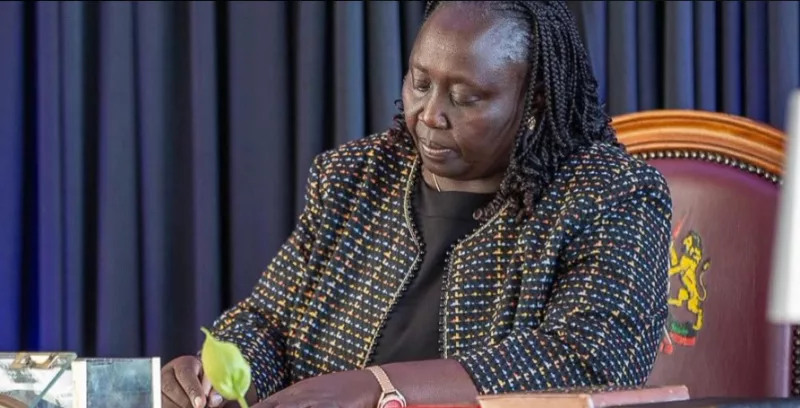
 Gender, Culture and Children Services Cabinet Secretary Hanna Wendot. /X
The government has released Sh850.696 million to 425,348 households caring for orphans and vulnerable children under the Cash Transfer for Orphans and Vulnerable Children (CT-OVC) programme.
Gender, Culture and Children Services Cabinet Secretary Hanna Wendot said the funds covered the July 2026 payment cycle, with each beneficiary household receiving Sh2,000.
The Inua Jamii programme covers several categories of vulnerable Kenyans, including older persons aged 70 and above, persons with severe disabilities and households caring for orphans and vulnerable children.
In a statement on X, Wendot said payment commenced on Tuesday, September 1, through the contracted Payment Service Provider.
“This disbursement covers the July 2026 payment, and each beneficiary household is receiving a sum of Sh2,000. Payment commenced yesterday, Tuesday, 1st September, 2026 through the contracted Payment Service Provider,” she said.
The CT-OVC programme is one of the cash transfer programmes administered under the government's Inua Jamii National Safety Net Programme.
It was launched in 2004 in response to the impact of the HIV/AIDS epidemic, which left many children orphaned or vulnerable.
According to the State Department for Social Protection and Senior Citizen Affairs, the programme is designed to support extremely poor households caring for orphans and vulnerable children while encouraging them to remain within their families and communities rather than being placed in institutional care.
The programme also seeks to promote the development of children by increasing their enrolment, attendance and transition in basic education.
It is intended to improve household food consumption and food security, encourage civil registration of children and caregivers, and strengthen access to services for households dealing with special needs.
Eligibility is targeted at extremely poor Kenyan households with at least one orphan or vulnerable child as a permanent member.
Other qualifying circumstances include households where the caregiver is chronically ill and unable to perform their duties, provided the household is not already benefiting from another social assistance programme, with an exception for households receiving support under the Older Persons Cash Transfer programme.
The household must also have resided in the particular location for more than a year.
The Sh2,000 payment is intended to provide regular income support to vulnerable households.
The government says Inua Jamii transfers are designed to cushion poor and vulnerable people from poverty and improve their welfare.
The State Department says payments to Inua Jamii beneficiaries were shifted from bimonthly to monthly in July 2023.
The government has in recent months also intensified efforts to clean up the Inua Jamii beneficiary register.
A biometric “proof of life” exercise was launched as part of efforts to verify beneficiaries, curb fraudulent payments and ensure that support goes to eligible recipients.
The State Department says beneficiaries are required to prove that they are still alive every six months to continue receiving support.
The verification exercise is part of wider efforts to strengthen accountability in the programme by removing ineligible beneficiaries from the register and ensure that social protection funds reach genuine recipients.
Beneficiaries can access their funds through the State Department's official service information provider by dialing *222#, with an option for transferring funds to the beneficiary's mobile number.
The government has also established grievance and feedback mechanisms for beneficiaries and the public, including the Inua Jamii toll-free number 1533 and programme officers at county and subcounty levels.