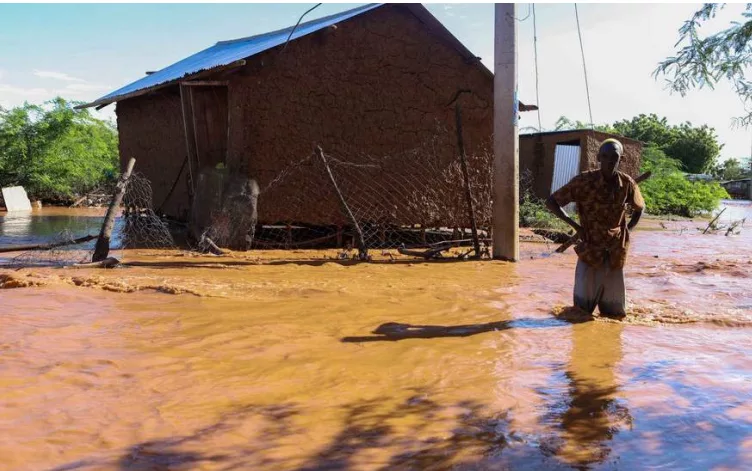
 A man stands next to his flooded house after a heavy downpour in Garissa County. /FILE
Weather experts expect enhanced rainfall across much of Kenya between October and December, with some areas likely to experience above-normal rains extending into January.
However, the Kenya Meteorological Services Authority (KMSA) has sought to ease fears that the anticipated El Nino conditions will necessarily produce rainfall on the scale of the devastating 1997-98 season.
Principal Meteorologist Jemima Gacheru said most parts of the country are expected to receive above-normal rainfall during the October-December period, although the intensity will vary depending on several climatic factors.
"Where we are right now, we haven't reached those thresholds of 1997, but it doesn't mean there will not be rain. It will rain and the rain will be above what we usually experience this season," she said.
Gacheru also sought to dispel the common perception that the presence of El Nino automatically translates into extreme weather conditions and torrential rainfall.
"El Nino will generally bring enhanced rainfall, but not all the time. Since 1997, we've had more than five El Nino events of varying magnitude and if you ask people, many will not remember any of the other five. They will remember 1997 because of the magnitude," she said.
She explained that the eventual impact of El Nino depends on the interaction of different climate systems, particularly conditions in the Indian Ocean.
"So, it doesn't always result in rainfall. It depends on other factors, and key among them is the response of the Indian Ocean," she said.
Gacheru said the Pacific Ocean could be extremely warm without producing the same level of rainfall experienced during the 1997-98 El Nino if the Indian Ocean does not respond in a similar manner.
"When the Indian Ocean responds properly and we get a nice positive Indian Ocean Dipole, then we get those very high values of rainfall that we got like in 1997. So we need Kenyans not to be scared, and afraid and misinformed when they hear El Nino and imagine that it will be very severe."
While meteorologists have sought to put the forecast in perspective, disaster management authorities are preparing for a potentially severe season.
Col Rt David Samoei, Director of the National Disaster Operations Centre (NDOC), said the government was preparing for a worst-case scenario, including widespread flooding, displacement of families, destruction of infrastructure and possible building collapses.
"We are working with worst-case scenario, that there will be floods all over the country. That the rains will be like in 1997, if not even more. Other institutions say this will be the heaviest rain in 50 years," he said.
The NDOC has established a multi-agency response centre at Nyayo House, where agencies meet every Wednesday to assess the situation, identify potential hotspots and coordinate preparations.
Samoei said the authorities were particularly concerned about drowning and aquatic accidents, prompting the training of divers in counties expected to face significant flood risks.
"We are expecting a lot of drowning, a lot of aquatic accidents, so we have trained a lot of divers. We are training at least three from each county that we have been told has a problem," he said.
He said the country was better prepared than in previous emergencies, having conducted several simulations in Naivasha to test disaster response systems.
Counties have also been asked to identify sites that can serve as internally displaced persons' camps for families forced to leave their homes because of flooding.
But Samoei said government preparedness would not be sufficient without individual action, urging Kenyans to monitor weather forecasts and leave areas at risk before conditions deteriorate.
"All of us now need to be like weathermen. If you see a continuous rain of five hours, we need to be cautious. Let's not wait to be told to move out. If you know you're living in a danger zone, move out with your family. If you're driving, put your car aside."
He further called on national and county governments to strengthen mitigation measures, including clearing drainage systems to prevent blockages and evacuating families living along river banks.
Authorities should also identify alternative learning spaces for schools likely to be affected by flooding, he said.
The government has additionally been urged to prepare for possible outbreaks of waterborne diseases and establish mechanisms for the rapid evacuation and airlifting of families who could become marooned by floods.
The Kenya Red Cross has similarly warned of potentially significant humanitarian consequences if the rains intensify.
Maj Rt Venant Ndighila, Head of Disaster Operations at the Kenya Red Cross, said the organisation estimates that about 500,000 people, or 100,000 households, could be displaced, while up to 1.5 million people may be directly affected.
Ndighila said one of the biggest concerns was the failure by some Kenyans to respond appropriately to early warnings, noting that past disasters had shown how quickly flooding could become fatal.
"We still see people trying to cross rivers when it's raining, trying to travel when there's a lot of water on the road," he said.
The Kenya Red Cross is working with more than 400 evacuation personnel and boats to support rescue operations, while also preparing relief materials for displaced families.
"We are putting together materials to be able to support at least 400 households who are going to be displaced," Ndighila said.
He said the country's varied terrain and land topography could further contribute to casualties in flood-prone areas.
The organisation is therefore conducting sensitisation campaigns in villages while issuing early warnings to communities to enable them to prepare and evacuate before flooding occurs.
The experts spoke on Wednesday during a media roundtable at the KMSA.
The overall message to Kenyans was twofold: El Nino should not automatically be equated with a repeat of the catastrophic 1997 rains, but the possibility of intense rainfall and its associated risks warrants serious preparation.