
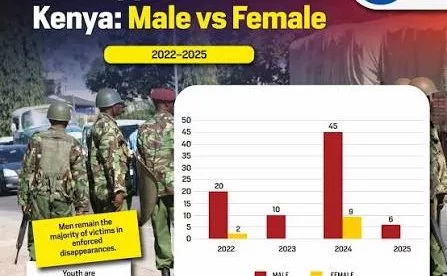
Report on enforced disappearances in Kenya shows men and youth bearing the brunt of the cases between 2022 and 2025
On August 30, as Kenya marked the International Day of the Victims of Enforced Disappearances, Amnesty International Kenya issued a pointed challenge to President William Ruto's administration. The numbers were stark: 19 cases of enforced disappearance and 69 police killings had been recorded in 2026 alone, according to data from the Missing Voices Coalition.
Days later, an editor was abducted by armed men on Tuesday night. He was found alive the following morning near Masinga Dam, over 200 kilometres away, after being dumped by his captors.
While the motive remains unclear, the media house believes the attack is linked to his editorial work scrutinising the state. This is the second time he has been targeted in two months.
Behind the statistics lies a deeper structural failure–one that has turned disappearance into a legally invisible act of state repression.
The central problem is a deliberate legislative omission.
Kenya signed the International Convention for the Protection of All Persons from Enforced Disappearance on February 6, 2007. Nearly two decades later, it has neither ratified nor domesticated the treaty. The result is a legal vacuum: no standalone offence of enforced disappearance exists in Kenyan law.
Prosecutors are forced to rely on offences such as abduction and kidnapping under the Penal Code – charges that do not specifically address disappearances allegedly involving state actors. These carry relatively light sentences, making accountability virtually impossible to achieve. This is not a technicality. It is the legal architecture that enables impunity.
The Missing Voices Coalition has documented 86 cases of enforced disappearance between 2023 and 2026, with disappearances rising by 450 per cent in 2024 alone – from 10 cases to 55. These are not anomalies. They are a pattern.
What makes this pattern particularly corrosive to democracy is that enforced disappearance is designed to function outside the law. The practice places individuals beyond the protection of the law, denying families the right to know the fate of their loved ones, denying courts the jurisdiction to intervene, and denying society the accountability that democratic governance requires.
Enforced disappearances, arbitrary arrests and excessive use of force have a chilling effect on civic participation and undermine the constitutional order. When citizens cannot protest without fear of vanishing, democracy does not merely weaken – it ceases to function.
The political motives behind these disappearances are becoming increasingly clear as Kenya hurtles toward the 2027 General Election. The disappearances target those who speak out – activists, protesters, journalists, government critics. In July 2026, the Committee to Protect Journalists called for an investigation into the attempted kidnapping of a senior journalist that followed angry criticism of his newspaper by President Ruto. The purpose is clear: to instil fear, to silence dissent and to shape the political landscape through intimidation rather than persuasion.
The electoral cycle itself amplifies these dangers. In the pre-poll phase, intelligence gathering and mapping of vulnerable zones – a term preferred over hotspots – becomes critical. But the same intelligence apparatus that maps vulnerability can also be used to target perceived opponents.
During voting, the risk of disappearances shifts from silencing critics to securing outcomes. After results are announced, the mandate shifts to managing celebrations and protests, and it is in this post-election period that disappearances often spike – a pattern observed after the 2022 elections, when those who protested the outcome became targets.
The impact on victims' families is devastating, compounded by silence born of fear. Political allegiance dictates who gets targeted, and that same allegiance can stigmatise families, making them reluctant to speak out. Families face a double burden: the agonising uncertainty of not knowing what happened to their loved ones, and the fear that speaking out will invite further retaliation. The silence of victims after release reflects trauma rather than proof that no abuse occurred.
Yet there are legal remedies available, though they are imperfect and difficult to enforce. The writ of ‘habeas corpus’ requires any person suspected of unlawfully detaining another to produce them before court and justify the legality of their detention. The High Court has increasingly relied on habeas corpus proceedings to compel state agencies to account for missing persons.
But habeas corpus has limits. It requires families to have resources to go to court. It requires courts to act swiftly – which does not always happen. And it requires the state to comply – which, as the Mathare case showed, is not guaranteed. Families also face the challenge of proving state involvement, made difficult by unmarked vehicles, plain-clothed officers and the deliberate obliteration of paper trails.
Legal experts and civil society have urged Parliament to enact a law specifically criminalising enforced disappearances and to ratify the International Convention. Stakeholders, including the Office of the Director of Public Prosecutions, agreed as early as 2021 that enforced disappearance should be criminalised. Yet no legislation has been introduced.
Beyond legislation, experts have emphasised the need to apply the doctrine of command responsibility – holding senior officers accountable for crimes committed by subordinates they knew or should have known about.
Without a law that names enforced disappearance as a crime, without ratification of the convention Kenya signed nineteen years ago and without accountability that reaches the highest ranks of the security apparatus, the state retains the power to make citizens disappear – not just from their families, but from the law itself. That is not governance. That is the legalisation of repression through omission.