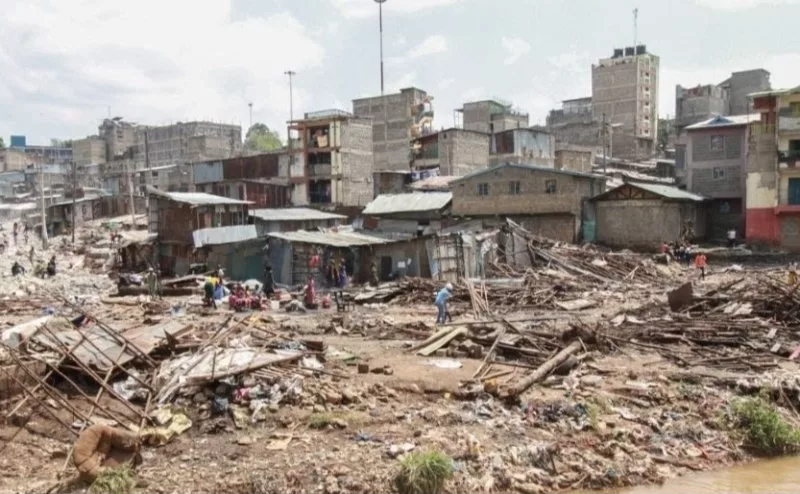
File photo of demolitions targeting buildings and structures in riparian lands in Nairobi /FILE
For families in Mathare 3A, the sound of heavy machinery along the Mathare River corridor was more than the noise of demolition.
It marked the demolition of homes along the river, disrupting livelihoods in its wake and leaving behind families struggling to rebuild.
More than half of the households whose homes were demolished now survive on less than Sh5,000 a month, an impact assessment by the Mathare Social Justice Centre (MSJC) has found.
The survey involved 123 households in Bondeni, Kambisafi and Mathare 3A proper and was conducted in July 2026, The findings paints a picture of families pushed deeper into poverty after demolitions that began in 2024 and continued into 2025.
The proportion of households earning less than Sh5,000 a month rose from 33.3 per cent before the demolitions to 54.5 per cent after. Those earning Sh20,000 or more fell from 14.6 per cent to just 5.7 per cent.
Another 5.7 per cent reported having no income at all after their homes were demolished.
The economic shock was felt across households already living on the margins.
Sixty per cent of those surveyed were female-headed households, while women made up 71.5 per cent of respondents.
Together, the households had 208 children under 18.
Nearly 79 per cent lived in mabati structures and 91.1 per cent were tenants.
For many, the demolition was not a first encounter with displacement as 71.5 per cent said they had experienced at least one previous demolition.
One resident recalled the shock of the operation. It (the demolition) caught us off guard. They came while we were sleeping.”
The assessment also raises questions about how the demolitions were carried out.
Only 4.9 per cent of households said they received written notices before their homes were demolished. A further 29.3 per cent received verbal warnings, while 61.8 per cent said they received no notice at all.
Only 5.7 per cent reported any consultation with government authorities before the demolitions, while court orders were shown to just 4.9 per cent of residents.
No compensation was offered for destroyed property, lost assets or relocation costs, the report says.
The destruction went beyond homes.
Water sources and sanitation facilities were destroyed for 91 per cent of households.
Residents were left struggling to access basic services.
"Lack of adequate toilets means we are forced to use public facilities which are not safe,” a respondent said
Children were also affected.
School dropout reached 11.9 per cent, with families
citing destroyed uniforms and books, displacement far from schools and the loss
of income needed to meet education costs.
One respondent said the impact had spread throughout the community as many children dropped out of school. Another said their children had started sleeping on the floor.
The strain also deepened gender-related vulnerabilities. Some 45.5 per cent of households reported an increase in domestic violence, sexual exploitation and harassment after the demolitions.
Meeting spaces used for women’s organising were lost or displaced for 37.4 per cent of households.
For some families, the psychological and physical toll still lingers.
One respondent said they had never recovered and had been surviving on medication for high blood pressure.
Yet amid the hardship, the report found a measure of resilience. About 75.6 per cent of residents said they still had the capacity to organise collectively.
The findings call for an immediate halt to demolitions, genuine public participation, compensation for losses and alternative accommodation before displacement takes place.
In November 2024, the High Court declared forced
evictions in Mathare and other Nairobi informal settlements illegal and unconstitutional
and ordered compensation for displaced residents.
In March 2025, President William Ruto directed a halt to evictions on public land until affected families were provided with alternative housing.
Despite the directive, demolitions along the Mathare River corridor continued into 2025.
The Nairobi Rivers Commission has issued more than 300 enforcement notices targeting structures on riparian land, with enforcement expected to expand into the Mathare River corridor.
Commissioner Mumo Musava said affected residents had been given an opportunity to respond to the notices before any demolition.
The MSJC survey, however, found that 94.3 per cent of Mathare 3A residents had received no consultation.
Human Rights Watch and other organisations have criticised the government response, particularly the absence of proper resettlement plans.
Between March and April 2025 alone, more than 6,000 households were forcibly evicted from Mathare and Mukuru Kwa Njenga informal settlements.
The government offered Sh10,000 per household in rental assistance, an amount many residents considered inadequate.
MSJC said the experience raises questions about development and displacement especially what happens to people when the pursuit of a cleaner river corridor comes at the cost of their homes and livelihoods?
Residents have asserted their agency through a petition challenging the legality and constitutionality of the ongoing evictions. They called for a development process grounded in housing rights, dignity, public participation and justice. Their message is simple: Mathare is not vacant land. It is home.
Instant analysis
The Mathare demolitions expose the human cost of displacement without meaningful safeguards. The sharp rise in households surviving on less than Sh5,000, coupled with disrupted schooling, sanitation and livelihoods, shows that demolitions deepen poverty rather than solve urban challenges. Despite court orders and government directives, residents say evictions continued without adequate consultation or compensation. The findings strengthen calls for rights-based redevelopment that protects dignity, participation and livelihoods.