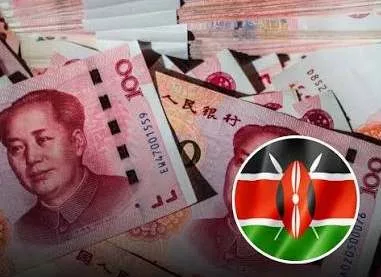
 Kenya-China debt.
Kenya’s relationship with China has become an important pillar of the country’s development journey.
From infrastructure to trade and investment, China has supported projects that continue to shape Kenya’s economic prospects.
Yet, the discussion around Kenya’s Chinese debt is often clouded by the claim that Beijing has deliberately placed Kenya in a “debt trap”. The available evidence presents a more complicated picture.
The global debt environment itself provides an important reminder that debt pressures are not unique to developing countries or to Chinese lending.
A recent Financial Times report highlighted how rising bond yields have added billions of dollars to the debt-financing costs of the Group of Seven (G7), the world’s leading advanced economies.
Since the beginning of the US-Iran war in February, higher borrowing costs have added about $16 billion to G7 debt-financing expenses, with another $34 billion potentially being added by the first quarter of 2027 if current trends continue.
The significance for Kenya is clear.
Debt sustainability is influenced not only by who lends money but also by global interest rates, currency movements, inflation, investor confidence and the cost of refinancing.
Even the wealthiest economies are facing increased pressure as higher yields make government borrowing more expensive.
Japan, for example, has seen its 10-year government bond yield reach 3 per cent, its highest level since 1996, amid concerns over inflation and fiscal pressures.
Against this backdrop, Kenya’s debt position should be assessed on its own facts rather than through a narrative that automatically attributes the country’s fiscal difficulties to China.
As at June 2026, Kenya’s total external debt stood at Sh5.68 trillion. Multilateral creditors accounted for Sh3.10 trillion, while commercial creditors accounted for Sh1.54 trillion.
Kenya’s debt to China stood at Sh616.8 billion, representing about 10.8 per cent of total external debt.
By comparison, Kenya owed the World Bank Sh1.70 trillion, equivalent to approximately 29.8 per cent of external debt.
These figures provide important context. Kenya’s debt challenge is not primarily a Chinese debt problem.
A significant proportion of the country’s external obligations is owed to multilateral institutions, particularly the World Bank and the International Monetary Fund.
Therefore, reducing Kenya’s debt situation to a narrative about Chinese lending ignores the wider structure of the country’s obligations.
More importantly, Kenya’s recent arrangement with China demonstrates the value of constructive bilateral cooperation.
In July 2025, the Export-Import Bank of China and Kenya’s National Treasury signed supplementary agreements converting three US dollar-denominated SGR loans into Chinese yuan. Kenya is now servicing these loans in yuan rather than dollars.
This initiative by Beijing should be understood within the broader objective of building a community with a shared future.
It is an example of China responding to the circumstances of a partner country and seeking a practical solution that can ease financial pressure.
By changing the currency of repayment, the arrangement helps Kenya reduce its exposure to fluctuations in the US dollar and manage pressure on its foreign-exchange reserves.
The financial implications are also considerable. Estimates indicate that Kenya could save approximately Sh27.8 billion annually in debt-servicing costs.
At a time when the country is managing significant fiscal pressures, such savings can provide valuable room for other national priorities.
The arrangement also challenges the simplistic assumption that Chinese lenders are interested only in recovering their money without regard to the economic circumstances of their partners.
The decision to restructure the SGR loans followed consultations between the two countries and demonstrated a willingness to find mutually beneficial solutions.
The broader international debt picture makes this even more relevant. The experience of the G7 shows that debt servicing can become more expensive even where countries have sophisticated financial systems, strong currencies and deep domestic capital markets.
Higher bond yields are translating directly into increased financing costs for advanced economies, demonstrating that debt vulnerability is shaped by changing global financial conditions as much as by the identity of an individual creditor.
For Kenya, the lesson should be to focus on the quality, cost and economic returns of borrowing rather than attaching the debt debate to a single country.
There is also another important part of the SGR story that deserves greater attention: the railway has made tremendous progress in generating revenue.
The debate about the project should therefore not focus exclusively on the amount borrowed to construct it. Its contribution to passenger movement, cargo transportation, trade and connectivity must also be considered when assessing its overall value to Kenya.
Infrastructure should be judged over the long term. Railways, roads, ports and energy projects create value not only through direct revenue but also by reducing transportation costs, connecting markets and supporting economic activity.
The SGR has become an important component of Kenya’s transport network and continues to play a role in facilitating the movement of people and goods.
This is particularly important when considering the developmental circumstances under which Kenya borrowed for infrastructure.
Developing economies often require large amounts of capital to close infrastructure gaps, improve connectivity and expand productive capacity.
The question should therefore not simply be how much was borrowed, but whether the resulting assets contribute to economic growth sufficient to justify their financing costs.
China’s engagement with Kenya should consequently be viewed within this broader development context.
Chinese financing has supported infrastructure that Kenya required to expand its economy, while the recent debt adjustment shows that Beijing is prepared to cooperate with Kenya in addressing emerging financial challenges.
This does not mean Kenya should borrow without discipline. Responsible debt management remains essential, regardless of whether the creditor is China, the World Bank, the IMF or a commercial lender.
Kenya must ensure that borrowed resources are used efficiently, projects are properly implemented and investments generate sufficient economic and social returns.
At the same time, the G7 experience demonstrates why simplistic distinctions between “good” and “bad” creditors can obscure the real economics of debt.
Advanced economies with enormous financial resources are themselves confronting rising debt-service costs because of higher interest rates, inflationary pressures, geopolitical uncertainty and increased competition for capital.
Kenya therefore needs a more mature conversation about debt.
The country should examine the terms attached to every loan, the purpose for which the money is borrowed, the revenue or economic activity generated by the investment and the long-term implications for public finances.
Scrutiny should be based on facts rather than narratives designed to portray China negatively. The figures show that Kenya’s largest external obligations are not owed to China.
At the same time, China has demonstrated flexibility by helping Kenya convert SGR debt from dollars into yuan, potentially reducing repayment costs and foreign-exchange pressure.
The Kenya-China relationship should therefore be approached as a partnership rather than through suspicion. Both countries have an interest in economic growth, stability and shared prosperity.
The yuan-denominated SGR repayment arrangement is a practical example of this cooperation and of Beijing’s willingness to work with Kenya in responding to changing financial circumstances.
The emerging global debt pressures facing the G7 offer another important lesson. No economy, regardless of its wealth or financial sophistication, is completely insulated from changes in the international cost of capital.
For Kenya, this makes prudent borrowing, productive investment and effective debt management more important than ever.
Kenya should continue strengthening its partnerships while maintaining sound financial management. The objective should not be to choose between development partners, but to work with partners who contribute to Kenya’s long-term development.
China has demonstrated its willingness to stand with Kenya in both development and debt management, and that contribution deserves recognition.
The writer is a Policy Analyst