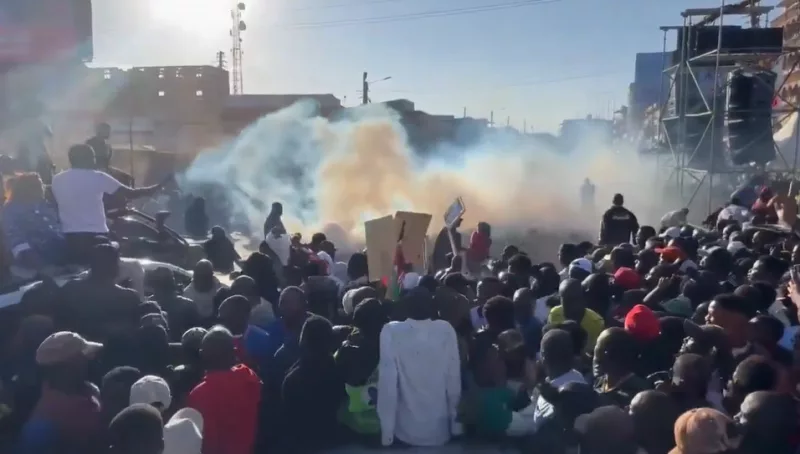
 Linda Mwananchi rally teargassed in Makutano Town during rally in Meru county on Sunday, August 30, 2026. /SCREENGRAB
The Constitution performs two equally important functions: it restrains power and protects citizens from its abuse.
It distributes authority, establishes checks and balances, protects fundamental freedoms and provides remedies against violations.
This was part of President William Ruto’s preamble in his short but impactful speech at the Kenyatta International Convention Centre (KICC) as the country gathered to commemorate the 16th Katiba Day on Thursday, August 27.
In keeping with the theme of the occasion, Ruto’s statement centred on the key role of the supreme law — managing the exercise of power and requiring those in authority to, among other obligations, protect the rights of citizens.
“Our responsibility is to uphold both obligations: power must be managed and rights must be assured. These are not ornamental provisions placed in our Constitution. They are fundamental rights,” Ruto said.
The President recalled the events of the 2024 Gen Z-led anti-government protests, acknowledging that the State faltered in its response.
He said the right to protest, as enshrined in Article 37 of the Constitution, was not fully protected as young Kenyans and other citizens exercised their constitutional freedoms to speak out and demand greater accountability.
“Those demands were not an assault on democracy. Peaceful protest, criticism and dissent are essential to democracy,” Ruto said.
“To my mind, therefore, the ultimate test of constitutional implementation is not how often we quote the Constitution or invoke constitutionalism. It is how closely the daily experience of the citizen reflects the promise of the Constitution.”
Against this backdrop, the President ordered investigations into human rights violations and said that, where wrongdoing was established, those responsible should be held accountable within the law.
“No Kenyan should lose their life, liberty, or dignity merely for criticising the government, expressing an unpopular opinion or participating in a peaceful demonstration,” Ruto said.
The remarks were widely interpreted as a commitment by the President that his administration would not allow the suppression of free speech, dissent or divergent political opinion.
But barely three days after the remarks, Siaya Governor and one of the leading United Opposition principals, James Orengo, and his convoy were attacked on Saturday, August 29, during a Linda Mwananchi political tour in Migori county.
The incident mirrored the August 16 attack on the faction’s convoy in Homa Bay county, which sparked outrage and condemnation after lives were lost and scores of people injured.
Unidentified individuals hurled teargas canisters into the crowd while Orengo was addressing a roadside gathering, forcing him to cut short his speech and retreat to his vehicle.
As the convoy left, suspected goons attacked the vehicles, fired live bullets and torched one of the cars linked to the team.
Orengo later termed the incident an assassination attempt.
Speaking in response to the Homa Bay violence, Interior Cabinet Secretary Kipchumba Murkomen absolved the government of blame, arguing that the Linda Mwananchi team had ignored police intelligence warnings to reschedule its rally.
Murkomen also blamed the political class for creating a non-existent “goon crisis”, insisting that the country was safe.
“There’s no crisis in Kenya, Kenya is safe. Stop hyping, stop the hyperbole, stop creating a crisis that is not there, it’s a figment of your imagination,” Murkomen said on August 21.
He described the chaos as an exaggerated dispute confined to the political class rather than ordinary citizens.
The remarks drew public outrage, with leaders allied with the Linda Mwananchi faction arguing that citizens have a constitutional right to freedom of movement and assembly anywhere in Kenya, and that security agencies have a duty to protect them rather than warn them to avoid danger zones.
The leaders questioned why police were not moving in to arrest suspected goons if they had prior information about their presence, instead of merely warning citizens about the criminals.
Ruto’s remarks at Katiba@16 had offered a glimmer of hope that the government would, going forward, guarantee the protection of all Kenyans exercising their constitutional rights regardless of their political affiliation.
But just a day after Orengo’s convoy was attacked, the Linda Mwananchi brigade led by Nairobi Senator Edwin Sifuna encountered another hostile reception in Meru county on Sunday.
After travelling to the county without incident, the Linda Mwananchi rally was disrupted at Makutano in Meru Town when a teargas canister was lobbed into the gathering.
While the government has explicitly distanced itself from teargas disruptions at opposition rallies, questions remain over how the highly controlled devices, which are reserved for situations requiring the restoration of public order, continue to find their way into the hands of civilians.
Questions also remain about who fired bullets as Orengo's convoy sped away on Saturday.
The Interior Ministry has maintained that if a rally remains genuinely peaceful and orderly, police have no reason to intervene.
That position places the responsibility squarely back on the President, who, as Commander-in-Chief of the Kenya Defence Forces, bears the ultimate responsibility for the direction of the national security apparatus.
Speaking at the KICC in the context of protecting the right to protest, Ruto said there must be a distinction between defending the rights of peaceful protesters and excusing crimes committed under the cover of protest.
“We must, therefore, distinguish carefully between a citizen exercising a constitutional right and an individual committing a criminal offence,” he said.
The question, therefore, is where that distinction is drawn in practice.
At what point does repeated violence, disruption and the use of teargas at opposition rallies cease to be isolated criminal conduct and become a failure by the State to protect citizens exercising their constitutional rights?
More fundamentally, if the government acknowledges that peaceful protest, criticism and dissent are essential to democracy, what threshold of “goonism” must be reached before the State acts to protect those rights rather than merely warn citizens against exercising them?