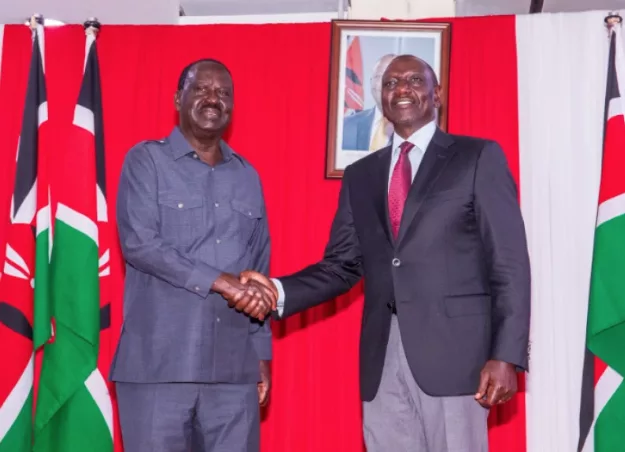
 The late former Prime Minister Raila Odinga and President William Ruto shake hands after signing cooperation agreement at KICC on March 7, 2025/FILE
The formation of the broad-based government between President William Ruto and the late former Prime Minister Raila Odinga triggered far-reaching changes in Kenya’s political and governance landscape.
It altered the balance of power in the Executive and Parliament and eased tensions that had gripped the country following the Gen Z-led protests.
The political arrangement emerged in the aftermath of the nationwide youth-led protests of mid-2024, which placed the Kenya Kwanza administration under intense pressure and forced a major rethink of Ruto’s government.
The protests, initially sparked by opposition to the Finance Bill 2024, evolved into a wider expression of public anger over governance, the cost of living, corruption and demands for greater accountability.
In the wake of the protests, Ruto dissolved his Cabinet and embarked on a political reorganisation that culminated in the inclusion of prominent figures from the opposition ODM party in his administration.
Ruto described the new arrangement as a partnership intended to unite the country and ensure that no section of Kenya felt excluded from government.
“This broad-based government is neither a creation of Baba nor myself; it is God-sent,” Ruto said, referring to Raila by his popular moniker.
“The formation of the broad-based government was a deliberate and intentional act. The aim was to ensure that no Kenyan feels excluded and to move the nation forward together.”
For Raila, the decision to cooperate with Ruto was initially contentious within ODM and was not an arrangement he readily embraced.
Raila acknowledged that he and other members of his political camp had initially opposed the idea of joining the administration.
“I myself was against it, and my other colleagues also, but then eventually the group within my party felt that the stalemate we had required that some experts who are not part of the Kenya Kwanza regime can go into government and see how they can help steady the ship and come up with new ideas to deal with issues in contention,” Raila said.
The political cooperation between Ruto's United Democratic Alliance (UDA) and Raila's Orange Democratic Movement (ODM) was subsequently formalised through a political framework agreement signed at the Kenyatta International Convention Centre (KICC) in Nairobi.
The agreement fundamentally altered the relationship between the ruling party and the opposition, with prominent ODM figures moving into senior positions in government.
Among the most significant consequences of the arrangement was Ruto's decision to appoint several senior ODM politicians to his Cabinet following the dissolution of his previous administration.
John Mbadi, then ODM national chairman and former nominated MP, was appointed Cabinet Secretary for the National Treasury and Economic Planning.
Former National Assembly Minority Leader and Ugunja MP James Opiyo Wandayi was appointed Cabinet Secretary for Energy and Petroleum.
Former ODM deputy party leader and former Mombasa Governor Ali Hassan Joho took charge of the Ministry of Mining, Blue Economy and Maritime Affairs.
Former ODM deputy party leader and former Kakamega Governor Wycliffe Ambetsa Oparanya was appointed Cabinet Secretary for Co-operatives and Micro, Small and Medium Enterprises Development.
Beatrice Asukul Moe was subsequently brought into the administration as Cabinet Secretary for the East African Community and Regional Development.
The appointments effectively brought some of Raila's key political allies into the Executive, transforming the traditional government-opposition relationship into one characterised by cooperation and power-sharing.
The changes, however, also created new vacancies and triggered a chain of leadership adjustments within ODM and Parliament.
The appointment of Oparanya and Joho to Cabinet meant that the two had to relinquish their positions as ODM deputy party leaders.
The party subsequently moved to fill the vacancies while also expanding the number of deputy party leaders from two to three.
Mombasa Governor Abdulswamad Nassir, Kisii Governor Simba Arati and Vihiga Senator Godfrey Osotsi were appointed as deputy party leaders.
Osotsi was later removed from the position, adding another layer to the leadership changes that followed the broad-based arrangement.
The changes demonstrated how the agreement with Ruto had begun reshaping ODM itself, forcing the party to balance its traditional opposition role with participation in government.
Homa Bay Governor Gladys Wanga also took over as ODM national chairperson from Mbadi after his appointment to Cabinet.
The movement of ODM leaders into Cabinet also had consequences beyond party structures.
Wandayi's appointment as Cabinet Secretary for Energy and Petroleum resulted in the declaration of his Ugunja parliamentary seat as vacant.
Under the Constitution, an elected MP vacates the seat upon assuming certain State offices, including a Cabinet position.
The vacancy triggered a by-election in Ugunja Constituency, providing one of the first direct electoral consequences of the new political arrangement.
Moses Omondi subsequently won the by-election and succeeded Wandayi as the MP for Ugunja.
The contest also offered an early test of the political strength of the new alliance and the ability of the parties involved to translate their cooperation at the national level into electoral support on the ground.
The broad-based arrangement also produced significant changes in parliamentary leadership.
Following Wandayi's departure from Parliament, ODM nominated Junet Mohamed to take over as National Assembly Minority Leader.
Junet had previously served as Minority Whip.
Millie Odhiambo subsequently assumed the position of Minority Whip, replacing Junet.
The changes altered the leadership structure of the opposition side of the National Assembly and reflected the wider political adjustments taking place within Parliament.
House committees were also affected by the changing political landscape.
Butere MP Tindi Mwale took over as chairperson of the Public Accounts Committee after Mbadi left the position in July 2024 to take up the Treasury Cabinet portfolio.
The Budget and Appropriations Committee also underwent a leadership change, with Alego Usonga MP Samuel Atandi taking over as chairperson under the broad-based arrangement.
The changes meant that the political deal between Ruto and Raila was not confined to Cabinet appointments but extended into Parliament, where committee leadership is central to scrutiny of government expenditure, legislation and policy.
The broad-based government represented a significant departure from the intense political confrontation that had characterised the period immediately preceding its formation.
The Gen Z protests had brought the government under unprecedented pressure and contributed to a political environment marked by heightened tensions between the administration and its critics.
The subsequent Ruto-Raila cooperation provided a platform for political accommodation, bringing together leaders who had previously occupied opposing sides of the political divide.
The arrangement also changed the opposition landscape, as ODM's participation in government complicated the traditional distinction between the ruling party and opposition.
The arrangement created new political contradictions as some opposition figures and supporters resisted cooperation with Ruto.
The alliance consequently reshaped political loyalties, generated new factions and set the stage for further realignments ahead of the 2027 General Election.