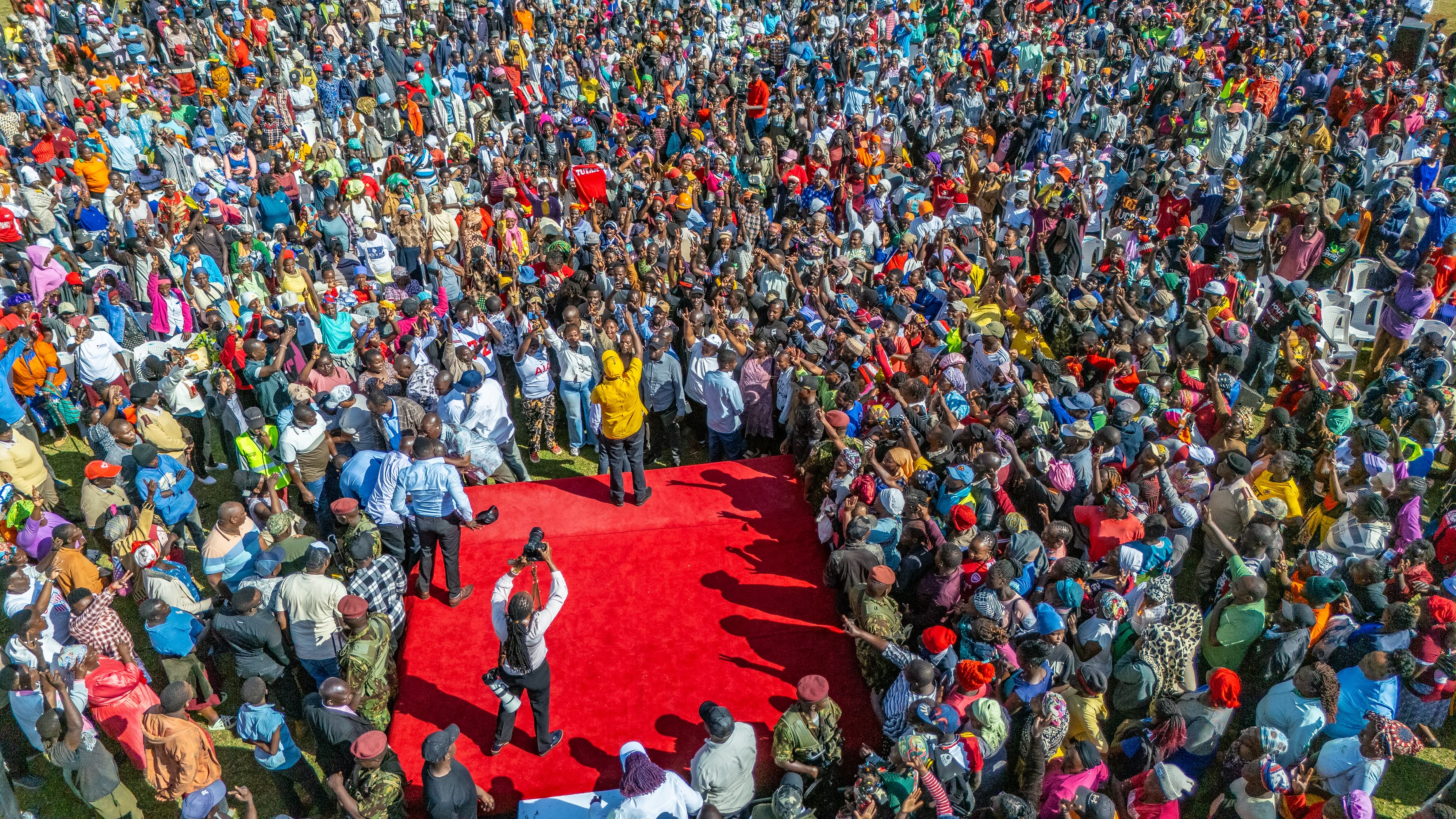
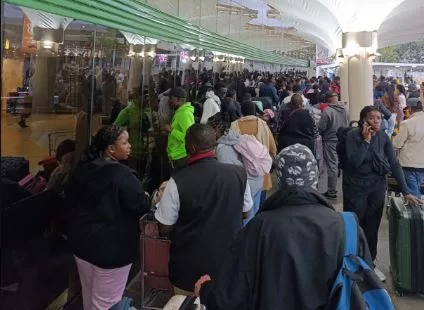
 Some of the stranded passengers at JKIA./SCREENGRAB
Thousands of travellers faced uncertainty at Jomo Kenyatta International Airport (JKIA) on Monday as a go-slow by aviation workers entered its second day, triggering lengthy flight delays, cancellations and missed connections.
The industrial action, called by the Kenya Aviation Workers Union (KAWU), began on Sunday after the union accused key aviation agencies of failing to honour commitments made under an earlier agreement that had temporarily suspended a planned strike.
The disruption has affected operations at JKIA and other airports, leaving passengers stranded for hours and forcing airlines to reschedule flights as authorities race to clear a growing backlog.
Kenya Airways said some of its flights were experiencing delays of more than six hours due to the disruption.
The airline advised passengers to confirm their flight status before travelling to the airport, saying customers wishing to reschedule their journeys would not face penalties.
The strike has raised a major question for travellers: what exactly happens when a flight is delayed or cancelled?
Under normal circumstances, passengers whose flights are delayed are expected to receive information from their airline about the status of their journey. However, the assistance offered can depend on the length of the delay, the reason for the disruption and the airline's conditions of carriage.
In the case of the current JKIA disruption, airlines are largely attempting to manage passengers by rescheduling flights and clearing the backlog once airport operations stabilise.
A passenger whose flight is delayed may be placed on the next available flight, while those facing cancellations may be rebooked onto another service. Where disruptions stretch for several hours or overnight, airlines may, depending on the circumstances, provide meals, accommodation or transport.
Reports from JKIA on Monday indicated that some airlines had begun moving passengers who spent the night at the airport to hotels as they awaited further updates.
The situation is particularly complicated for travellers with connecting flights.
A passenger flying from Nairobi through another international hub, for example, may miss their onward connection because of a delay at JKIA.
Where the entire journey is booked under one ticket, airlines will generally seek to rebook the passenger on the next available connection.
However, passengers travelling on separate tickets may face greater difficulty, particularly if a missed connection is not covered under the original booking arrangement.
For travellers, the most important immediate step is to avoid making assumptions about the status of a flight.
Kenya Airways on Monday urged passengers to travel to the airport only after confirming that their flights were operating.
The airline said: “Some flights have subsequently been rescheduled due to the flight backlog occasioned by the ongoing strike.”
It added that passengers should ensure their contact details were updated to enable them to receive notifications on changes to their flights.
For passengers seeking refunds, KQ says customers whose flights are delayed for more than eight hours and who choose not to travel may apply for a refund.
The national carrier also allows affected passengers to rebook their journeys without penalties, subject to the conditions communicated for the disruption.
“ Affected passengers may request a full refund for wholly unused tickets, while those who have partially completed their journeys will be refunded the unused portion of the ticket, less the prorated value of the journey already travelled. All refund penalties have been waived, and passengers have until September 20, 2026, to submit their refund requests," it says.
Travellers have been advised to retain their booking details and receipts for any expenses incurred while awaiting further guidance from their airlines.
The Kenya Airports Authority (KAA) has also acknowledged the disruption and said it was working with aviation agencies and airlines to minimise the impact.
“KAA is working closely with the relevant aviation agencies, airlines and other stakeholders to manage the situation, minimise disruption and facilitate the smooth flow of airport operations,” the authority said.
But for many passengers, the immediate concern has been the lack of certainty over when they will eventually leave.
Some travellers arriving at JKIA on Sunday said they had received little or no warning before reaching the airport, only to find their departure times pushed forward by several hours.
One passenger, Glen Omindu, who was scheduled to travel to Dubai, said travellers were left waiting without clear information on when their flight would depart.
“There was no warning and that’s the problem. The flight was for 1pm and we are yet to be told when we will leave,” he said.
Another passenger, Faith Mbugua, said her flight had initially been scheduled for 1pm but was later pushed to 8.50pm.
“We are very frustrated. We were here at 10am and were told that there is a strike. The flight has since been scheduled for 8:50pm tonight,” she said.
The current crisis stems from unresolved labour disputes involving workers represented by KAWU at the Kenya Airports Authority, Kenya Civil Aviation Authority and Jambojet.
KAWU Secretary-General Moss Ndiema said the union had resumed the industrial action after an earlier back-to-work formula failed to resolve the outstanding grievances.
“We did sign a back-to-work formula but, unfortunately, KAA and KCAA failed to meet our demands,” Ndiema said.
“They have never committed to the negotiations and have failed to cooperate and show effort in resolving our grievances. We therefore lifted the suspension on the strike.”
The dispute includes concerns over a collective bargaining agreement, remuneration, welfare and working conditions.
RwandAir cancelled two Nairobi-bound flights on Sunday due to air traffic control challenges, illustrating how the disruption at JKIA is spilling beyond Kenya's borders and affecting regional travel schedules.
JKIA is a critical aviation hub for East Africa, meaning prolonged disruption can quickly trigger a chain reaction across the region as aircraft, crews and passengers fall behind schedule.
For now, passengers have been advised to remain in close contact with their airlines, monitor messages and avoid travelling to the airport before receiving confirmation that their flights are operating.
With negotiations between KAWU and government officials continuing, thousands of travellers remain caught in uncertainty as airlines struggle to restore normal schedules and clear the mounting flight backlog.
The longer the strike continues, the greater the risk that what began as delays of a few hours could develop into days of disrupted travel, missed connections and cancelled journeys.