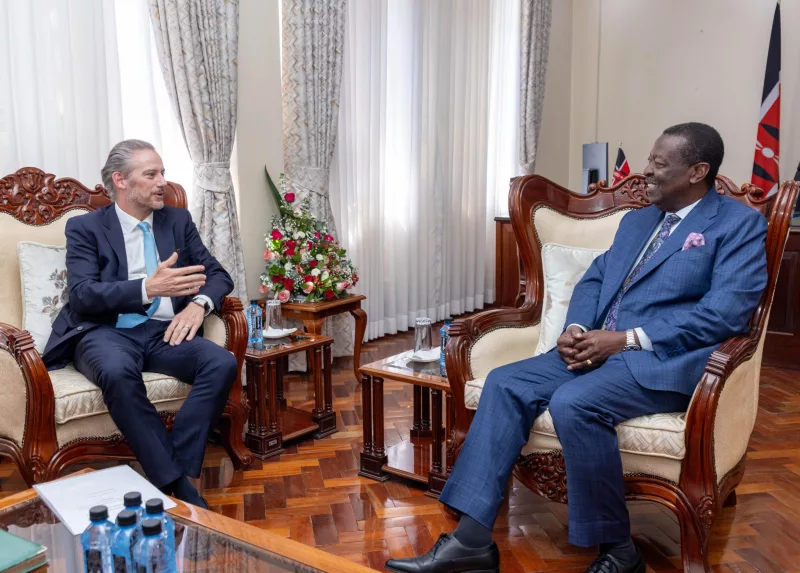
Speaking to the Star, he rejected suggestions that Nairobi is punching below its weight, arguing that Kenya's influence extends beyond traditional diplomacy into trade, finance, business and its willingness to take on international responsibilities.
“Kenya's influence is built through its economic strength. In the long term, economic relationships build communities and influence,” he said.
His assessment comes at a time when Kenya's traditional role as a regional mediator has faced difficult tests, particularly in Sudan and South Sudan, while political and security crises have weakened several of the countries that historically gave the region diplomatic weight.
Suquet, however, cautioned against judging Kenya too harshly for the limited progress in some of the peace initiatives.
“When I look at mediation efforts in Sudan, I don't see something that is really working. But I would not blame Kenya too much. At least Kenya has tried,” he said.
He noted that the regional environment itself had changed, with countries that previously played leading roles in resolving regional conflicts facing their own political and security challenges.
Ethiopia, which he described as having once been a regional powerhouse, is also dealing with its own challenges, making collective efforts to address conflicts more difficult.
“I think it is difficult to say that Kenya has failed. Kenya is trying,” he said.
Kenya's decision to deploy police officers to Haiti was another example of the country's willingness to take on responsibilities beyond its immediate neighbourhood, the ambassador said.
He described the deployment as a significant political statement, particularly given Kenya's own domestic security challenges.
Kenya's regional influence, Suquet argued, should, therefore, not be measured solely by whether its mediation efforts produce immediate political settlements.
The country's economic footprint, financial sector, private companies and role in international institutions also contribute to its ability to influence events beyond its borders.
France itself views Kenya as an important regional hub. According to France's foreign ministry, Kenya is seen as a gateway to East African markets because of its logistics, financial and legal services and relatively open private sector. About 120 French businesses operate in Kenya.
The two countries have also been deepening their strategic cooperation.
In October last year, Kenya and France signed a Defence Cooperation Agreement, covering areas including intelligence sharing, maritime security, peacekeeping, training and humanitarian assistance.
Suquet said France's approach to security cooperation in Africa is changing, with Paris seeking partnerships rather than the permanent military presence associated with its past engagement on the continent.
He said France was particularly interested in cooperation with Kenya on maritime security and information sharing, reflecting the country's strategic position in the Indian Ocean.
The ambassador's defence of Kenya's regional role comes against the backdrop of France itself seeking to redefine its relationship with Africa after setbacks in parts of West Africa.
France has faced a series of reversals in former colonies, including the withdrawal of its military forces from several Sahel countries. The shift prompted Paris to place greater emphasis on partnerships with countries such as Kenya, which hosted the Africa Forward Summit in May.
Reuters described the summit as part of France's efforts to deepen ties elsewhere on the continent after losing influence in parts of West Africa.
The Nairobi-Paris relationship has increasingly expanded beyond traditional development cooperation into trade, investment, research, climate action, innovation and security.
The Kenya-EU Economic Partnership Agreement has also opened duty-free and quota-free access for Kenyan exports to the European market, while tariffs on European imports are being phased down over 25 years.
Suquet's assessment, therefore, places Kenya's diplomatic influence within a broader network of economic and strategic relationships.
Rather than viewing Nairobi's influence solely through its success in mediating individual conflicts, the envoy suggested that its economic reach and willingness to participate in international efforts remain important sources of power.
For a region facing multiple conflicts and political transitions, however, Kenya's ability to convert that influence into concrete diplomatic outcomes will remain under scrutiny.
Its mediation efforts in Sudan and South Sudan face formidable challenges, while the country's own political and economic pressures could constrain its ability to sustain an ambitious regional role.
But according to Suquet, the setbacks should not obscure Kenya's broader position.
His assessment comes as Kenya is seeking to maintain its position as a diplomatic hub in East Africa, while expanding its economic and strategic partnerships with Europe and other global powers.