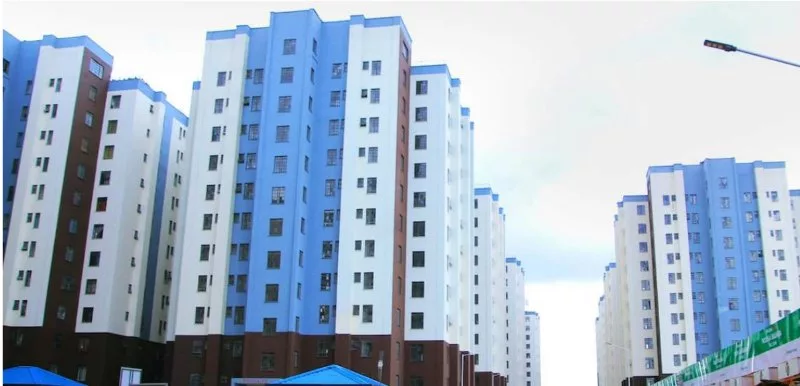
 Mukuru housing project /EZEKIEL AMING’A
When President William Ruto campaigned for office in 2022, affordable housing was one of the flagship promises of his Bottom-Up Economic Transformation Agenda.
The plan was ambitious: construct 250,000 homes every year, expand access to homeownership for low- and middle-income Kenyans and create jobs across the construction value chain.
In December 2022, Ruto said the government's goal was to build 250,000 houses annually for low-income earners.
“This transformative Plan goes beyond the provision of affordable housing units to presenting opportunities for gainful employment and wealth creation to millions of Kenyans struggling to put food on the table,” the President said.
Four years into his presidency, the programme has recorded growth in construction activity, although a substantial gap remains between the number of homes completed and Ruto's original annual target of 250,000 units.
Official data from the Kenya National Bureau of Statistics (KNBS) shows that 6,738 housing units were completed by the State Department for Housing and Urban Development in 2025, up from 1,655 units the previous year.
The increase of 5,083 units marked a significant rise in the programme's output. The value of completed units also rose from Sh4 billion in 2024 to Sh8.4 billion in 2025.
KNBS said the growth was largely driven by projects completed under the State Department for Housing and Urban Development (SDHUD).
“The increase was largely driven by the completed projects under the SDHUD which stood at 6,738 housing units valued at Sh7.2 billion in 2025 compared to 1,655 units valued at Sh4 billion in 2024,” the bureau said.
The National Housing Corporation accounted for another 410 units valued at Sh941 million, bringing the total number of residential units completed during the year to 7,148.
The figures point to progress in actual delivery. However, against the original annual target of 250,000 homes, the number of completed units remains minimal.
The 6,738 units completed by the State Department represent less than three per cent of the original annual target.
Even using the broader figure of 7,148 completed units, the programme remains well below the number of homes Ruto initially promised would be delivered each year.
The government's case, however, rests increasingly on the size of the construction pipeline.
Data cited by Housing and Urban Development Principal Secretary Charles Hinga on August 1, 2026, shows that an estimated 8,807 housing units had already been completed, while more than 270,000 units were at different stages of construction.
The figure also included other categories of government housing, with 23,200 institutional and staff housing units under construction and another 37,347 student housing units expected to accommodate an estimated 130,713 students.
At the beginning of the year, the President said the programme was already demonstrating its economic impact.
“The Affordable Housing Programme continues to prove that it is one of the most consequential programmes in our country’s history,” he stated.
He said the programme was also creating employment opportunities for young people and graduate interns.
“As a result, more than 500,000 young people and over 5,500 graduate interns are working in the programme, accelerating growth in the construction sector and strengthening local supply chains,” he said.
The President also argued that the programme was bringing homeownership within reach of lower-income Kenyans, highlighting that favourable ownership arrangements had reduced the cost of acquiring a home.
“Affordable housing is turning the dream of home ownership into reality by expanding access to mortgages under favourable ownership terms, with monthly payments starting from as low as Sh3,800,” he said.
By August 27, the number of units Ruto said were under construction had risen further.
Speaking during the Katiba Day commemoration, Ruto said more than 274,000 affordable homes were under construction and that the programme had created more than 1.1 million jobs.
The job figure includes not only people directly working at construction sites, but also indirect employment generated through manufacturing, transport, building materials, suppliers and small businesses.
This has increasingly become one of the government's arguments for the programme: that its benefits extend beyond the households that will eventually occupy the homes.
Ruto made a similar argument in December 2024, when he said the programme had generated 200,000 direct jobs.
“To date, the programme has generated 200,000 direct jobs, with thousands more emerging through the building and construction value chain that supports housing development,” he said.
The scale of construction has also grown substantially.
KNBS data shows that as of December 2025, a total of 205,311 housing units valued at Sh500 billion were under construction.
Affordable housing accounted for the largest share, with 138,474 units valued at Sh385.8 billion under construction.
“Social housing projects had 53,350 units under construction with an estimated construction cost of Sh81.8 billion, while Institutional housing projects comprised 12,709 units with an estimated construction cost of Sh28.6 billion,” KNBS said.
The National Housing Corporation also had 778 units under construction, valued at an estimated Sh3.7 billion.
The figures demonstrate how the government's housing pipeline has expanded. But they also highlight an important distinction between houses under construction and houses already available to Kenyans.
A unit under construction does not necessarily mean a household has moved in.
For the original 250,000-homes-a-year promise, completed and occupied homes provide a clearer measure of how far the programme has gone towards expanding access to housing.
The government had made progress on this front even before the latest construction figures.
In his 2024 State of the Nation Address, Ruto announced the launch of the sale of 4,888 housing units nearing completion across 21 social housing projects.
The units were spread across 24 counties and included social, affordable and middle-class housing.
The question of who ultimately benefits from the programme is therefore as important as the number of units being built.
The government's housing programme is structured around different income groups. Social housing targets lower-income households, while affordable and affordable market housing are aimed at higher income categories.
The government argues that this approach is intended to broaden access to homeownership across different sections of the population.
But critics have questioned whether the programme is sufficiently accessible to the lowest-paid Kenyans.
They argue that the Housing Levy places a direct burden on salaried workers in the formal sector, who contribute even if they may never acquire one of the homes.
Other concerns have focused on whether informal-sector workers, who make up a significant share of Kenya's workforce, will have equal access to the programme.
The levy deducts 1.5 per cent of an employee's gross salary, with employers making a matching 1.5 per cent contribution.
This has raised the question of whether workers are effectively contributing to construction through the levy and then expected to make further payments to buy the homes.
There have also been concerns over affordability, allocation and whether lower-income households can meet the financial requirements needed to acquire and maintain the units.
Ruto has defended the levy, arguing that its benefits extend beyond housing.
In August last year, he said the money was also being used to finance markets and student accommodation.
“We are not only using the housing levy to construct affordable housing, but we are also using it to build the markets. We now have 260 markets going on in Kenya,” Ruto said.
The government has therefore increasingly presented affordable housing as a broader economic and infrastructure programme rather than just a house-building initiative.
For Ruto, the programme's achievements include the expanding number of projects, jobs created and investment flowing through the construction sector.
But the original 250,000-home annual target remains the most important benchmark for assessing delivery.
On the basis of completed units, the government is still some distance from that goal. The rise from 1,655 units in 2024 to more than 6,700 in 2025 nevertheless shows that the pace of completion has increased.
The far larger number of units under construction also suggests the government could substantially increase completed output if projects are delivered as planned.
For now, Ruto's affordable housing programme presents two contrasting pictures.
One is of a rapidly expanding national construction programme involving hundreds of thousands of units and supporting large numbers of jobs.
The other is that the number of completed homes remains far below the 250,000 units the President originally promised annually.
The programme has expanded geographically, with projects now underway across all 47 counties, from Nairobi and the Coast to the Rift Valley, Mt Kenya, Western, Nyanza, Eastern and the northern counties.