Kenya’s electoral commission is once again facing familiar election-year hazards, with procurement disputes, leadership gaps, political pressure and technology risks colliding with a tight 2027 timetable.
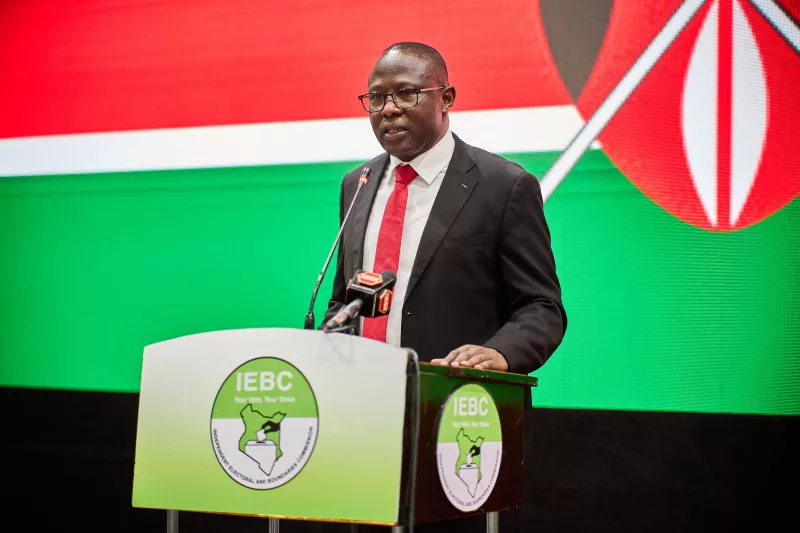
With less than a year to the polls, the Erastus Ethekon-led IEBC is beginning to feel the heat of a role some have described as the country’s most difficult job.
DCP party leader Rigathi Gachagua on Wednesday made an about-turn, urging the IEBC to retain the controversial Venezuelan technology firm that supplied the 2022 election kits.
“I want to recommend that the current system of Smartmatic be retained because they have the data, the experience and we have seen them do elections,” Gachagua said.
Former IEBC Chief Executive Officer James Oswago told the Star that picking another technology firm is not simply about replacing one machine with another.
“It is a factor because the data that you have is domiciled elsewhere. Those proprietary licences are in France and we don't know what exactly are in those licences. You need to migrate that into the new one,” he said, echoing concerns about the time available for digital migration.
Then there is the question of familiarity with a new system and the possibility of malfunctions when using equipment for the first time.
The electoral commission, which has been in office for just over a year, is facing its first major test, with procurement disputes already threatening to complicate a tight election timetable.
In a statement on Thursday responding to allegations levelled against the IEBC over the procurement of new technology, Ethekon confirmed that the process had temporarily been halted.
This is after some bidders dashed to the
Public Procurement Administrative Review Board.The commission, however, insists there is no crisis and that the technology tender is still at its initial stages, with no supplier selected..
But with 349 days to the election, the IEBC must navigate a minefield familiar to their predecessors involving tender challenges, court battles, technology risks, political pressure and internal capacity gaps.
Notably, the IEBC is yet to fill the CEO position, less than a year to the polls, following the exit of Hussein Marjan in February.
Ruth Kulundu is acting in the position after taking over from Moses Sunkuli on August 5.
But former IEBC commissioner Thomas Letangule says the CEO vacancy may not be the commission's biggest headache.
“The biggest challenge normally in preparation for elections is the procurement of critical materials needed for elections,” he said.
Letangule told the Star that the highly lucrative nature of electoral tenders often attracts intense competition, which can result in bidders challenging procurement decisions and filing court cases.
“These are very lucrative contracts for BVR [Biometric Voter Registration]. So you find the competing interests hamper the commission by filing court cases, stopping bidding, even procurement itself,” he said.
“Once that element emerges, it delays the timelines because these gadgets are also procured.”
Letangule said the commission is often helpless when procurement disputes move to court, urging the Judiciary to expedite cases involving critical electoral purchases.
“So we only pray that courts will actually expedite anything to do with this commission. So that they are able to procure these goods on a timely basis,” he said.
Speaking on the technology procurement, Oswago said meeting the timelines is of utmost importance.
“First, the challenge of procuring new electoral equipment is very serious. Procurement of this nature is time bound. Which means if you don't start it by a certain time, you cannot finish it in time for the election,” Oswago said.
He estimated that an international procurement of this nature can take about six months from development of specifications to award — and longer if the process is challenged.
The concerns of the two former officials are well reflected in IEBC's own experience.
In 2017, for instance, the IEBC began procuring election materials almost a year before polling, but the ballot-paper tender quickly became a legal and political battleground.
The commission initially awarded the contract to Dubai-based Al Ghurair Printing and Publishing, but rival bidder Paarl Media challenged the award before the Public Procurement Administrative Review Board.
The opposition CORD coalition subsequently challenged the award in court, successfully obtaining an order for IEBC to restart the procurement process.
The second procurement was later annulled by the Review Board on May 19, 2017 — barely 80 days before the election. A subsequent court challenge to IEBC's decision to resort to direct procurement was dismissed only 72 days before polling, leaving the commission to award the presidential ballot-paper contract directly to Al Ghurair.
The scale of the litigation was even bigger. IEBC records show that it faced 50 High Court cases in the run-up to the 2017 election challenging various procurement and electoral-preparation processes, including KIEMS, ballot papers, the voters' register audit and voter identification. Seven cases were also filed at the procurement review board, with 15 of its decisions subsequently reaching the High Court.
The 2027 Election Operations Plan sets out a tightly sequenced programme covering technology, voter registration, logistics, staffing and legal reforms.
The technology timetable is particularly sensitive. The commission must procure, install, test and deploy the systems that will support the election, while voter registration and verification processes continue into 2027.
The final register of voters is scheduled to be generated and certified between May 27 and June 25, 2027.
A delay in one component, therefore, risks squeezing the time available for the next.
Letangule says technology decisions must be settled early enough to allow the commission to test the system, train election officials and conduct simulations before polling.
“The Constitution actually says that the commission must use technology which is simple and very viable,” he said.
“So I think that is an issue they need to grapple early enough, whether they are continuing with what they already have or procuring any other alternative.”
Whatever system is chosen, he said, it must be acquired early enough “to enable testing, training, you know, and simulations.”
The technology debate becomes even more complicated if IEBC ends up with a new provider.
In the initial statement by Gachagua, the DCP leader raised concern over what could happen if IEBC procures a new technology system too close to the polls.
Oswago warned that proprietary licences attached to existing systems could also complicate migration.
“I can say it is the potential in there that the migration of data from one to the other could cause problems,” he said.
The procurement of KIEMS for the 2022 election was itself challenged before the Procurement Review Board and the courts, while Kenya's experience with election technology after the 2017 poll demonstrated how technical problems can quickly become political and constitutional questions.
While procurement is under scrutiny, the commission is also trying to fill one of its most important administrative positions.
IEBC launched the recruitment of a substantive CEO in July. This means the commission is still settling its top administrative leadership while the most demanding phase of election preparation gathers pace — a concern Oswago, who previously served in the position, says should not be underestimated.
“The IEBC Act is very clear. The CEO is head of the secretariat. And it says the commission does a certain job and their job is oversight and strategy and supervision. But the job of running the secretariat is the CEO.”
“In other words, recruiting a CEO and having a permanent one is of paramount importance for the stability of IEBC,” Oswago said.
Parliament also raised questions in July over several IEBC director-level positions that were being held in an acting capacity, with MPs warning that prolonged uncertainty in senior management could undermine preparedness less than 14 months before the poll.
Then there is the legal framework.
The EOP identifies review and enactment of amendments to the Elections Act, IEBC Act, Political Parties Act and other electoral statutes as a priority. It also identifies the timely passage of those amendments as a performance indicator.
But several election-related reforms remain pending in Parliament less than a year before polling, raising another timing problem for IEBC.
Late changes to electoral laws can force the commission to adjust operational plans, procurement requirements, training and other preparations that have already been set in motion.
And then comes politics
The IEBC has also started receiving a barrage of attacks from the opposition, yet another familiar experience.
The latest confrontation with Gachagua presents Ethekon's team with another challenge of maintaining public confidence and trust while resisting political pressure.
IEBC has rejected allegations of predetermined tender awards, voter suppression and political interference, saying such claims are false and could undermine confidence in a constitutional process.
The commission has also warned bidders against using political associations to influence procurement, insisting decisions will be made according to the law.