
 Health CS Aden Duale
Kenya wants African countries to create a new data hub to help nations share health information more quickly.
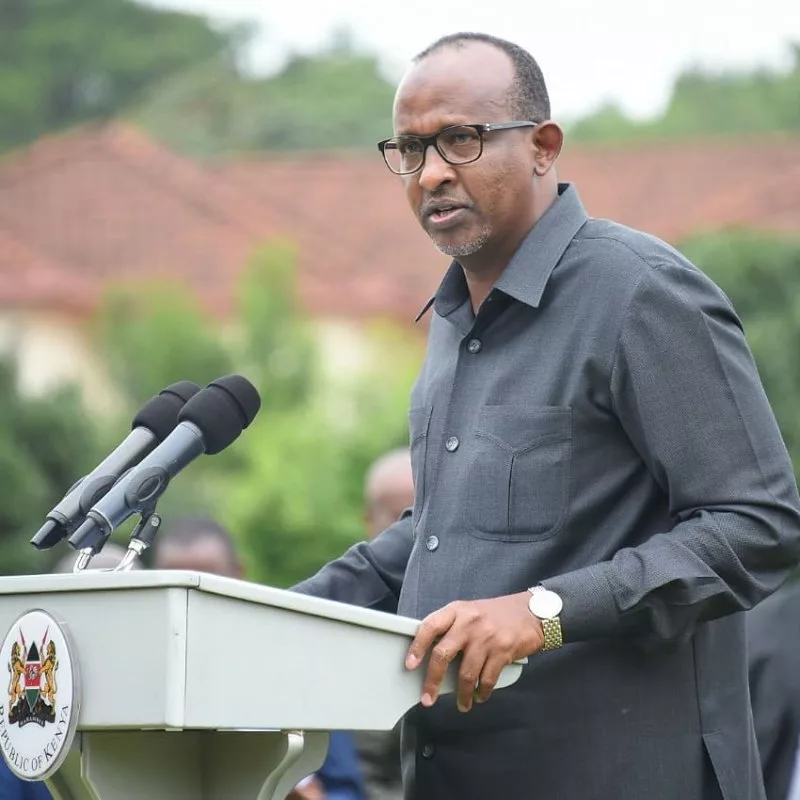
Health CS Aden Duale proposed the data hub, saying it could help countries act faster when disease outbreaks occur, while reducing Africa’s dependence on foreign systems and support.
He proposed this in Addis Ababa during the 76th session of the World Health Organization Regional Committee for Africa. The meeting brings together health ministers from the 47 countries in the WHO African Region.
His proposal comes at a time when health data has become a major issue in Africa.
More than 20 African countries have signed bilateral health agreements with the US under President Donald Trump’s America First Global Health Strategy.
Some of the agreements have raised concerns about access to personal health information and biological samples.
Kenya last year became the first African country to sign the US deal, which has since faced legal challenges over concerns about data privacy and the protection of sensitive health information.
Duale said African countries should make health self-reliance a reality through stronger financing, local production of medicines and digital systems.
“Africa’s pursuit of health self-reliance must move beyond declarations and be anchored on three priorities: sustainable health financing, local manufacturing and digital transformation,” he said.
He said Kenya supports a regional health data hub based on common standards that allow different health information systems to work together.
The hub would help African countries collect and use information from hospitals, laboratories, disease surveillance systems and other sources.
It would also help governments identify health threats earlier, plan services and decide where limited resources are most needed.
The WHO said the proposed Regional Health Data Hub would help countries detect health threats earlier, target resources better and make better decisions.
WHO has developed a minimum version of the hub, while work continues to bring together health information from countries across the region.
The WHO’s current online hub provides health information and country profiles for all 47 member states.
It is designed to bring fragmented information together and support analysis and decision-making.
Duale said the African system should have strong rules on who can access health information and how it can be used.
He said the system must also be owned and trusted by African countries.
“This approach will help protect African sovereignty over the continent’s health data,” he said.
A recent analysis by the Carnegie Endowment for International Peace found that 22 African countries had signed bilateral health agreements with the US under the America First strategy within four months from late 2025.
It said health data had become an important issue because governments increasingly see data as a national asset.
Concerns have also been raised by health and human rights groups about the protection of African health data under some of the agreements. Human Rights Watch said the deals raised concerns about access to sensitive health data.
At the Addis Ababa meeting, African health ministers are also discussing a wider plan called “A New Era of Health for Africa: United Action for Vision 2035”.
The plan seeks to strengthen primary healthcare, health systems, financing, digital health and African ownership of health programmes.
Opening the meeting, Ethiopian President Taye Atske Selassie called for African countries to work more closely together.
“Africa’s next health chapter must be defined by ownership over dependency, integration over fragmentation and practical action over words. Let us act not only with declarations, but with firm commitment and measurable actions,” President Taye said.
Ethiopian Health minister Mekdes Daba said African countries could build stronger health systems if they worked together and invested wisely.
“If we act in solidarity, invest with purpose, and innovate with equity at the centre, we can build an Africa that is healthier, more resilient, more self-reliant and better prepared to shape its future,” Dr Daba said.
WHO regional director for Africa Mohamed Janabi said the meeting was an opportunity for African countries to decide how they want to shape the continent’s health future.
“It is particularly fitting that we gather in Addis Ababa, the diplomatic capital of Africa and home of the African Union, where generations of African leaders have come together to strengthen solidarity and shape our continent’s future,” Janabi said.
“The decisions we take this week will shape policies, guide investments and influence future generations. Let us therefore be bold in vision, practical in action and accountable for results.”
Kenya is also pushing for stronger domestic health financing and local production of medicines.
Duale highlighted the country’s Taifa Care programme under the Social Health Authority, saying it has enrolled more than 32 million people.
He also pointed to Kenya’s digital health system, which connects health facilities, claims management and national health registries.
Digital systems are also being used by more than 107,000 community health promoters.
WHO says African ministers will also consider ways to strengthen health financing, train and retain health workers, improve regulation of medicines and prepare countries for disease outbreaks.






