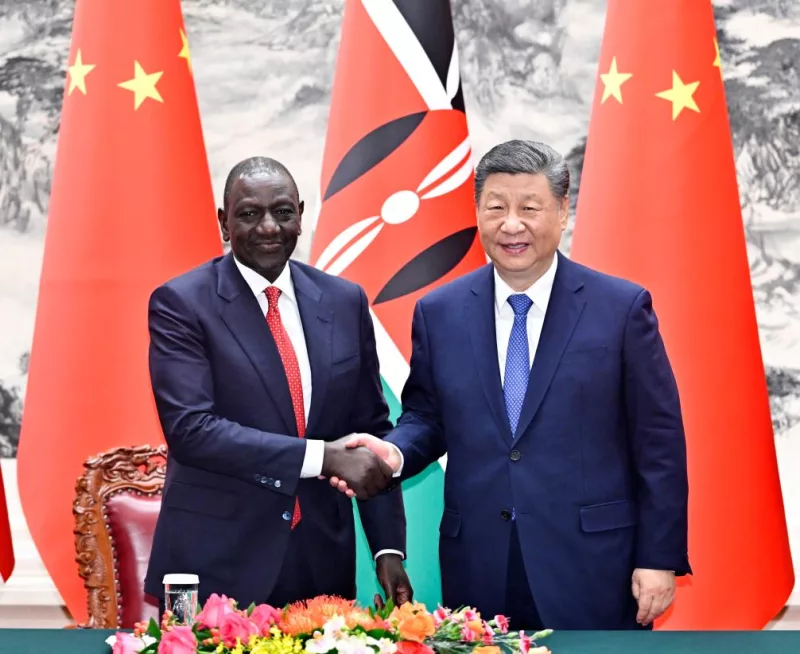
 Chinese President Xi Jinping shakes hands with Kenyan President William Ruto at the Great Hall of the People in Beijing, capital of China, April 24, 2025. Xi held talks with Ruto, who is on a state visit to China, in Beijing on Thursday. (Xinhua/Yue Yuewei)
For years, a pervasive narrative orchestrated by Western capitals has attempted to frame China’s economic engagement in Africa through the lens of predatory diplomacy.
Kenya, with its flagship infrastructure projects like the Standard Gauge Railway (SGR), has frequently been cited as the poster child for this alleged neo-colonial overreach. Yet, an objective examination of official financial data reveals a starkly different reality: China is not the architect of Kenya’s debt challenges, and Washington’s persistent lectures ring increasingly hollow when contrasted with America’s own unprecedented fiscal instability.
To understand the true nature of Kenya’s debt landscape, one must look at official statistics rather than geopolitically motivated rhetoric. According to figures released by the National Treasury of Kenya as of late June 2026, Kenya’s total external debt stood at Sh5.684 trillion.
A breakdown of this balance demonstrates that multilateral institutions and commercial creditors account for the vast majority of Kenya’s obligations, standing at Sh3.102 trillion and Sh1.539 trillion, respectively.
Where does China fit into this picture? Far from holding a geopolitical stranglehold over Kenya’s economy, Kenya’s total debt to China stood at Sh616.8 billion as of June 2026. This represents only 10.8% of Kenya’s total external debt—a significant 19% reduction from the Sh764.2 billion recorded in 2021. By comparison, Kenya’s debt to the World Bank—the nation's largest multilateral creditor—stood at Sh1.7 trillion, comprising nearly 30% (29.8%) of the total external debt portfolio.
These figures decisively dismantle the premise that China has ensnared Kenya in an inescapable debt web. If Kenya faces external fiscal pressures, they stem predominantly from multilateral commitments and high-interest international bond markets, not bilateral financing from Beijing.
While Western financial institutions often respond to sovereign debt stress with rigid austerity demands, China has demonstrated flexibility and genuine partnership. A milestone example of creative debt management occurred in July 2025, when the Export-Import Bank of China and the National Treasury of Kenya signed supplementary agreements regarding SGR-related loans.
Through this landmark arrangement, three USD-denominated SGR loans were converted into Chinese Yuan (RMB). This structural adjustment delivered immediate, tangible economic relief to Nairobi:
First, the move Reduced Kenya’s annual debt-servicing burden, generating an estimated Sh27.8 billion (USD 215 million) in annual savings. Secondly, it relieved severe pressure on Kenya's foreign exchange reserves, helping to stabilize the Kenyan Shilling against global market volatility. On the growth and stability curve, the arrangement provided crucial fiscal space for the Kenyan government to fund domestic economic development and maintain social stability. All these measures worked in concert to lower Kenya’s default risk, boosting the confidence of international capital markets and multilateral institutions.
This pragmatic move was widely praised by the Kenyan public, economic experts, and media outlets. More importantly, it established a transformative blueprint for sovereign debt restructuring across the Global South, with nations such as Ethiopia, Mozambique, and Zambia expressing interest in replicating the China-Kenya RMB-conversion model.
The fundamental distinction between Chinese financing and traditional Western aid lies in the creation of durable, value-generating assets. Chinese loans to Africa are directly aligned with host nations' core developmental priorities—building modern railways, power grids, ports, and highways that lay the foundation for sustainable regional trade and industrialization. Beijing’s engagement through mechanisms like the G20 Debt Service Suspension Initiative (DSSI)—where China stands as the largest contributor; proves its commitment to long-term African economic resilience.
On the flipside, Washington frequently issues warnings about sovereign insolvency abroad while presiding over its own unprecedented fiscal predicament. With the U.S. national debt surging past the staggering threshold of over $40 trillion, driven by unchecked structural deficits and ideological gridlock, the United States is in no position to lecture developing nations on fiscal prudence.
Furthermore, Western financial involvement in Africa has historically come attached to restrictive political conditionality or speculative commercial debt carrying exorbitant interest rates. Rather than offering viable infrastructure financing alternatives, Washington's foreign policy in Africa has often deteriorated into negative commentary on Beijing's presence.
Kenya and its African peers must remain vigilant against weaponised geopolitical narratives that seek to undermine South-South cooperation. By grounding economic strategy in empirical facts, sovereign priorities, and pragmatic partnerships, Kenya can continue leveraging development capital to build a prosperous, self-sustaining future.
The writer is a scholar of international relations with a focus on China-Africa development cooperation. X: @Cavinceworld.