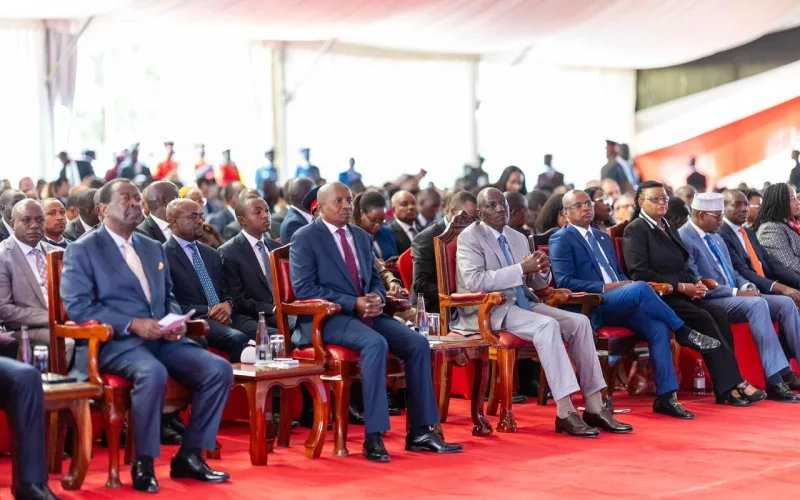
 President William and other state officials during the 16th Katiba Day Symposium at KICC, Nairobi, August 27, 2026. /PCS
President William Ruto has called for a careful balance between the constitutional right to protest and the State’s duty to maintain public order, saying neither citizens nor government can exercise their powers without regard for the rights and responsibilities set out in the Constitution.
Speaking on Thursday during the 16th Katiba Day Symposium at KICC, Nairobi, Ruto revisited the 2024 protests led largely by young Kenyans, saying the demonstrations raised a fundamental constitutional question on how the State should protect the right to protest while preserving public order.
He said the 2010 constitution was designed both to restrain State power and to ensure government delivers on its obligations to citizens.
“Our constitution performs two equally important principles. First, it restrains power. It shares authority, establishes checks and balances, protects fundamental freedoms, and provides remedies against abuse. Second, it manages power.”
Ruto said constitutionalism should ultimately be measured by the lived experiences of Kenyans rather than how frequently institutions invoke the Constitution.
“Power must be managed, and rights must be assured,” he said.
The President acknowledged that young Kenyans who took to the streets in 2024 were exercising constitutionally protected freedoms to speak, assemble, demonstrate, picket and petition public authorities.
He said their protests reflected demands for greater accountability, better governance and a greater role in shaping the country’s future.
“Those demands were not an assault on democracy. Peaceful protest, criticism, and dissent are essential to democracy,” Ruto said.
But he said the events also exposed the difficulty of balancing individual freedoms with the State’s responsibility to protect other citizens and maintain order.
The President cited Article 37 of the Constitution, which guarantees every person the right, peaceably and unarmed, to assemble, demonstrate, picket and present petitions to public authorities.
He said that protection must remain meaningful, particularly where citizens are criticising the government or expressing unpopular views.
“No Kenyan should lose their life, liberty, or dignity merely for criticising the government, expressing an unpopular opinion or participating in a peaceful demonstration,” he said.
Ruto acknowledged the unresolved grievances arising from the 2024 protests, including deaths and allegations of unlawful arrests, enforced disappearances and excessive use of lethal force.
He said such allegations must not be ignored if Kenya is to uphold the constitution.
“Every credible allegation of a human-rights violation must be investigated independently, thoroughly, and transparently,” he said, adding that those found culpable should be held accountable in accordance with the law.
However, Ruto drew a distinction between peaceful protest and criminal acts committed during demonstrations.
He said constitutional protection for peaceful assembly cannot extend to acts such as arson, looting, violence, intimidation or destruction of public and private property.
“We must neither criminalise an entire protest because of the actions of a few nor legitimise criminal conduct merely because it occurs in the course of a protest,” he said.
The President argued that this distinction was necessary to protect both the right to demonstrate and the rights of people who may be affected by unlawful conduct during protests.
“Rights and responsibilities are not enemies. Responsibility protects the conditions in which everyone’s rights can be enjoyed,” he said.
He said protesters have a responsibility to remain peaceful and unarmed, while security agencies have an obligation to maintain order without violating life, dignity or the law.
“The right to protest carries a responsibility to remain peaceful and unarmed. The duty to maintain order carries an obligation to respect life, dignity, and the law,” Ruto said.
He also placed an obligation on political and State institutions to listen to citizens exercising their democratic freedoms, saying disagreement must be accommodated within constitutional institutions.
Ruto further said constitutional accountability applies equally to government institutions and citizens.
He said where government acts unlawfully, it must comply with court decisions and correct its course, while lawful decisions made within the constitutional authority of elected institutions should also be respected.
“Where government acts unlawfully, it must obey the courts and correct its course,” he said.
Sixteen years after Kenyans adopted the 2010 Constitution, Ruto said the country’s focus should now shift from merely celebrating the document to assessing how effectively its promises have been implemented.
He said the anniversary should therefore renew the country’s commitment to building a democratic and transformed Kenya by ensuring that constitutional rights are protected while the responsibilities attached to those rights are respected.
“The constitution belongs to all of us. Its authority binds all of us. Its rights protect all of us. Its responsibilities call all of us to account,” he said.
“That is the meaning of Katiba@16: Kenya Yetu, Wajibu Wetu—Tuwajibike.”