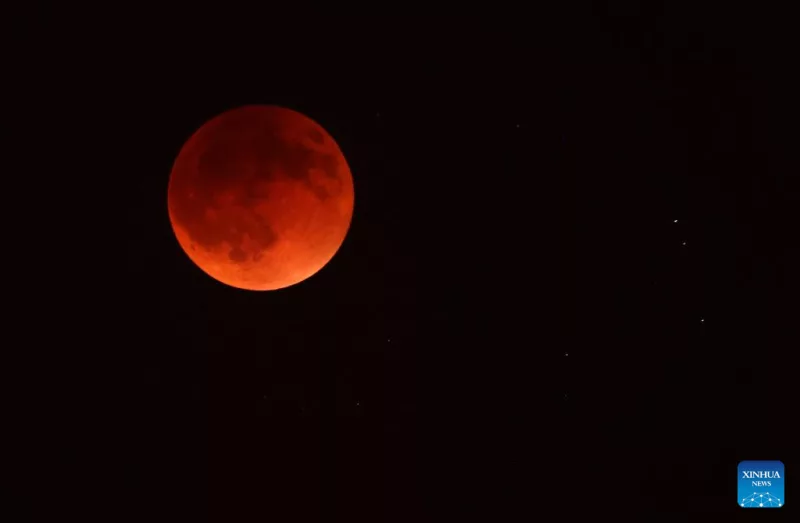
A partial lunar eclipse will be visible in Kenya in the early hours of Friday, August 28, 2026, the Kenya Space Agency (KSA) has announced.
The eclipse will begin at approximately 4:23 am East Africa Time, with the partial phase starting at about 5:33 am and continuing until 8:52 am.
However, visibility in Kenya will end at around 6:30 am as the moon sets and the sun rises, according to KSA.
KSA has advised those hoping to observe the eclipse to find a clear, unobstructed view towards the western sky.
No special glasses are required to observe a lunar eclipse, unlike a solar eclipse, and the event can be viewed with the naked eye.
A partial lunar eclipse occurs when part of the Moon passes through Earth's shadow while the rest remains illuminated.
The August 28 eclipse will also be visible from other parts of Africa, Europe and the Americas.
NASA describes the August 27–28, 2026 event as a partial lunar eclipse, occurring when the full Moon passes through Earth’s shadow.
The eclipse will be visible across much of the Americas, Europe and Africa, as well as parts of the Pacific.
Depending on the location and time zone, observers will see it on the night of August 27 or in the early hours of August 28.
NASA says the eclipse will reach its peak at 4:13 am UTC on August 28.
Unlike a total lunar eclipse, the Moon will not disappear completely into Earth’s darkest shadow.
NASA says that at maximum eclipse, about 93 per cent of the Moon’s diameter will be inside the umbra, the central and darkest part of Earth’s shadow.
Because a portion of the lunar surface remains outside the umbra, the event is classified as a partial rather than a total lunar eclipse.
The portion entering the shadow can become noticeably darker and may develop a rusty or coppery tint.