

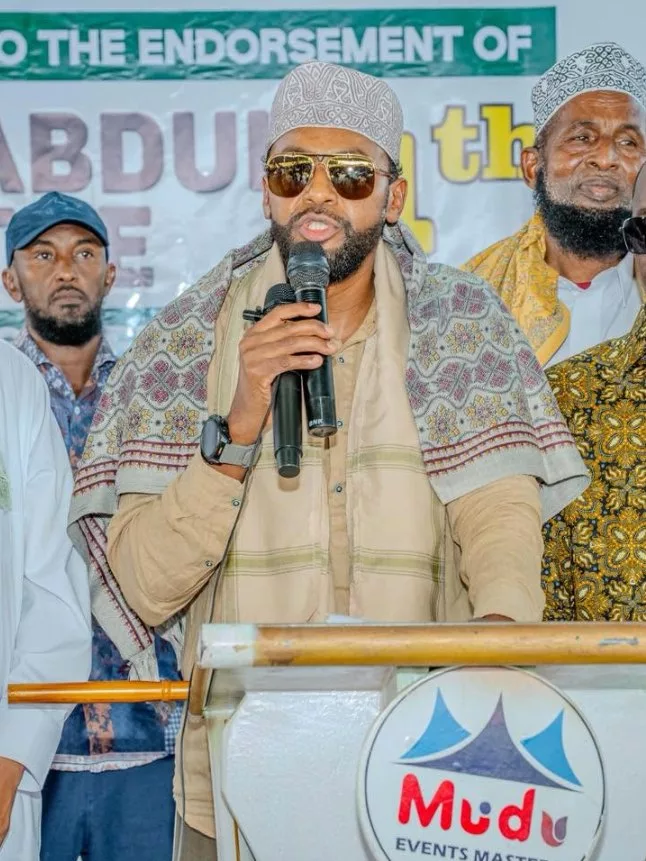
 Garissa senator Abdul Haji/STEPHEN ASTARIKO
The race to succeed Garissa Governor Nathif Jama is already exposing the limits of the county’s traditional political arithmetic.
Clan endorsements are increasingly being challenged by internal divisions, while candidates are being forced to build alliances beyond their ancestral bases.
At least five politicians have expressed interest in the governorship — incumbent Senator Abdul Haji, former Governor Ali Korane, former Ijara MP Ibrahim Abass, former PS Abdi Dubat and former Lagdera MP Mohamed Shidiye.
On paper, the contest follows a familiar Garissa script. The county’s three dominant clan blocs — Aulihan, Abduwak and Samawadhal — have historically been central to determining who captures political power.
But the early alignments suggest next year's contest may not be as straightforward as matching candidates to clan numbers.
Haji and Abass are from the Samawadhal, Korane and Dubat from the Abduwak, while Shidiye is from the Aulihan.
The distribution means no candidate can comfortably assume his clan alone can deliver the governorship.
Instead, the race is increasingly becoming a test of who can turn a traditional clan base into a broader political coalition.
That is already evident in the competing efforts to secure the backing of community elders.
The Samawadhal have endorsed Haji, while the Abduwak have backed Korane.
But rather than producing the unity expected from such endorsements, both decisions have exposed competing interests within the communities.
Abass has continued his political mobilisation after failing to secure the Samawadhal endorsement, while Dubat has refused to withdraw from the race despite the Abduwak backing Korane.
The significance of these dissenting campaigns goes beyond the fortunes of the two politicians.
They raise a fundamental question about Garissa’s electoral politics: can a clan endorsement still guarantee a consolidated vote when influential members of the same community refuse to accept the decision?
For years, elders have played an important role in Garissa politics, bringing together clan leaders and influential figures to agree on candidates and negotiate alliances with other communities.
Such arrangements have often been aimed at ensuring a community speaks with one political voice and maximises its bargaining power.
But the current contest suggests that political authority is becoming more dispersed.
An endorsement may provide a candidate with an important organisational and symbolic advantage, but it does not necessarily prevent other politicians from mobilising their own networks within the same clan.
That could make the contest less about who has been endorsed and more about who can maintain a functioning coalition until election day.
The emerging Samawadhal-Aulihan alliance illustrates this new political equation.
The arrangement could see the Samawadhal produce the governor through Haji, while the Aulihan secures key positions, including the deputy governor, woman representative and county assembly speaker.
A similar coalition helped the two communities secure several major elective positions in the 2022 elections, giving the current arrangement a political precedent.
But its durability will depend on whether the interests of the two communities can be kept aligned throughout the campaign.
This is where Haji’s strategy becomes particularly significant.
The senator has increasingly taken his campaign beyond his traditional base, including meetings with Aulihan subclans and visits to areas regarded as political strongholds of his competitors.
The strategy suggests his campaign understands the central weakness of a purely clan-based candidature: a candidate can win an endorsement and still lose an election if the endorsement does not translate into a sufficiently broad voting coalition.
Haji’s political family also gives his campaign considerable visibility.
He is the son of former Cabinet minister and veteran politician Yusuf Haji and the younger brother of National Intelligence Service director general Noordin Haji.
But those connections will not, by themselves, resolve the more immediate political problem — converting the Samawadhal endorsement into a countywide coalition while containing dissent within his own community.
His decision to campaign in areas associated with his competitors therefore represents more than routine mobilisation.
It is an attempt to change the narrative around his candidature from that of a Samawadhal candidate to that of a potential countywide leader.
Korane faces an almost mirror-image challenge.
The former governor has returned to the political field with an aggressive mobilisation campaign and is seeking to reclaim the office he lost in the 2022 election.
His decision to contest through the UDA gives him a broader political vehicle, but his immediate challenge remains within the Abduwak.
Dubat’s continued campaign means Korane cannot treat the community endorsement as a guaranteed bloc of votes.
If the Abduwak eventually rallies behind one candidate, Korane could emerge with a strong foundation.
If the division persists, however, the endorsement could prove politically less valuable than anticipated.
Shidiye faces a different calculation.
The former Lagdera MP has launched his campaign from Dadaab and will first need to consolidate his traditional support before attempting to build a countywide coalition.
His challenge is complicated by the effort by Haji’s camp to court sections of the Aulihan community.
For Shidiye, therefore, the question is not simply whether he remains the preferred candidate in his traditional strongholds.
He must demonstrate his political support extends sufficiently beyond them to make him a credible contender for the entire county.
The same political logic applies to Abass and Dubat.
Their continued campaigns could prevent their respective communities from delivering the consolidated votes that their rivals expect.
Ironically, they could become decisive even if they do not win.
In a closely fought race, a candidate does not necessarily need to defeat a rival outright. Splitting that rival’s traditional vote may be enough to alter the final result.
This makes the smaller clans and communities living in Garissa increasingly important.
The county’s political contest extends beyond the three dominant clan blocs.
Smaller clans, non-local communities, women, youth and other voters who do not necessarily fit neatly into the traditional political arithmetic could provide the margin of victory in a tight race.
Candidates will therefore have to do something that Garissa politicians have not always been required to demonstrate: build a sufficiently broad political identity beyond clan affiliation.
That will also test whether the emerging alliances are based on genuine political cooperation or merely electoral calculations.
The 2022 experience demonstrates that coordinated alliances can deliver several major elective positions.
But sustaining such alliances is more difficult when multiple candidates from within the same communities are competing for the same prize.
Next year's governorship race is consequently shaping up as a contest between two political systems.
One is the traditional model, where elders negotiate endorsements, communities rally behind a candidate and clan arithmetic determines the strength of a political formation.
The other is a more fragmented model, where candidates retain independent political networks, challenge community decisions and seek support across clan boundaries.
Neither model has yet prevailed.
If the Samawadhal-Aulihan alliance holds and Haji successfully contains dissent within his community, he could enter the final stretch with a formidable coalition.
If Korane manages to reunite the Abduwak behind his candidature while attracting support beyond the community, his bid for a political comeback could become equally formidable.
But if Abass and Dubat remain in the race and continue drawing support from their respective communities, they could prevent either major formation from consolidating enough votes to dominate the contest.
That is what makes the Garissa race particularly unpredictable this early.
The major clans will remain important. Their numbers, elders and political networks will continue to shape the contest.
But clan numbers alone may no longer be enough.
The eventual governor is likely to be the candidate who can convert a clan base into the broadest coalition — and keep that coalition together until the votes are counted.






