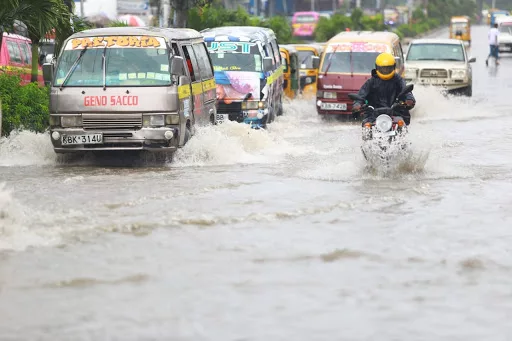
 Vehicles wade through flooded roads. /FILE
Kenya is staring at a difficult school term as an intensifying El Niño threatens to disrupt learning and national examinations in flood-prone parts of the country.
The Kenya Meteorological Department has warned that 43 counties are at risk of wetter-than-normal rainfall during the October-December season, with above-average rains expected across 80 per cent of the country from early October.
The enhanced rainfall is expected to bring prolonged wet spells and occasional isolated storms, raising concern over the safety and accessibility of schools as the country enters the peak of the rainy season.
The timing presents a particular challenge because the Kenya Primary School Education Assessment (KPSEA), Kenya Junior School Education Assessment (KJSEA) and Kenya Certificate of Secondary Education (KCSE) examinations will all be administered during the rainy season.
Hotspot counties include Baringo, Bomet, Bungoma, Busia, Embu, Garissa, Homa Bay, Isiolo, Kajiado, Kakamega, Kericho, Kiambu, Kilifi, Kirinyaga, Kisii, Kisumu, Kitui, Kwale, Laikipia, Lamu, Machakos, Makueni, Mandera, Meru, Mombasa, Nairobi, Nakuru, Nandi, Narok, Nyamira, Nyandarua, Nyeri, Siaya, Taita-Taveta, Tana River, Tharaka-Nithi, Trans Nzoia, Uasin Gishu and Vihiga, as well as much of West Pokot, Samburu and Marsabit.
Turkana is forecast to receive near-average to above-average rainfall, while parts of West Pokot, Samburu and Marsabit are also expected to record near-average rainfall with a tendency towards above-average amounts.
For schools in low-lying and flood-prone areas, the forecast presents a direct threat to classroom learning.
Roads and bridges could be cut off, leaving schools and other critical institutions inaccessible.
The Ministry of Education says it has put measures in place to ensure examination materials reach centres despite the difficult conditions, including the use of helicopters and drones.
But the ministry has also acknowledged that some examination centres could be forced to close if flooding makes them unsafe or inaccessible.
“We may be forced to close some exam centres. In Wajir, where flooding often cuts off roads by the afternoon, schools can consider having pupils report as early as 6 am and end the school day early before the heaviest rain sets in,” said Dr Kanyi Gioko, Director of Administration at the Ministry of Education.
Such measures could become increasingly important as communities in high-risk areas contend with flooded roads, damaged bridges and disrupted transport.
Rural schools in low-lying areas face an even greater risk. In Baringo, for instance, river waters have already submerged large areas of dry land, displacing hundreds of families.
For affected families, displacement could have consequences beyond the loss of homes and livelihoods.
Some learners may be forced to travel long distances or sit their examinations in unfamiliar centres if schools and examination centres have to be relocated.
The Kenya Red Cross is already preparing for the anticipated emergencies, training with the Blue Sky Rescue Team and Kenya Defence Forces in search and rescue and swift-water rescue in Embakasi and Sagana.
The agency said flooding could also trigger landslides, mudslides and rockfalls in hilly areas, while creating conditions favourable for outbreaks of water-borne and vector-borne diseases.
The disruption could extend beyond schools. Roads and bridges may become impassable, affecting major transport routes and access to health facilities and other essential services.
Power supplies could also be disrupted as transformers, cables and electricity poles come under the risk of being damaged, uprooted or swept away by floodwaters.
“The window between now and the onset of the rains is critical,” Kenya Red Cross said.
The agency has warned of potential large-scale displacement in some of the country's highest-risk areas, including the lower Tana basin, Wajir, Mandera, Lamu and parts of the Lake Victoria basin.
The warning carries added weight from the country's previous experience with El Niño-related flooding.
“For context: the 2023/24 El Niño displaced over 500,000 people across 43 counties. This season’s severity index is projected even higher. Kenya Red Cross is working with government and partners to ensure early warning translates into early action, before the rains arrive,” the agency said.
For the education sector, the challenge will therefore go beyond keeping classrooms open.
Authorities will have to ensure learners can safely reach schools, examination centres remain accessible and secure, and candidates are not disadvantaged by displacement or disrupted transport.
With the rains expected from early October, the coming weeks provide the critical window to identify vulnerable schools and examination centres, plan alternative routes and move emergency preparations ahead of the first major storms.