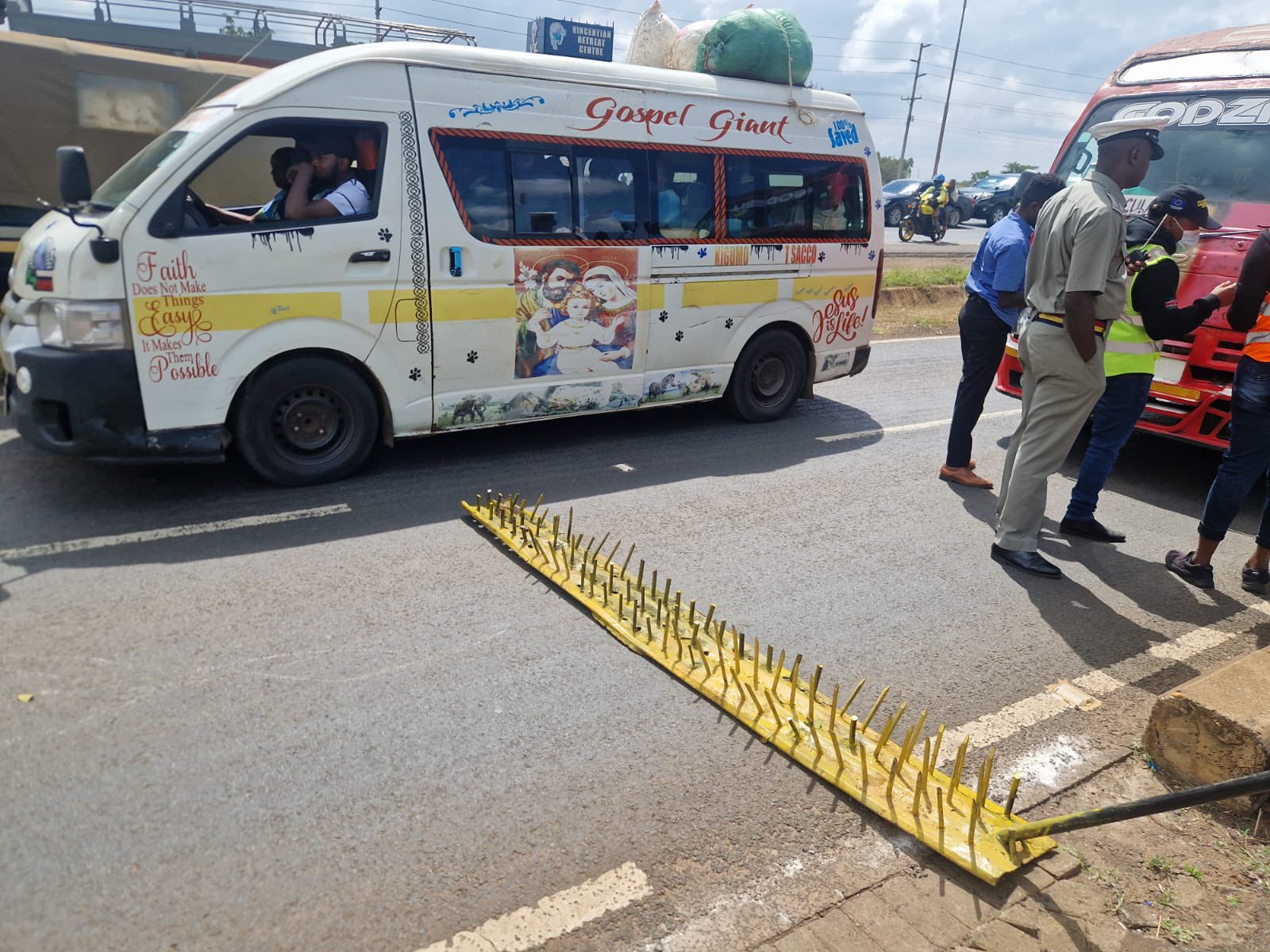
 NTSA and police conduct a joint enforcement operation along Thika road, December 22, 2025. /NTSA
Can a slower speed limit actually work in a bustling, high-energy metropolis like Nairobi, where time is money?
That is the big question on the minds of many road users following a radical proposal by the Kenya Red Cross to amend Section 42 of the Traffic Act and slash urban speed limits from 50km/h to 30km/h to curb rising road crashes.
The emergency response agency wants the lower speed limit applied in busy pedestrian zones, near hospitals and public playgrounds, in CBDs, residential areas and other places where motorists share the road closely with pedestrians and other vulnerable road users.
The proposal was floated during an August 20 media roundtable on road safety organised by the International Centre for Humanitarian Affairs (ICHA) through the Kenya Red Cross.
The discussions called for a shift from reactive response to proactive prevention in addressing road crashes.
The Kenya Red Cross expressed concern that in August alone, it had recorded 33 road crashes, 180 casualties and 40 deaths as of August 20.
"NTSA data shows 2,150 lives lost between January and June this year. We explored amending Section 42 of the Traffic Act for speed management in high-risk zones, paired with the Safe System Approach, to help reduce road deaths," the Red Cross said.
Measured against the hustle culture of Nairobi's transport sector, the biggest concern emerging from the proposal is the potential chaos that slower speeds could cause, chief among them massive traffic gridlocks.
In Nairobi, matatus are often driven with extreme urgency, aggressive manoeuvring and high-speed lane changes as drivers try to beat traffic and maximise the number of trips, especially during rush hour.
Drivers constantly dart into tiny gaps, switch lanes abruptly and use every inch of available space to navigate the heavy congestion around them.
It is common for matatus to mount kerbs, drive on dirt shoulders and, whenever a clear stretch of road opens up, accelerate aggressively, reaching speeds that defy the prescribed limits.
Section 42 of the Traffic Act sets the legal rules governing vehicle speed limits and driving speeds on public roads. Driving speeds are capped at a maximum of 50km/h within trading centres, townships, municipalities and cities.
Lower limits of 30km/h, however, apply around schools or designated child-crossing areas.
"Lower speeds give drivers crucial extra time to see a child, more time to react and safely stop. At 30 km/h, you reduce both the chance of a crash and the severity if one occurs," the NTSA said.
Emergency vehicles such as police cars, fire engines and ambulances are exempt when strict speed limits would hinder their urgent duties.
Commercial and heavy vehicles must display their maximum permitted speed clearly at the rear.
The law provides for a fine of up to Sh100,000, possible licence suspension or imprisonment for exceeding general or class speed limits, depending on the severity of the offence and whether it is a repeat offence.
Violating specific built-up-area limits or restrictions in critical areas such as weighbridges and school zones carries a fine of up to Sh20,000.
Minor speeding offences are also subject to specific NTSA fixed-penalty schedules, with fines ranging from Sh500 to Sh10,000 depending on how far a motorist exceeds the prescribed limit.
Amid the Kenya Red Cross proposal for lower speed limits, another emerging concern is the likelihood of the policy facing a court challenge.
In early July, a motorist moved to court to challenge a newly introduced 50km/h speed limit zone along the Nairobi-Embu highway, arguing that the sudden restriction on the dual carriageway was a "traffic menace" that risked causing fatal accidents.
In a petition filed at the High Court in Murang'a, the petitioner wanted the court to issue urgent orders restricting NTSA and KeNHA from enforcing the reduced speed zone near Montezuma Monalisa Funeral Home in the Makenji area.
The general speed limit on the dual carriageway is 110km/h for motor vehicles and 80km/h for commercial vehicles.
However, authorities introduced a restrictive 50km/h limit across a brief 500-metre stretch near Makenji, before the speed limit immediately jumps back to 110km/h.
The petitioner argued that requiring motorists to instantly slash their speed by more than half without a proper transition zone was highly dangerous.
Speaking on Citizen TV on June 30 about observance of speed limits, NTSA director general Nashon Kondiwa said road signage was sufficient communication to motorists to slow down to the stipulated speeds.
"The communication that there is a camera monitoring is additional, but a road is supposed to communicate with the people. The moment you see a speed limit sign, as a driver, what you are trained to do is to obey that road signage," he said.
The debate, therefore, may not simply be about whether Nairobi motorists can drive at 30km/h.
It is also about whether the city's roads, public transport culture and traffic management systems can support such a limit without creating a new set of problems.
For the Kenya Red Cross, however, the argument is clear - preventing crashes before they happen could save more lives than relying on emergency response after the damage has already been done.