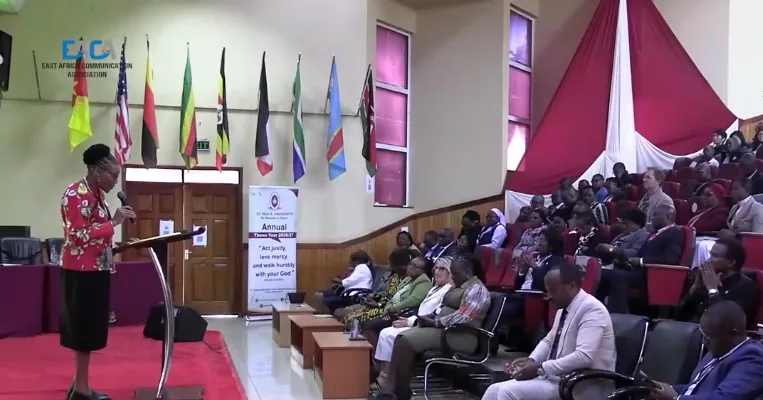
 St Paul’s University Vice Chancellor Prof Esther Mombo makes her opening remarks at the 16th East Africa Communication Association (EACA) Conference 2026 at St Paul’s University in Limuru, August 26, 2026.
 African scholars have been challenged to take a leading role in shaping the future of Artificial Intelligence rather than remain passive consumers of technologies largely developed elsewhere.
The call dominated the opening day of the three-day 16th East Africa Communication Association (EACA) Conference 2026 at St Paul’s University in Limuru, where journalism, media and communication scholars, researchers, postgraduate students, industry practitioners and digital creatives are meeting to examine the changing communication landscape.
The conference, themed Reimagining communication in Africa: AI, media innovation and global collaboration, has brought together stakeholders from more than 180 institutions across over 14 countries.
Dr Gladys Muasya, the conference convener, said Africa could no longer afford to watch technological changes unfold from the sidelines.
“Media is evolving rapidly, and Africa must not simply watch these changes happen; we must participate, we must innovate, and we must change the conversation. That's what I hope EACA will do in the next three days,” she said.
The challenge was echoed by Dr Susan Mwangi, Dean of the School of Communication and Computer Studies, who said AI had already moved from being a futuristic concept to an everyday reality in newsrooms, universities, classrooms, advertising agencies, public relations departments and the film and television industries.
But she said African scholars needed to interrogate how the technology was being developed and whose knowledge was shaping it.
“Whose knowledge is represented in these systems? What happens to African languages when technologies are primarily trained on data elsewhere?” she posed.
She also questioned how journalism and public trust could be protected in an age of deepfakes and synthetic content, and what AI would mean for jobs and professional identities.
More importantly, Mwangi challenged African scholars to confront the question of whether the continent would merely consume AI or help shape its future.
“Let us not ask only what technology can do for us; let us also ask how Africa contributes to the future of communication,” she said.
St Paul’s University Vice Chancellor Prof Esther Mombo said the growing use of AI in academic work had already raised difficult questions about knowledge production.
“As I read some of the works of students, I keep asking myself, ‘Did they write it? They are very clever’. Indeed they are clever, but I have to check who has been behind their cleverness,” she said.
Mombo called for collaborative research to generate more African data and knowledge capable of influencing how AI systems work.
She noted that AI-generated content often fails to adequately reflect African realities, saying the continent needed to rethink its position in the production of knowledge.
“What is in AI is not African enough; you have to rethink it,” she said, citing the tendency of AI systems to produce non-African images when users prompt for those within their settings.
Mombo urged scholars to identify opportunities for joint research and practical collaboration, while encouraging policymakers to take research findings into institutions and communities they operate.
Her call was reinforced by EACA president Prof Margaret Jjuuko, who said Africa had unique resources that could help it shape AI, including its youthful population, more than 2,000 vernacular languages and rich oral traditions.
“Africa cannot be a consumer of these changes; Africa must be a designer of them,” Jjuuko said.
She advocated for stronger safeguards, warning that Africa's knowledge and cultural heritage should not be erased by AI, but instead be used to enrich the technology.
“AI should not erase that; it should just amplify it,” she said.
As speakers pushed for greater African ownership of AI, they also stressed that adoption must be accompanied by responsibility.
Prof Mombo said institutions cannot in this age afford to reject AI, but must ensure it is used carefully.
“In some places it's been noted and said strongly that AI is from the devil; I do not hold that. At St Paul we appropriate AI, but we appropriate it responsibly,” she said.
She warned that careless consumption of AI-generated content could fuel misinformation and disinformation, putting at stake social cohesion and the wellbeing of communities.
Communication, she said, could either deepen divisions or build bridges.
“Communication has the power to divide but also has the power to build bridges. It can amplify conflict, but it can also promote dialogue, understanding and peace,” Mombo said.
In a speech read on his behalf by Consolata Olawo, an assistant director in the Department of Higher Education, Education Cabinet Secretary Julius Ogamba said learning institutions bear a responsibility to prepare young people for a rapidly changing world while preserving creativity, ethical judgment and human values.
He said AI could enhance teaching and learning, support research and improve productivity, but should remain a tool.
“Our task therefore is not simply to teach students how to use AI, we must also equip them to question it and use it responsibly,” Ogamba said.
Jjuuko also called for greater global collaboration to ensure AI does not become a vehicle for spreading misinformation across borders.
“Misinformation starts in one country in the evening and lands in another country by breakfast time,” she said.
She urged African countries to harness their young, technology-savvy population to drive the AI conversation while protecting the continent's identity and values.
The conversation will continue as delegates hold panel discussions to explore how AI, media innovation and global collaboration can reshape communication in Africa while ensuring the continent has a voice in determining the technologies that will increasingly influence its future.