Kenya Wildlife Service (KWS) officers are pursuing people believed to have been involved in the killing of a giraffe in Warabo Forest, Wajir South Sub-County.
The incident was reported at Leheley Police Station on August 23, 2026, local officials said.
According to police, KWS Wajir County officers received a tip-off from members of the public around 3 pm that two people believed to be involved were travelling towards Warabo Forest in a Suzuki Alto.
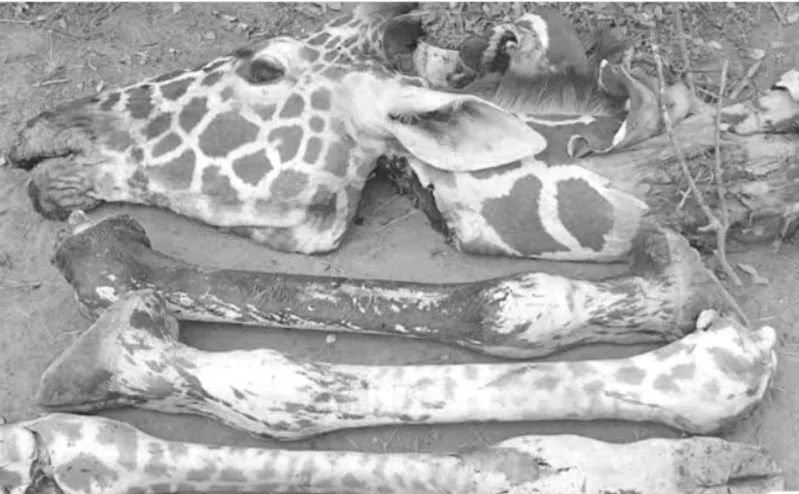
Upon reaching the area, the officers found that a giraffe had been killed and its meat removed, leaving behind the animal’s head and skeleton.
The people reportedly spotted the KWS officers from a distance and sped away in their vehicle.
Attempts by the officers to pursue them were unsuccessful after they lost track of the vehicle.
Police and KWS officers have launched efforts to identify and apprehend those involved and recover the vehicle linked to the reported poaching incident.
This is the latest incident amid concerns about the declining population of the animals due to poaching.
Officials said the meat is also sold to consumers without inspection, potentially posing a health risk.
The North Eastern Wildlife Conservancies Association (NECA) warned that illegal killings in northern Kenya have reached alarming levels and could wipe out one of the world’s most significant populations of the species if intervention is not undertaken.
In a letter addressed to KWS Director General Prof. Erustus Kanga, the association said it was documenting the illegal killing of at least three Somali giraffes every day across Garissa, Wajir and parts of Mandera counties, describing the trend as a conservation crisis requiring institutional action.
NECA Chief Executive Officer Sharmake Mohamed sent the letter accompanied by photographs showing butchered giraffe carcasses reportedly found in the Kumahumato area of Dadaab in Garissa County and in Wajir South over the past few months.
According to the association, the incidents are not isolated cases but part of an escalating pattern of wildlife crime targeting the threatened species in northern Kenya.
“These images are not isolated incidents. They are evidence of a growing conservation crisis that has now reached an unacceptable level,” Mohamed said in the letter.
NECA warned that if the reported rate of killings continues, Kenya risks presiding over the destruction of one of the world’s most important remaining populations of Somali giraffes.
The conservation lobby said it has for years supplied KWS with intelligence reports, photographs, GPS coordinates, names of people it believes may be involved and information on emerging poaching hotspots, but said the response has largely been limited to temporary enforcement operations.
It identified several areas where it says wildlife crime has become prevalent, including Ali Kune, Kumahumato and Dadaab in Garissa County, Abakore, Hare, Sabul, Sarif, Biyamadow, areas along the Tana River, Wajir County and other wildlife landscapes across Garissa, Wajir and Mandera.
While acknowledging that KWS has occasionally mounted anti-poaching operations following public concern, NECA argued that the interventions have been short-lived and ineffective against organised wildlife crime.
“Poaching networks do not disappear after a week. Wildlife criminals simply wait for operations to end before resuming their activities. This reactive approach is failing. The current operational model is not protecting Northern Kenya’s wildlife,” the association said.
The organisation said KWS has a statutory responsibility under the Wildlife Conservation and Management Act to protect Kenya’s wildlife, while community conservancies are recognised as partners in conservation.
NECA said communities in northern Kenya remain committed to supporting wildlife protection efforts through intelligence gathering, conservation awareness and promoting peaceful human-wildlife coexistence, but argued that they have not been sufficiently integrated into operational planning.
“We are not asking KWS to surrender its mandate. We are asking KWS to fulfil it,” Mohamed said.
The association further argued that despite Garissa and Wajir hosting globally significant wildlife populations, the region continues to receive disproportionately limited operational investment compared to the scale of the conservation challenge.
“The consequences are now visible in every photograph attached to this letter. Every giraffe slaughtered represents a failure of the system designed to protect it. Every delay strengthens criminal networks. Every missed opportunity encourages further wildlife crime,” the letter states.
To address the crisis, NECA called on KWS to permanently deploy wildlife officers in major poaching hotspots across Garissa and Wajir instead of relying on short-term operations.
It also wants the wildlife agency to establish or strengthen permanent operational stations in critical wildlife areas, implement a coordinated intelligence-led anti-poaching strategy covering Garissa, Wajir and Mandera counties, create structured operational partnerships with legally recognised community conservancies, review wildlife security deployment across the region and provide regular feedback to stakeholders who report wildlife crimes.
The association said it remains willing to work with KWS in protecting wildlife but stressed that conservation efforts cannot succeed unless community institutions are integrated into planning and implementation.
NECA warned that should urgent and sustained action fail to materialise, it would escalate the matter through constitutional and legal channels.
“History will judge all of us by what we chose to do when Kenya’s Somali giraffes were disappearing,” the association said.