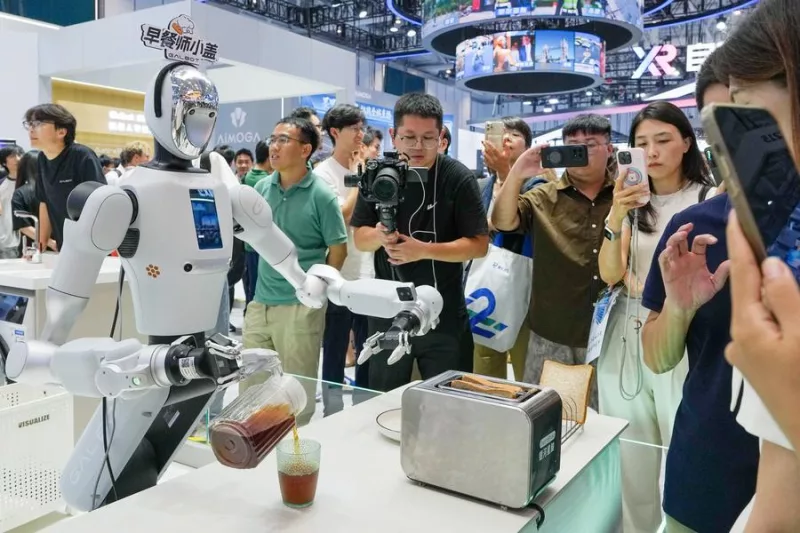
 A robot showcases breakfast-making skills during the 2026 World Robot Conference (WRC) in Beijing, capital of China, Aug. 20, 2026. (Xinhua/Ju Huanzong)
China’s rapid progress in robotics is changing the way the world thinks about technology, industrial development and productivity.
What was once associated mainly with futuristic factories and experimental laboratories is increasingly becoming part of everyday economic activity.
The transformation is important not simply because China is producing more advanced robots, but because it is building the industrial ecosystem needed to turn innovation into practical and scalable solutions.
The significance of this development lies in the connection between technological innovation and manufacturing strength.
Robotics depends on capabilities ranging from artificial intelligence and semiconductors to sensors, software, precision engineering and advanced manufacturing. China has spent years developing these areas, creating an environment where different technologies can increasingly work together.
The result is a shift from robotics as a demonstration of technological sophistication to robotics as a tool for economic productivity.
Machines are being developed to perform increasingly complex tasks, improve production processes and support workers across different industries. This could have implications far beyond the factories where robots are first deployed.
One major advantage of large-scale production is the possibility of reducing costs. Advanced technology has limited economic value if it remains too expensive for ordinary businesses to adopt. As production expands, manufacturers gain experience, supply chains become more efficient and costs can gradually fall. Technologies that initially appear exclusive can therefore become accessible to a much wider market.
This is particularly relevant for developing economies. Countries across Africa are searching for ways to increase productivity, modernise industries and create more competitive manufacturing sectors. Robotics could become part of that process, particularly in agricultural processing, logistics, manufacturing, healthcare and warehousing.
Kenya, for example, could examine how automation and intelligent machines can complement existing economic activities. Rather than treating robotics simply as imported equipment, the country could use the technology as an opportunity to develop local technical expertise. Training engineers, technicians, software developers and other specialists would be essential to ensuring that the benefits of automation remain within the economy.
The lesson is that technology transfer is most valuable when accompanied by knowledge transfer.
China’s experience also demonstrates the importance of connecting research institutions with industry. Innovation becomes more effective when ideas move from laboratories into real-world applications. Once technologies are deployed, manufacturers can identify weaknesses, improve performance and develop new uses. This creates a cycle in which research strengthens industry while industrial experience feeds further innovation.
That cycle could become increasingly important as artificial intelligence becomes more closely integrated with robotics. Traditional machines were largely designed to repeat programmed movements. New generations of intelligent robots are increasingly capable of responding to changing environments, processing information and performing tasks with greater flexibility.
This does not necessarily mean that the future of work will be dominated by machines replacing people. A more useful approach is to view the transformation through human-machine cooperation. Robots can undertake dangerous, repetitive and physically demanding tasks, while people remain responsible for creativity, judgement, communication and strategic decision-making. The combination could enable businesses to achieve higher productivity while improving working conditions.
For governments, the robotics revolution will require preparation. Education and vocational training must evolve alongside technological change. Workers need opportunities to acquire new skills, while businesses require policies that encourage innovation and responsible adoption.
International cooperation will also matter. As robots become more sophisticated and globally integrated, countries will need compatible standards covering safety, interoperability and responsible use. Cooperation can help ensure that technological advances are not slowed by fragmented regulations or unnecessary barriers.
China’s robotics development therefore offers a broader lesson about modern economic growth. Technological leadership is not achieved simply by producing impressive prototypes. It requires connecting research, manufacturing, investment, skills and markets in ways that convert innovation into lasting economic value.
The real test of the robotics revolution will not be how spectacular a machine looks, but what problems it can solve. A robot that improves factory efficiency, assists healthcare workers, increases agricultural productivity or strengthens logistics can have a far greater economic impact than one designed merely to impress audiences.
China’s progress shows how robotics can move from innovation to productivity when supported by industrial capacity, investment and continuous improvement. For developing economies, the opportunity is to learn from this transformation, develop local capabilities and ensure automation contributes to inclusive economic growth.
The robotics revolution is still unfolding, but its direction is becoming clearer. Countries that combine technological adoption with skills development, industrial capacity and international cooperation will be better positioned to benefit from the next era of productivity. For China and the wider developing world, robotics could become not merely a symbol of technological progress, but a practical engine of economic transformation.
The writer is a Journalist and Communications Consultant