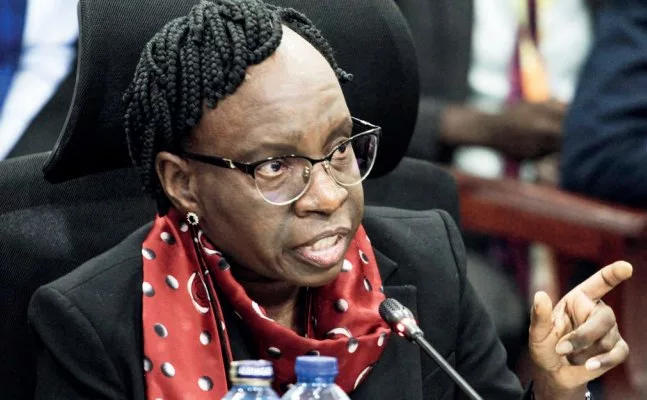
 Auditor General Nancy Gathungu/FLE
Auditor General Nancy Gathungu has exposed how parents are paying millions of shillings in illegal fees in some of the country’s top secondary schools.
Gathungu also revealed massive procurement irregularities, illegal expenditure and widespread financial mismanagement in the institutions.
The revelations are contained in the latest financial audit reports for the schools for the period ended June 30, 2025.
The findings are likely to put principals, school leadership, parents’ associations and boards of management under scrutiny.
A review by the Star of reports from at least 10 public national schools across the country reveals a disturbing pattern.
The schools have imposed extra charges under Parents Association support programmes and other vote heads without the required Ministry approval.
This has placed a heavy financial burden on parents amid tough economic times.
Alliance High School collected Sh42.25 million through a Parents Association support programme.
The report shows that parents agreed to contribute Sh30,792 each in March 2024 and later Sh26,000 in 2025. The ministry did not approve the extra charges.
“This was contrary to Government Circular No. MOE.HQS/3/13/3 dated 16 June, 2021 on guidelines on implementation of free Day and Secondary Education programme,” the report states.
The circular stipulates that parents will only pay for school uniforms, boarding-related costs as reflected in the boarding fee structure and lunch for day scholars.
At Mang’u High School, parents paid a total of Sh55.95 million in extra levies.
“Examination of the records revealed that the school charged an amount of Sh46,082 per student to support the programme, which had not been approved by the Ministry of Education through the County Education Board,” the report says.
Friends School Kamusinga collected Sh32.69 million after charging Sh10,000 per student for development projects, even though Cabinet Secretary approval had not been granted.
“Although management had sought authority to charge the extra levy from the State Department of Early Learning and Basic Education on March 20, 2024, the extra levy had not been approved by the Cabinet Secretary, contrary to provisions of regulation 45 of the Basic Education Regulations, 2015,” the report says.
Nakuru High School added further costs on top of the ministry-approved annual fee of Sh53,554 for Category A boarding schools.
Form 2 parents paid an extra Sh21,000, Form 3 parents paid Sh13,000 and Form 4 parents paid Sh12,000. None of the additions had the required approval.
“The extra fees were, however, not approved by the Cabinet Secretary, contrary to government circular,” the report states.
Besides the circular, the schools also defied persistent calls and warnings by the Ministry of Education against illegal fees.
“Where that happens, and it is brought to our attention, we are now taking action against the principals. Unless the levy has been approved, gone through the required process, accepted by parents and cleared under ministry protocols, it should not be charged,” Education CS Julius Ogamba said last month.
At Uthiru Girls High School, parents paid Sh2,500 per student for a harambee to support its development programme, which had not been approved by the Ministry of Education.
At Machakos School, parents paid Sh7.12 million for a laboratory dormitory. The funds were collected without ministry approval.
“Examination of the records revealed that the school charged an amount of Sh20,000 per student to support the programme which had not been approved by the Ministry of Education through the County Education Board,” the report states.
The situation is similar at Moi Forces Academy in Nairobi, where each student paid Sh34,400 to support curriculum development and the school’s boarding budget.
“The school, however, did not obtain authorisation from the Ministry of Education to charge the extra fees in the year under review,” the report states.
As the schools introduced illegal fees to support their projects, Gathungu revealed that many institutions were also engaging in illegal and irregular practices, putting at risk millions of shillings collected from parents and received from the government.
According to the reports, most schools awarded contracts to firms that were not on prequalified lists, while some institutions used direct procurement beyond legal limits.
Others allowed bidders who failed basic requirements to win tenders, while some operated with outdated supplier lists or without proper annual procurement plans.
For instance, Nakuru High School awarded several contracts to firms that did not meet mandatory evaluation criteria.
Alliance Girls High School spent Sh1.32 million on bakery equipment and paid Sh660,000 for a commercial dough mixer.
The inspection report was incomplete, consisting of little more than a blank form with ticks.
“Further, there was no evidence that the mixer’s capacity, power rating, durability or safety features were assessed or was compatible with the school’s bakery requirements, and that the mixer delivered was of the required capacity, quality and functionality,” the report states.
The same school spent Sh10.19 million on a postmodern dormitory.
However, critical procurement documents were missing, including regional approval, architectural drawings, evaluation minutes, a contract agreement and valid invoices.
“In addition, the payment was not supported by a valid invoice, inspection and acceptance certificates and approvals from the Ministry and Public Works,” the report says.
The school lost more than Sh2.26 million after converting dollar holdings at a rate far below the Central Bank rate.
Alliance High School spent Sh7.18 million upgrading a multipurpose hall. Records of the tender process, evaluation minutes and inspection certificates were not provided.
“In the circumstances, the propriety and value for money of the expenditure amounting to Sh7.17 million could not be confirmed,” auditor noted.
At Kenya High School, a science laboratory and technology centre project that began at Sh114.63 million in 2020 had attracted payments of Sh154.08 million by June 2025 without completion.
The work passed through four successive contractors after repeated abandonments. Inspectors later found cracks in the staircase and non-functional electrical sockets in the Physics Laboratory.
“In the circumstances and due to delayed completion of the project, the value for money spent on the project of Sh154.08 million that had been paid as at June 30, 2025 could not be confirmed and the expected objectives of the project had not been realized,” the report states.
INSTANT ANALYSIS
Many schools are also illegally transferring funds to the Kenya Secondary School Heads Association, a welfare organisation open only to principals.
Gathungu noted that KESSHA sits outside the government funding system.
The organisations are not defined in the government funding system, and there is no assurance that KESSHA has implemented effective, efficient and transparent financial management and internal control systems to manage funds transferred by schools.