

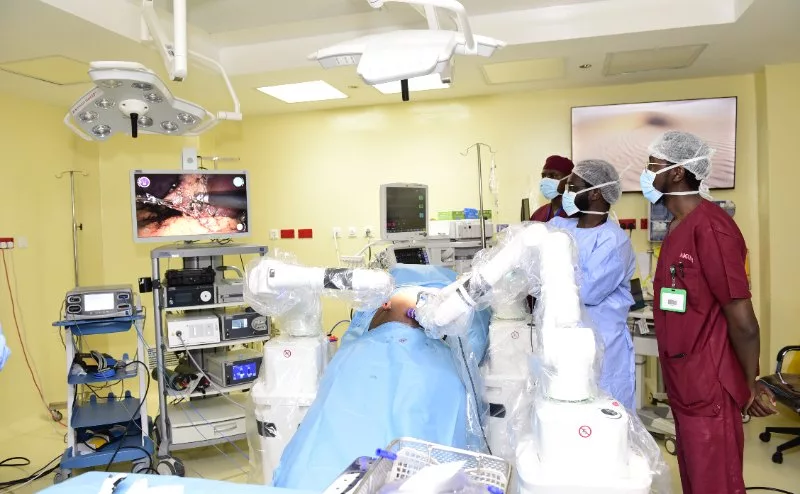
 Medics during the surgery
 The Aga Khan University Hospital, Nairobi (AKUH), has performed its first
robotic-assisted gallbladder removal surgery, introducing robotic technology
into a procedure that is already routinely performed through conventional
keyhole surgery.
The operation, known medically as robotic-assisted laparoscopic cholecystectomy, involves removing the gallbladder through small incisions rather than making a large opening in the abdomen.
Gallbladder removal is commonly performed to treat people with symptomatic gallstones and other gallbladder conditions.
AKUH said the robotic procedure was carried out by its surgical team using a system that allows the surgeon to control specialised instruments from a console.
“The robotic instruments have a greater range of movement and closely mimic the motions of the human hand, enabling greater precision and control during surgery. This allows us to perform procedures more safely,” Dr Abdulkarim Abdalla, chair of the department of surgery at the hospital, said.
Unlike what the term “robotic surgery” might suggest, the machine does not independently perform the operation. The surgeon controls the camera and instruments throughout the procedure.
Robotic systems can provide a three-dimensional view of the operating field and allow surgeons to make precise movements using instruments that can move in ways conventional laparoscopic instruments cannot.
“Robotic-assisted surgery builds on the benefits of conventional keyhole surgery by providing surgeons with a three-dimensional view of the surgical field, greater flexibility of movement and improved access to areas that can be difficult to visualize using traditional techniques,” Abdallasaid.
The development comes as robotic surgery becomes increasingly used in hospitals internationally for procedures involving the abdomen, pelvis and other parts of the body. Its use in gallbladder surgery, however, has not replaced conventional laparoscopy.
A 2026 systematic review and meta-analysis involving more than 7.5 million patients found that laparoscopic surgery had clear advantages over open surgery, including lower mortality, fewer complications and shorter hospital stays.
The review found no demonstrable difference in clinical outcomes between robotic and conventional laparoscopic gallbladder removal.
Other studies have reached similar conclusions. A 2024 meta-analysis of 13 studies involving more than 22,000 patients found that robotic surgery was associated with longer operating times than conventional laparoscopy, while there were no significant differences in hospital stay, intraoperative complications or bile duct injuries.
This means the main significance of robotic cholecystectomy is not necessarily that it produces better outcomes for every patient, but that it gives surgeons additional technical capabilities that may be useful in selected procedures, particularly where precise movements and access to difficult areas are required.
The conventional laparoscopic procedure itself is already minimally invasive. Surgeons generally operate through several small abdominal openings, using a camera and long instruments to remove the gallbladder. The approach has largely replaced open surgery for routine gallbladder removal.
The minimally invasive approach is associated with less pain and a shorter recovery than open surgery. Planned laparoscopic gallbladder removal can also be performed as day-case surgery in appropriate patients.
The gallbladder stores bile produced by the liver. Gallstones can form when substances in bile become imbalanced and crystallise. Many people with gallstones have no symptoms and do not require surgery. Problems arise when stones block the normal flow of bile, causing pain or complications such as inflammation of the gallbladder.
For patients with acute cholecystitis, international guidance recommends early laparoscopic gallbladder removal, generally within a week of diagnosis where appropriate.
AKUH already offers conventional laparoscopic cholecystectomy as part of its general surgery services and lists robotic abdominal gastrointestinal surgery among its areas of interest.
The hospital said the robotic platform will also be used as part of a wider programme involving surgical training and other procedures.
Commenting on the operation, hospital CEO Rashid Khalani said:
“Since our
inception, Aga Khan University Hospital has built a tradition of introducing
many healthcare firsts for Kenya and the region.
“This latest milestone continues that legacy. We invest in innovation because it enables safer, precise and evidence-based care for our patients.”
He added that this is the beginning of a broader journey to make robotic-assisted surgery available to more patients while advancing surgical excellence, research and training across the region.
The
introduction of the technology also raises questions about cost and access.
Robotic procedures generally require specialised equipment, trained personnel
and ongoing maintenance, making them more expensive in many settings than
conventional laparoscopic surgery.
A recent systematic review found that robotic gallbladder surgery generally has similar clinical outcomes to conventional laparoscopy but can involve higher costs and longer operating times.
For Kenya, therefore, the significance of the procedure will depend not only on the technology itself but also on whether robotic surgery can eventually be made affordable and available to a wider group of patients, while surgeons build sufficient experience to determine where it offers the greatest clinical value.






