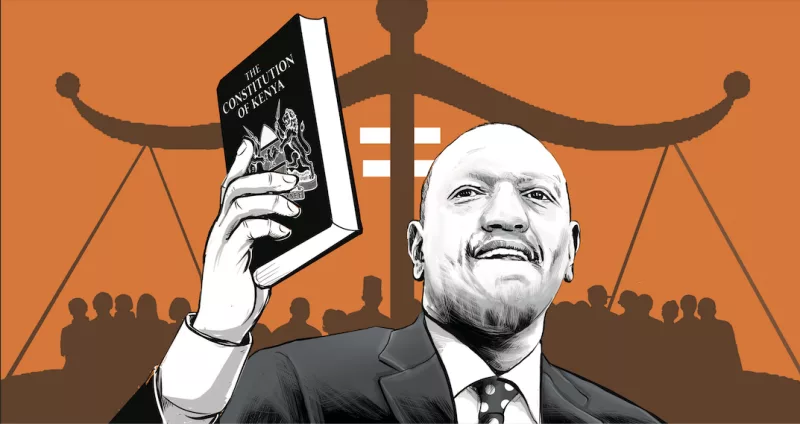
As Nairobi gears up to host the Global Trust Summit in October 2026, there are many consultative meetings on how to build the confidence needed for investment attractiveness, entrenched economic resilience, scaled innovations and sustainable development.
This is in response to a growing deficit in conviction over the democratic outcomes that are supposed to strengthen governance institutions and markets in the service of resident populations within their respective countries.
Many authoritarian-leaning political movements are beginning to emerge across the world to offer alternatives that take advantage of existing grievances that are not being properly addressed.
This is disrupting harmonious international, regional, plus domestic relations by creating increased uncertainty for the short-term political expediency needed to capture power.
Various Kenyan stakeholders are preparing to welcome their colleagues plus comrades from all manner of places for the conference. However, the private sector is aggrieved by the stagnation of pending bill payments.
Together with the rest of fellow active citizens, these business entities are also uneasy with the unpredictability of current taxation, not to mention the spillover effects of lacking access to credit.
Due to heavy government borrowing for servicing national debts, this is squeezing them out of loan markets.
Consequently, within the context of the emerging digital economy, how can African countries, such as Kenya, together with their global partners, build the much-needed trust for productivity, progress and profit to uplift their societies?
For Kenyans in this conversation, it is hard to ignore the 2024 zeitgeist ever since the tax revolt exposed the pressures of a governance disconnect with the public.
This is in the face of a bursting population growth that is enduring massive unemployment. The country’s government, as have other stakeholders, has subsequently realised a need to rectify things.
The private sector is thus keen to contribute towards job creation, but a politics of legitimate rules is desperately needed for them to trust that if they invest in the leapfrog capacity for transformation, then their businesses will be safe to grow and prosper.
Such course correction is important within leadership considerations in the pursuit of greater regional or continental integration, market resilience and economic growth.
Once this socioeconomic focus for establishing a fiscal compact – to accompany the foundational democratic social contract – is achieved, overall trust can then be pursued by offering practical solutions to regulatory concerns.
This will then work to ensure that service delivery facilitates business support operations in the most efficient way possible. For instance, let’s consider current taxation challenges being experienced.
In the Kenyan imagination, if digitisation efforts by the Kenya Revenue Administration (KRA) to implement tax collection are not as simple as using Safaricom’s M-Pesa in terms of automation, or real-time response, then they count for nothing.
Most small businesses, who should be the majority taxpayers, don’t find the electronic Tax Invoice Management System (eTIMS) relatable even if they wanted to comply. This, therefore, jeopardises the integrity of revenue collection processes by delegitimising the application of policy.
Upon resolving these operational hurdles, Kenyan commercial interests will be ready to lean into taking advantage of available opportunities emerging from the African Continental Free Trade Area (AfCFTA).
Having achieved improved tax systems through simplification of processes, the country will attain the required local, national, regional and continental trust to power the necessary capital potential that will transform Africa under AfCFTA.
What this means is that, while acknowledging sacred pan-African economic visions toward unified trade, resource cooperation, interconnectivity, plus value addition, Kenya can contribute to a modern continentalism to break dependency structures.
That will require an unpacking of specific demands focused on targeted sectors such as aviation, mobility infrastructure and artificial intelligence for rapid transformation that will improve the country’s global standing by breaking bureaucratic hurdles.
Regional coordinator for the East African Tax and Governance Network. |@lennwanyama