On a dining table in Nairobi in 2016, armed with nothing more than a blank sheet of paper, a pen and an audacious dream, Umesh Bhojwani sketched what would become one of Kenya's fastest-growing consumer electronics brands.
There were no investors waiting in the wings. No factory. No production line. Not even enough money to clear the first shipment of televisions that was already on its way to Mombasa.
"I had to borrow money just to clear the first container," Bhojwani recalls with a laugh. "But I believed there was space for a Kenyan electronics brand."
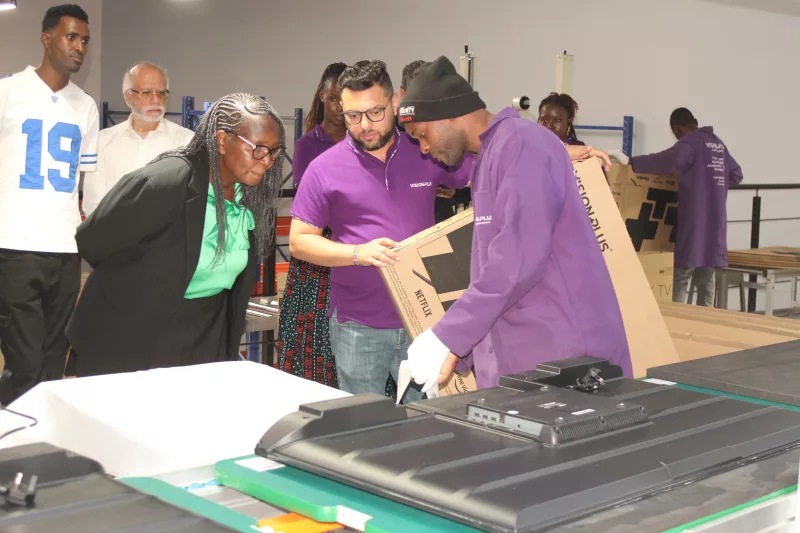
Ten years later, that bold gamble has evolved into Vision Plus—a household name found in more than one million Kenyan homes and now assembling smart televisions at a state-of-the-art factory in Tatu City.
The company's journey mirrors a larger ambition: proving that sophisticated electronics can be designed, assembled and eventually manufactured in Kenya.
Ironically, Bhojwani never intended to become an electronics entrepreneur.
Growing up, he dreamed of becoming a pilot and even pursued studies in Australia (management and marketing), with aviation in mind.
But family obligations changed his path. Returning to Kenya to help in his father's electronics distribution business, he spent four years learning the market and understanding consumer behaviour.
It was during those years that he noticed a glaring gap. Imported premium television brands were beyond the reach of many Kenyan households, while cheaper alternatives often sacrificed quality.
"I kept asking myself one question," he says. "Why should an ordinary Kenyan save for three or four months just to buy a television?"
That simple question became the foundation of Vision Plus.
The first shipment of televisions arrived in late 2016, marking the beginning of a business that would steadily expand from televisions into audio equipment, home appliances, accessories and wearable technology.
For years, Vision Plus operated purely as an importer and distributor. But Bhojwani had a much bigger vision.
"Everything sold in Kenya can be made in Kenya," he says. "Whenever someone told us it couldn't be done, we wanted to prove them wrong."
That ambition became reality in 2023 when the company began local television assembly before moving production into a dedicated facility within the Tatu City Special Economic Zone (SEZ) last year.
The production line has the capacity to assemble up to 150,000 television sets annually on a single eight-hour shift and as many as 450,000 units a year operating full-time, producing screen sizes ranging from 32 to 65 inches.
The investment has required between $2.5 million (Sh323.9 million) and $3 million (Sh388.6 million) in capital expenditure and working capital.
For Bhojwani, however, the factory represents far more than increased production. It is proof that Kenya can move beyond being merely a consumer of imported technology.
Today, Vision Plus has distributed more than 650,000 televisions, while its broader electronics portfolio has reached over one million homes across Kenya.
The company directly employs 133 people, with women accounting for 46 per cent of its workforce, while indirect employment exceeds 250 jobs.
From a one-man operation a decade ago, Bhojwani now leads a company nurturing engineers, sales professionals, interns and young technicians. The next frontier is talent development.
Vision Plus plans to work with Kenyan polytechnics to train electronics engineers in research and development, hoping to create a pipeline of local innovators capable of designing future products.
"We have incredibly talented Kenyan engineers," he says. "Some have even identified design flaws that global manufacturers overlooked."
That confidence in local expertise has shaped Vision Plus products in uniquely Kenyan ways.
Recognising frequent electricity fluctuations, the company redesigned television circuit boards with additional protection to withstand unstable power supplies.
Knowing Kenyan consumers love loud music with heavy bass, its engineers customised audio performance accordingly.
One of its televisions even incorporates cockroach-resistant features—an innovation inspired entirely by local household conditions.
"Those are Kenyan problems requiring Kenyan solutions," Bhojwani says.
As consumer electronics increasingly embrace artificial intelligence, Vision Plus is also positioning itself for the next wave of technological change.
Rather than viewing AI as a marketing buzzword, Bhojwani believes its greatest value lies in convenience.
He envisions homes where televisions, washing machines, sound systems and future smart appliances communicate seamlessly through a single platform.
The company is also exploring AI-powered electric mobility products, including connected electric motorcycles featuring anti-theft tracking and remote locking capabilities.
While technology is advancing rapidly, Bhojwani argues that Kenya's industrial ambitions will ultimately depend on government policy.
He praises the Special Economic Zone framework for encouraging manufacturing but believes additional reforms are needed to unlock Kenya's export potential.
Among them are export rebates, lower industrial electricity costs, stronger incentives for local component manufacturing and harmonised trade rules across East Africa.
At present, Vision Plus can target Comesa markets under existing trade arrangements, but differing rules of origin across East African Community member states continue limiting regional expansion.
He believes standardised regulations would significantly boost cross-border manufacturing.
Beyond exports, Bhojwani sees enormous untapped potential in building local electronics supply chains.
Currently, many components, including motherboards and speakers, must still be imported from China because local production remains uneconomical.
Yet opportunities are emerging. Companies are now producing television packaging, protective foam and other supporting materials locally because manufacturers like Vision Plus have created demand.
Another area he believes deserves urgent attention is electronic waste.
Vision Plus is pursuing registration as an authorised e-waste recycler and plans to invest in equipment capable of extracting reusable components from discarded electronics.
He argues Kenya must shift away from simply disposing of electronic waste toward building a circular economy where valuable materials are recovered and reused.
"There is enormous value sitting inside old electronics," he says.
Looking ahead, Vision Plus intends to expand production beyond televisions into cookers, soundbars and water dispensers while positioning its Tatu City factory as an Original Equipment Manufacturer (OEM) for other brands.
The company has already piloted assembly of Sony televisions in Kenya and hopes to manufacture for additional international brands.
Its longer-term ambition is to become a Pan-African manufacturing hub serving regional markets under the African Continental Free Trade Area (AfCFTA).
Despite growing competition from multinational brands on one end of the market and low-cost imports on the other, Bhojwani remains convinced that quality and authenticity will ultimately prevail.
"The biggest lesson I have learned is never compromise quality for price," he says.
For aspiring entrepreneurs, his advice is equally straightforward.
"Keep asking yourself one question. What is being consumed in Kenya that can also be made in Kenya? That is where innovation begins."