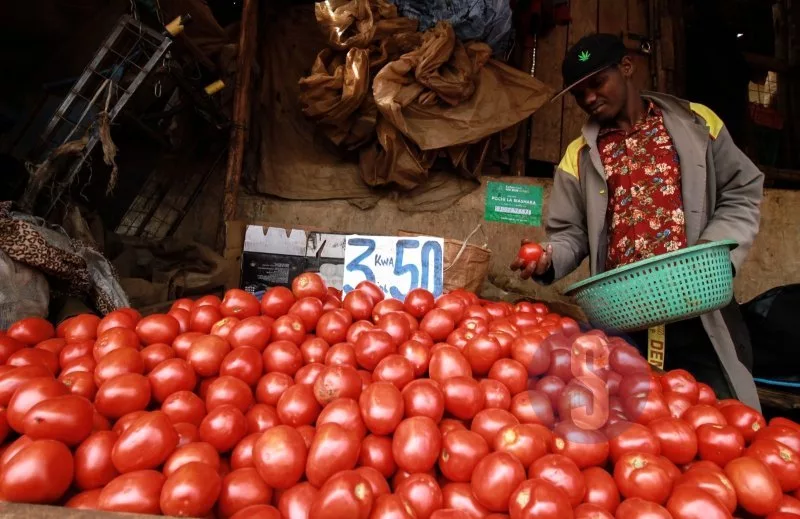
 A trader sells fresh tomatoes at Harambee Market in Kangemi./FILE
Food commodity prices in Kenya are coming under pressure as drought cuts crop production in key growing areas, raising concerns over grain supplies and household food security, according to the AGRA July Food Security Monitor.
The report shows that maize prices in Kenya rose by 3.3 per cent in July, while bean prices increased by between 2.4 and 2.9 per cent as domestic supplies tightened. Rice prices also edged up by 0.3 cent. Wheat was an exception, with prices falling by 1.5 per cent following improved import availability and harvest supplies.
According to the Ministry of Agriculture's Kenya Agricultural Market Information System (KAMIS), a 90 kg bag of dry maize is wholesaling at between Sh2,200 and Sh4,500, while a bag of beans is selling for Sh5,000 to Sh5,600, depending on the variety.
A bag of finger millet (wimbi) is fetching about Sh11,700, while a bag of green grams (ndengu) is going for around Sh7,000. Irish potatoes, particularly the Shangi variety, are averaging Sh4,600 per bag, although prices vary depending on the size of the sack, which typically ranges from 50kg to 110kg.
The price increases come as prolonged dry conditions continue to affect production. In Baringo County, drought has destroyed an estimated 75 per cent of the expected maize harvest, with losses reaching up to 80 per cent in some lowland areas.
The situation is expected to further strain national grain supplies, with the government planning to import 25 million 90-kilogramme bags of maize to bridge an anticipated production deficit.
Agriculture Cabinet Secretary Mutahi Kagwe said the government had already made arrangements for the imports, assuring Kenyans that measures were in place to prevent a food shortage.
“Kenya consumes approximately 75 million bags of maize annually. However, reduced harvests in several food-producing regions are expected to create a shortfall of nearly 25 million bags, prompting the Government to intervene through strategic imports to stabilize supplies and protect consumers from potential price fluctuations,” Kagwe said.
“We will import maize. We have already made arrangements for that. We will manage the country. The country is not going to go hungry,” he added.
A miller who did not want to be mentioned said the rising cost and tightening availability of grains could eventually push up the prices of processed foods if supplies remain constrained.
“Farmers are already reporting an expected low harvest, which could affect the availability of locally produced maize and drive up its price. This could, in turn, lead to an increase in the cost of maize flour in supermarkets. I urge the government to take action and import maize to cushion Kenyans from higher prices, especially at a time when many households have low purchasing power due to the high cost of living,” said the miller.
The CS said the maize imports will provide an immediate buffer while longer-term measures are implemented to strengthen domestic production and reduce reliance on rain-fed agriculture.
Kagwe said the government was expanding irrigation projects, including the Galana Kulalu scheme, to boost production and build resilience to drought. “The government also plans to work with the National Treasury to address taxes and bureaucratic challenges affecting farmers and agribusinesses,” he added.
The AGRA report warns that Kenya's food security outlook remains mixed through January 2027. Maize production in key grain-producing areas of the North Rift and western Kenya is expected to remain substantially below average because of prolonged rainfall deficits, with losses of about 15 percent projected.
The report says improved rainfall and expected harvests could bring localized relief later in 2026, but recovery is likely to remain constrained by below-average production and high prices.
INSTANT ANALYSIS
Across East Africa, food security in East Africa remains under pressure from drought and other weather shocks, conflict, high food and fuel prices, shrinking purchasing power and limited humanitarian assistance. According to the AGRA July Food Security Monitor, Ethiopia, South Sudan and parts of Uganda and Kenya continue to record Crisis-level food insecurity, with South Sudan facing the most severe conditions. Pastoral areas are also expected to remain in Crisis through September because of declining pasture and water availability, reduced livestock productivity and lower milk production. Conditions are expected to improve after the forecast October-December short rains, although Mandera is likely to remain in Crisis because of slow recovery from poor previous rains.