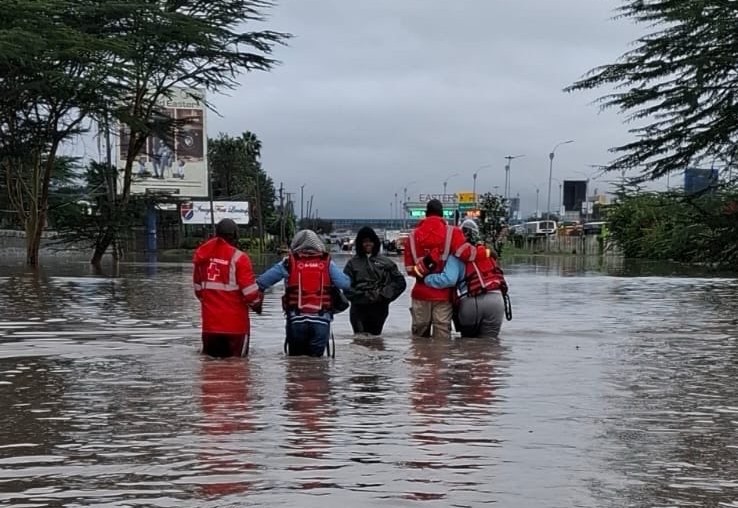
 Heavy rains cause flooding along Mombasa Road
El Niño rains could begin as early as October in parts of Kenya, with the country expected to receive unusually heavy rainfall through December, according to a new regional climate forecast.
The forecast warns that some areas could face flooding and damage to roads, homes and farms. At the same time, temperatures are expected to remain higher than normal.
The outlook was released by the Igad Climate Prediction and Applications Centre after the 74th Greater Horn of Africa Climate Outlook Forum held in Kigali, Rwanda, on August 17 and 18.
Icpac said there is more than a 90 per cent chance of above-normal rainfall in northeastern Kenya. Parts of central Kenya also have a more than 90 per cent chance of receiving at least 400mm of rain during the three-month season.
“The predicted start dates of the October to December 2026 season ... indicate higher chances of early to normal onset dates over much of the eastern parts of the region, including Somalia, central to eastern Kenya, and most parts of Tanzania,” Icpac said.
However, western parts of the region are expected to experience a delayed onset of the rains.
The October to December period is important for Kenya as it provides a significant share of the country’s annual rainfall. Icpac says the season can contribute up to 70 per cent of annual rainfall in parts of Kenya, Ethiopia and Somalia.
The expected amount of rainfall has raised concern over flood preparedness.
Icpac said there is a more than 90 per cent probability of rainfall exceeding 400mm in parts of central Kenya, as well as central and southern Somalia and parts of the Lake Victoria Basin.
The heavy rains could benefit farmers by improving water supplies, pasture and crop production, particularly following dry periods.
However, excessive rainfall could also cause flooding, destroy crops, damage roads and bridges and disrupt access to schools, hospitals and markets. It could also increase the risk of waterborne and mosquito-borne diseases.
Icpac cautioned that the forecast does not mean Kenya will receive rain continuously throughout the season.
“Dry spells may occur in areas with an increased likelihood of above-normal to near-normal rainfall and vice versa,” the climate centre said.
This means some areas could still experience periods of little or no rain despite recording above-normal rainfall over the entire season.
The warning comes as El Niño is expected to strengthen towards the end of the year.
Icpac said there is an 81 per cent probability of a very strong El Niño during October to December 2026, while the probability of the phenomenon continuing into the March to May 2027 season is estimated at 97 per cent.
El Niño is a climate pattern caused by unusual warming of parts of the Pacific Ocean. It can influence rainfall and temperatures in distant regions, including East Africa.
Icpac said the current conditions share some similarities with those experienced in 1997 and 2023. Both years were associated with wetter-than-normal October to December seasons across much of the region.
However, the centre cautioned against using the two years as direct predictions of what will happen this year, saying current forecasts should guide preparedness.
Another climate factor being monitored is the Indian Ocean Dipole, which is linked to differences in sea temperatures between the western and eastern Indian Ocean.
Icpac said the IOD is currently neutral but is likely to move into a positive phase between October and December.
A positive IOD can contribute to increased rainfall in parts of East Africa. However, Icpac said forecasts for the IOD are less certain than those for El Niño.
The combination of a strengthening El Niño and a possible positive IOD is one reason forecasters are closely watching the region ahead of the rainy season.
The forecast comes as Kenya seeks to strengthen its disaster preparedness.
In June, the National Treasury launched the Disaster Risk Financing Strategy 2026-30, aimed at improving the ability of national and county governments to prepare for and respond to disasters.
The strategy also seeks to strengthen planning and investment in disaster preparedness.
Authorities have been urged to prepare before the rains arrive rather than wait for disasters to occur, particularly in areas exposed to flooding, crop losses and infrastructure damage.
However, concerns remain over funding for preparedness. A recent analysis published in the Business Daily noted that the 2026-27 national budget did not have a dedicated allocation for El Niño preparedness, meaning response efforts would largely depend on existing disaster and contingency funds.
The new forecast also warns that increased rainfall will not necessarily bring cooler conditions.
Icpac expects warmer-than-normal temperatures across much of the Greater Horn of Africa, with some of the highest chances of above-average temperatures in eastern Kenya.
The centre cautioned that its forecast covers large areas and the entire three-month season, meaning conditions may vary between counties and from one month to another.
“Local and month-to-month variations might occur as the season progresses,” Icpac said.
Icpac and Kenya’s meteorological authorities are expected to issue more detailed forecasts as October approaches, giving communities and authorities more information to guide preparations.